

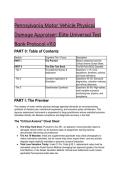
Pennsylvania Motor Vehicle Physical
Damage Appraiser: Elite Universal Test
Bank Protocol v11.0
PART 0: Table of Contents
Section Cognitive Tier / Focus Description
PART I The Preview Mission statement and the
Critical Axioms Cheat Sheet.
PART II The Elite Test Bank The 60-Point MCQ Gauntlet.
- Tier 1 Foundational Syntax & Questions 1–15: Core
Application regulations, timelines, policies,
and base definitions.
- Tier 2 Complex Application & Questions 16–35: Structural
Simulation diagnostics, valuation matrices,
and ethical dilemmas.
- Tier 3 Grandmaster Synthesis Questions 36–60: High-stakes,
multi-variable scenarios
combining law, physics, and
compliance.
PART I: The Preview
The mastery of motor vehicle physical damage appraisal demands an uncompromising
synthesis of statutory law, mechanical engineering, and insurance policy architecture. This
rigorous assessment instrument is engineered to forge practitioners whose analytical precision
translates directly into flawless compliance and diagnostic accuracy in the field.
The "Critical Axioms" Cheat Sheet
● The 6-Day Hard Deck: Pursuant to Act 361, an appraiser must physically inspect a
damaged vehicle within six (6) business days of assignment, barring extreme,
documented intervening circumstances.
● The Act 79 Mandate: Initial and supplemental appraisals may utilize photographs or
videos voluntarily submitted, but an insurer may never require them, and any actively
disputed repair explicitly mandates a personal, physical inspection.
● Total Loss Valuation Trinity: Under 31 Pa. Code § 62.3, replacement value must be
calculated using the Guide Source Method (averaging two approved guides), the Actual
Cost Method, or the Dealer Quotation Method. All total loss settlements must include
applicable Pennsylvania state sales tax.
, ● Unibody Diagnostics: Sag alters the horizontal plane (vertical panel gaps pinch at top);
Sway alters the lateral plane (shifting the centerline); Twist occurs when opposite ends
are driven in opposing vertical directions; Diamond shifts one rail longitudinally, creating
asymmetrical diagonal cross-measurements.
● The Aftermarket Axiom: Non-OEM parts must be explicitly identified, limited to
non-mechanical exterior components, and carry a warranty equal to or better than the
voided OEM warranty.
PART II: THE ELITE TEST BANK
Tier 1 - Foundational Syntax & Application
Q1: Under the statutory framework governing Pennsylvania Motor Vehicle Physical Damage
Appraisers (63 P.S. § 854), upon what exact date and time does an active appraiser’s license
mandate annual renewal to avoid expiration? A) December 31st at midnight. B) The last day of
the appraiser's birth month. C) June 30th at midnight. D) One calendar year from the exact date
of initial issuance.
● The Answer: C (June 30th at midnight.)
● Distractor Analysis:
○ A is incorrect: December 31st is a common renewal date for other financial licenses
but is statutorily incorrect for PA MVPDA licenses.
○ B is incorrect: Birth month renewal applies to resident insurance producers and
public adjusters in Pennsylvania, not physical damage appraisers.
○ D is incorrect: Appraiser licenses operate on a fixed state fiscal cycle, not an
individualized anniversary date.
The Mentor's Analysis: Statutory compliance begins with the maintenance of legal authority.
The Pennsylvania Insurance Department strictly enforces a uniform renewal deadline for all
physical damage appraisers, ensuring universal compliance checks at the end of the fiscal
cycle. Professional/Academic Intuition: An appraiser’s authority to operate in
Pennsylvania ceases universally at midnight on June 30th without exception.
Q2: Pursuant to Act 361, an appraiser receives a new claim assignment on a Monday morning.
Assuming no catastrophic weather events or uncooperative parties, what is the MAXIMUM
allowable timeframe the appraiser possesses to complete the physical inspection? A) 48 hours.
B) 6 business days. C) 10 calendar days. D) 15 business days.
● The Answer: B (6 business days.)
● Distractor Analysis:
○ A is incorrect: While 48 hours is an industry best practice for initial customer
contact, it is not the statutory ceiling for the inspection itself.
○ C is incorrect: The statute explicitly utilizes business/working days, deliberately
excluding Sundays and recognized state holidays.
○ D is incorrect: Fifteen days applies to certain grace periods for vehicle registrations
and emissions, not damage appraisals.
The Mentor's Analysis: Timeliness is codified into law to prevent insurers from utilizing
administrative delays as a tactic to stall claim payouts. Act 361 establishes a strict operational
rhythm. Professional/Academic Intuition: The 6-business-day inspection window is a
statutory hard deck; failure to meet it without documented extreme circumstances invites
regulatory penalties.
,Q3: When utilizing the 17-character Vehicle Identification Number (VIN) to decode a vehicle's
manufacturing data for an appraisal, which character position universally dictates the vehicle's
model year? A) The 1st character. B) The 8th character. C) The 10th character. D) The 17th
character.
● The Answer: C (The 10th character.)
● Distractor Analysis:
○ A is incorrect: The first character designates the country of origin (e.g., 1, 4, 5 for
the USA).
○ B is incorrect: The eighth character typically identifies the engine type and
specifications.
○ D is incorrect: The final characters (12-17) represent the vehicle's unique sequential
production serial number.
The Mentor's Analysis: Accurate valuation relies entirely on identifying the correct asset. Since
1981, the National Highway Traffic Safety Administration (NHTSA) has enforced a globally
standardized VIN architecture. Professional/Academic Intuition: The 10th character of a VIN
is the absolute cryptographic key to the vehicle's model year, bypassing any potential
owner misrepresentation.
Q4: According to 31 Pa. Code § 62.3, when a motor vehicle is deemed a total loss and the
insurer elects to use the Guide Source Method to determine replacement value, what is the
MINIMUM requirement for establishing that value? A) Utilizing the highest value provided by a
single Department-approved guide. B) Averaging the figures from at least two guide sources
approved by the Commissioner. C) Utilizing the NADA base trade-in value and adding
applicable sales tax. D) Averaging a single guide source value with one local dealer quotation.
● The Answer: B (Averaging the figures from at least two guide sources approved by the
Commissioner.)
● Distractor Analysis:
○ A is incorrect: Relying on a single guide source violates the regulatory mandate
intended to prevent valuation bias.
○ C is incorrect: Trade-in value represents wholesale metrics; replacement value
must reflect retail book value.
○ D is incorrect: The Guide Source Method and the Dealer Quotation Method are
distinct and may not be hybridized to meet the minimum standard.
The Mentor's Analysis: Total loss valuations must remain objective and reproducible. By
requiring an average of two distinct, Commissioner-approved guide sources, the
Commonwealth mathematically dilutes the risk of an artificially depressed settlement offer.
Professional/Academic Intuition: A legally defensible Guide Source valuation
fundamentally requires the mathematical mean of two independent, approved data sets.
Q5: An appraiser is evaluating an estimate utilizing standard industry terminology. What is the
fundamental operational difference between the labor operations R&I and R&R? A) R&I
designates structural repair; R&R designates cosmetic refinishing. B) R&I requires the original
part to be reused; R&R requires the original part to be discarded and replaced. C) R&I involves
mechanical components only; R&R involves unibody sheet metal only. D) R&I denotes removing
and inspecting a part; R&R denotes removing and recycling a part.
● The Answer: B (R&I requires the original part to be reused; R&R requires the original
part to be discarded and replaced.)
● Distractor Analysis:
○ A is incorrect: These acronyms dictate the disposition of the part, not the type of
physical labor (structural vs. cosmetic).
, ○ C is incorrect: Both operations apply universally across mechanical, electrical, and
structural components.
○ D is incorrect: R&I stands for Remove and Install (reusing the existing part to gain
access); R&R stands for Remove and Replace (installing a completely new part).
The Mentor's Analysis: Estimating syntax must be universally understood by insurers, shops,
and consumers. R&I is utilized when an undamaged component impedes access to a damaged
area. R&R is utilized when the component itself is compromised beyond salvage.
Professional/Academic Intuition: R&I preserves the original asset; R&R introduces a
replacement asset.
Q6: Under Pennsylvania Act 79 of 2016, how is the use of digital media (photographs, videos,
or telephonic means) regulated during the initial appraisal process? A) An appraiser or insurer
may mandate the submission of photographs by the consumer prior to dispatching an appraiser.
B) An appraiser may write an estimate based on photographs, but must disclose to the
consumer that there is no requirement to submit them. C) Photographs and videos are strictly
forbidden for initial estimates and may only be utilized for supplemental damage. D) An
appraiser must personally inspect the vehicle regardless of the consumer's willingness to
provide comprehensive video evidence.
● The Answer: B (An appraiser may write an estimate based on photographs, but must
disclose to the consumer that there is no requirement to submit them.)
● Distractor Analysis:
○ A is incorrect: The statute explicitly forbids insurers or appraisers from requiring
digital media as a prerequisite to an appraisal.
○ C is incorrect: Act 79 modernized the law to specifically allow photo-based initial
estimates, provided it is voluntary on the part of the consumer.
○ D is incorrect: Personal inspection is only strictly mandated by Act 79 if the extent of
repairs becomes actively disputed.
The Mentor's Analysis: Act 79 balances modern technological efficiency with consumer
protection. While virtual claims processing accelerates indemnification, it cannot be weaponized
to shift the investigative burden onto the policyholder. Professional/Academic Intuition: Photo
appraisals are an allowable convenience, but physical inspections remain an absolute
consumer right upon request or dispute.
Q7: When visually inspecting a unibody vehicle involved in a severe frontal offset collision, the
appraiser notes that the cowl panel gaps are unusually wide at the bottom and narrow at the
top. Which specific structural condition does this geometry MOST LIKELY indicate? A) Diamond
B) Twist C) Sag D) Sway
● The Answer: C (Sag)
● Distractor Analysis:
○ A is incorrect: A Diamond condition affects the longitudinal dimensions (one rail
pushed further back than the other), not vertical bending.
○ B is incorrect: Twist involves opposing vertical forces (e.g., left front high, right rear
low), which does not uniformly pinch the upper cowl gaps.
○ D is incorrect: Sway is a lateral (side-to-side) deviation of the centerline, affecting
width measurements rather than vertical gaps.
The Mentor's Analysis: Unibody damage diagnosis relies on interpreting visual stress
indicators before utilizing measuring systems. Sag represents a failure of the horizontal plane,
causing the vehicle's extremities to droop, which invariably pinches the upper gaps of vertical
panels like doors and cowls. Professional/Academic Intuition: A gap that is pinched at the
top and wide at the bottom is the cardinal visual signature of structural Sag.
Damage Appraiser: Elite Universal Test
Bank Protocol v11.0
PART 0: Table of Contents
Section Cognitive Tier / Focus Description
PART I The Preview Mission statement and the
Critical Axioms Cheat Sheet.
PART II The Elite Test Bank The 60-Point MCQ Gauntlet.
- Tier 1 Foundational Syntax & Questions 1–15: Core
Application regulations, timelines, policies,
and base definitions.
- Tier 2 Complex Application & Questions 16–35: Structural
Simulation diagnostics, valuation matrices,
and ethical dilemmas.
- Tier 3 Grandmaster Synthesis Questions 36–60: High-stakes,
multi-variable scenarios
combining law, physics, and
compliance.
PART I: The Preview
The mastery of motor vehicle physical damage appraisal demands an uncompromising
synthesis of statutory law, mechanical engineering, and insurance policy architecture. This
rigorous assessment instrument is engineered to forge practitioners whose analytical precision
translates directly into flawless compliance and diagnostic accuracy in the field.
The "Critical Axioms" Cheat Sheet
● The 6-Day Hard Deck: Pursuant to Act 361, an appraiser must physically inspect a
damaged vehicle within six (6) business days of assignment, barring extreme,
documented intervening circumstances.
● The Act 79 Mandate: Initial and supplemental appraisals may utilize photographs or
videos voluntarily submitted, but an insurer may never require them, and any actively
disputed repair explicitly mandates a personal, physical inspection.
● Total Loss Valuation Trinity: Under 31 Pa. Code § 62.3, replacement value must be
calculated using the Guide Source Method (averaging two approved guides), the Actual
Cost Method, or the Dealer Quotation Method. All total loss settlements must include
applicable Pennsylvania state sales tax.
, ● Unibody Diagnostics: Sag alters the horizontal plane (vertical panel gaps pinch at top);
Sway alters the lateral plane (shifting the centerline); Twist occurs when opposite ends
are driven in opposing vertical directions; Diamond shifts one rail longitudinally, creating
asymmetrical diagonal cross-measurements.
● The Aftermarket Axiom: Non-OEM parts must be explicitly identified, limited to
non-mechanical exterior components, and carry a warranty equal to or better than the
voided OEM warranty.
PART II: THE ELITE TEST BANK
Tier 1 - Foundational Syntax & Application
Q1: Under the statutory framework governing Pennsylvania Motor Vehicle Physical Damage
Appraisers (63 P.S. § 854), upon what exact date and time does an active appraiser’s license
mandate annual renewal to avoid expiration? A) December 31st at midnight. B) The last day of
the appraiser's birth month. C) June 30th at midnight. D) One calendar year from the exact date
of initial issuance.
● The Answer: C (June 30th at midnight.)
● Distractor Analysis:
○ A is incorrect: December 31st is a common renewal date for other financial licenses
but is statutorily incorrect for PA MVPDA licenses.
○ B is incorrect: Birth month renewal applies to resident insurance producers and
public adjusters in Pennsylvania, not physical damage appraisers.
○ D is incorrect: Appraiser licenses operate on a fixed state fiscal cycle, not an
individualized anniversary date.
The Mentor's Analysis: Statutory compliance begins with the maintenance of legal authority.
The Pennsylvania Insurance Department strictly enforces a uniform renewal deadline for all
physical damage appraisers, ensuring universal compliance checks at the end of the fiscal
cycle. Professional/Academic Intuition: An appraiser’s authority to operate in
Pennsylvania ceases universally at midnight on June 30th without exception.
Q2: Pursuant to Act 361, an appraiser receives a new claim assignment on a Monday morning.
Assuming no catastrophic weather events or uncooperative parties, what is the MAXIMUM
allowable timeframe the appraiser possesses to complete the physical inspection? A) 48 hours.
B) 6 business days. C) 10 calendar days. D) 15 business days.
● The Answer: B (6 business days.)
● Distractor Analysis:
○ A is incorrect: While 48 hours is an industry best practice for initial customer
contact, it is not the statutory ceiling for the inspection itself.
○ C is incorrect: The statute explicitly utilizes business/working days, deliberately
excluding Sundays and recognized state holidays.
○ D is incorrect: Fifteen days applies to certain grace periods for vehicle registrations
and emissions, not damage appraisals.
The Mentor's Analysis: Timeliness is codified into law to prevent insurers from utilizing
administrative delays as a tactic to stall claim payouts. Act 361 establishes a strict operational
rhythm. Professional/Academic Intuition: The 6-business-day inspection window is a
statutory hard deck; failure to meet it without documented extreme circumstances invites
regulatory penalties.
,Q3: When utilizing the 17-character Vehicle Identification Number (VIN) to decode a vehicle's
manufacturing data for an appraisal, which character position universally dictates the vehicle's
model year? A) The 1st character. B) The 8th character. C) The 10th character. D) The 17th
character.
● The Answer: C (The 10th character.)
● Distractor Analysis:
○ A is incorrect: The first character designates the country of origin (e.g., 1, 4, 5 for
the USA).
○ B is incorrect: The eighth character typically identifies the engine type and
specifications.
○ D is incorrect: The final characters (12-17) represent the vehicle's unique sequential
production serial number.
The Mentor's Analysis: Accurate valuation relies entirely on identifying the correct asset. Since
1981, the National Highway Traffic Safety Administration (NHTSA) has enforced a globally
standardized VIN architecture. Professional/Academic Intuition: The 10th character of a VIN
is the absolute cryptographic key to the vehicle's model year, bypassing any potential
owner misrepresentation.
Q4: According to 31 Pa. Code § 62.3, when a motor vehicle is deemed a total loss and the
insurer elects to use the Guide Source Method to determine replacement value, what is the
MINIMUM requirement for establishing that value? A) Utilizing the highest value provided by a
single Department-approved guide. B) Averaging the figures from at least two guide sources
approved by the Commissioner. C) Utilizing the NADA base trade-in value and adding
applicable sales tax. D) Averaging a single guide source value with one local dealer quotation.
● The Answer: B (Averaging the figures from at least two guide sources approved by the
Commissioner.)
● Distractor Analysis:
○ A is incorrect: Relying on a single guide source violates the regulatory mandate
intended to prevent valuation bias.
○ C is incorrect: Trade-in value represents wholesale metrics; replacement value
must reflect retail book value.
○ D is incorrect: The Guide Source Method and the Dealer Quotation Method are
distinct and may not be hybridized to meet the minimum standard.
The Mentor's Analysis: Total loss valuations must remain objective and reproducible. By
requiring an average of two distinct, Commissioner-approved guide sources, the
Commonwealth mathematically dilutes the risk of an artificially depressed settlement offer.
Professional/Academic Intuition: A legally defensible Guide Source valuation
fundamentally requires the mathematical mean of two independent, approved data sets.
Q5: An appraiser is evaluating an estimate utilizing standard industry terminology. What is the
fundamental operational difference between the labor operations R&I and R&R? A) R&I
designates structural repair; R&R designates cosmetic refinishing. B) R&I requires the original
part to be reused; R&R requires the original part to be discarded and replaced. C) R&I involves
mechanical components only; R&R involves unibody sheet metal only. D) R&I denotes removing
and inspecting a part; R&R denotes removing and recycling a part.
● The Answer: B (R&I requires the original part to be reused; R&R requires the original
part to be discarded and replaced.)
● Distractor Analysis:
○ A is incorrect: These acronyms dictate the disposition of the part, not the type of
physical labor (structural vs. cosmetic).
, ○ C is incorrect: Both operations apply universally across mechanical, electrical, and
structural components.
○ D is incorrect: R&I stands for Remove and Install (reusing the existing part to gain
access); R&R stands for Remove and Replace (installing a completely new part).
The Mentor's Analysis: Estimating syntax must be universally understood by insurers, shops,
and consumers. R&I is utilized when an undamaged component impedes access to a damaged
area. R&R is utilized when the component itself is compromised beyond salvage.
Professional/Academic Intuition: R&I preserves the original asset; R&R introduces a
replacement asset.
Q6: Under Pennsylvania Act 79 of 2016, how is the use of digital media (photographs, videos,
or telephonic means) regulated during the initial appraisal process? A) An appraiser or insurer
may mandate the submission of photographs by the consumer prior to dispatching an appraiser.
B) An appraiser may write an estimate based on photographs, but must disclose to the
consumer that there is no requirement to submit them. C) Photographs and videos are strictly
forbidden for initial estimates and may only be utilized for supplemental damage. D) An
appraiser must personally inspect the vehicle regardless of the consumer's willingness to
provide comprehensive video evidence.
● The Answer: B (An appraiser may write an estimate based on photographs, but must
disclose to the consumer that there is no requirement to submit them.)
● Distractor Analysis:
○ A is incorrect: The statute explicitly forbids insurers or appraisers from requiring
digital media as a prerequisite to an appraisal.
○ C is incorrect: Act 79 modernized the law to specifically allow photo-based initial
estimates, provided it is voluntary on the part of the consumer.
○ D is incorrect: Personal inspection is only strictly mandated by Act 79 if the extent of
repairs becomes actively disputed.
The Mentor's Analysis: Act 79 balances modern technological efficiency with consumer
protection. While virtual claims processing accelerates indemnification, it cannot be weaponized
to shift the investigative burden onto the policyholder. Professional/Academic Intuition: Photo
appraisals are an allowable convenience, but physical inspections remain an absolute
consumer right upon request or dispute.
Q7: When visually inspecting a unibody vehicle involved in a severe frontal offset collision, the
appraiser notes that the cowl panel gaps are unusually wide at the bottom and narrow at the
top. Which specific structural condition does this geometry MOST LIKELY indicate? A) Diamond
B) Twist C) Sag D) Sway
● The Answer: C (Sag)
● Distractor Analysis:
○ A is incorrect: A Diamond condition affects the longitudinal dimensions (one rail
pushed further back than the other), not vertical bending.
○ B is incorrect: Twist involves opposing vertical forces (e.g., left front high, right rear
low), which does not uniformly pinch the upper cowl gaps.
○ D is incorrect: Sway is a lateral (side-to-side) deviation of the centerline, affecting
width measurements rather than vertical gaps.
The Mentor's Analysis: Unibody damage diagnosis relies on interpreting visual stress
indicators before utilizing measuring systems. Sag represents a failure of the horizontal plane,
causing the vehicle's extremities to droop, which invariably pinches the upper gaps of vertical
panels like doors and cowls. Professional/Academic Intuition: A gap that is pinched at the
top and wide at the bottom is the cardinal visual signature of structural Sag.


