

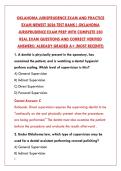
OKLAHOMA JURISPRUDENCE EXAM AND PRACTICE
EXAM NEWEST 2026 TEST BANK| OKLAHOMA
JURISPRUDENCE EXAM PREP WITH COMPLETE 350
REAL EXAM QUESTIONS AND CORRECT VERIFIED
ANSWERS/ ALREADY GRADED A+ (MOST RECENT!!)
1. A dentist is physically present in the operatory, has
examined the patient, and is watching a dental hygienist
perform scaling. Which level of supervision is this?
A) General Supervision
B) Indirect Supervision
C) Direct Supervision
D) Personal Supervision
Correct Answer: C
Rationale: Direct supervision requires the supervising dentist to be
"continually on site and physically present when the procedures
are being performed." The dentist must also examine the patient
before the procedure and evaluate the results afterward .
2. Under Oklahoma law, which type of supervision may be
used for a dental assistant performing coronal polishing?
A) General Supervision
B) Indirect Supervision
1
,C) Direct Supervision
D) No supervision required
Correct Answer: C
Rationale: Dental assistants require Direct Supervision for all
procedures. General and indirect supervision may NOT be used
for a dental assistant or an oral maxillofacial surgery assistant .
3. A dentist diagnosed a patient 14 months ago, left the state,
and authorized a hygienist to perform a scale and polish
while he is gone. Is this legal?
A) Yes, if the hygienist notifies the Board
B) Yes, if the patient signs a waiver
C) No, General Supervision requires diagnosis within the past 13
months
D) No, hygienists cannot work without a dentist present at all
times
Correct Answer: C
Rationale: General supervision requires the dentist to have
"diagnosed any conditions to be treated within the past thirteen
(13) months." At 14 months, the authorization has expired and
constitutes a violation .
2
,4. A dentist is in the office but in a different room seeing
another patient while a hygienist performs a fluoride
treatment. The dentist diagnosed the condition. This is:
A) General Supervision
B) Indirect Supervision
C) Direct Supervision
D) Personal Supervision
Correct Answer: B
Rationale: Indirect supervision applies when the dentist is in the
facility and has diagnosed the condition, but is not necessarily in
the same room. This may only be used for dental hygienists, not
assistants .
5. A dental hygienist is treating a patient under general
supervision. Where is the supervising dentist?
A) In the same room
B) In the building but not the room
C) Not required to be on-site (may be in another city)
D) Cannot be in the same county
Correct Answer: C
Rationale: Under General Supervision, the dentist does not need
to be physically present. They may be off-site entirely as long as
3
, they diagnosed the patient within the past 13 months and will
evaluate the results. This is only permitted for hygienists .
6. A dentist is actively working on a patient in a surgical
suite. A dental assistant is placing a rubber dam. Which
supervision level applies?
A) Indirect
B) Personal
C) General
D) Direct
Correct Answer: D
Rationale: The dentist is on-site and physically present in the
facility. While they may not be in the exact operatory, for a
dental assistant, this still requires direct supervision—meaning the
dentist is on the premises and available .
7. What is the maximum length of time a patient may be
treated under General Supervision without a new diagnosis?
A) 6 months
B) 12 months
C) 13 months
D) 18 months
4
EXAM NEWEST 2026 TEST BANK| OKLAHOMA
JURISPRUDENCE EXAM PREP WITH COMPLETE 350
REAL EXAM QUESTIONS AND CORRECT VERIFIED
ANSWERS/ ALREADY GRADED A+ (MOST RECENT!!)
1. A dentist is physically present in the operatory, has
examined the patient, and is watching a dental hygienist
perform scaling. Which level of supervision is this?
A) General Supervision
B) Indirect Supervision
C) Direct Supervision
D) Personal Supervision
Correct Answer: C
Rationale: Direct supervision requires the supervising dentist to be
"continually on site and physically present when the procedures
are being performed." The dentist must also examine the patient
before the procedure and evaluate the results afterward .
2. Under Oklahoma law, which type of supervision may be
used for a dental assistant performing coronal polishing?
A) General Supervision
B) Indirect Supervision
1
,C) Direct Supervision
D) No supervision required
Correct Answer: C
Rationale: Dental assistants require Direct Supervision for all
procedures. General and indirect supervision may NOT be used
for a dental assistant or an oral maxillofacial surgery assistant .
3. A dentist diagnosed a patient 14 months ago, left the state,
and authorized a hygienist to perform a scale and polish
while he is gone. Is this legal?
A) Yes, if the hygienist notifies the Board
B) Yes, if the patient signs a waiver
C) No, General Supervision requires diagnosis within the past 13
months
D) No, hygienists cannot work without a dentist present at all
times
Correct Answer: C
Rationale: General supervision requires the dentist to have
"diagnosed any conditions to be treated within the past thirteen
(13) months." At 14 months, the authorization has expired and
constitutes a violation .
2
,4. A dentist is in the office but in a different room seeing
another patient while a hygienist performs a fluoride
treatment. The dentist diagnosed the condition. This is:
A) General Supervision
B) Indirect Supervision
C) Direct Supervision
D) Personal Supervision
Correct Answer: B
Rationale: Indirect supervision applies when the dentist is in the
facility and has diagnosed the condition, but is not necessarily in
the same room. This may only be used for dental hygienists, not
assistants .
5. A dental hygienist is treating a patient under general
supervision. Where is the supervising dentist?
A) In the same room
B) In the building but not the room
C) Not required to be on-site (may be in another city)
D) Cannot be in the same county
Correct Answer: C
Rationale: Under General Supervision, the dentist does not need
to be physically present. They may be off-site entirely as long as
3
, they diagnosed the patient within the past 13 months and will
evaluate the results. This is only permitted for hygienists .
6. A dentist is actively working on a patient in a surgical
suite. A dental assistant is placing a rubber dam. Which
supervision level applies?
A) Indirect
B) Personal
C) General
D) Direct
Correct Answer: D
Rationale: The dentist is on-site and physically present in the
facility. While they may not be in the exact operatory, for a
dental assistant, this still requires direct supervision—meaning the
dentist is on the premises and available .
7. What is the maximum length of time a patient may be
treated under General Supervision without a new diagnosis?
A) 6 months
B) 12 months
C) 13 months
D) 18 months
4


