

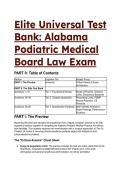
Elite Universal Test
Bank: Alabama
Podiatric Medical
Board Law Exam
PART 0: Table of Contents
Section Cognitive Tier Subject Focus
PART I: The Preview Universal Critical Axioms & Exam
Architecture
PART II: The Elite Test Bank
Questions 1–15 Tier 1: Foundational Syntax Scope of Practice, Anatomy
Limits, Disciplinary Baselines
Questions 16–35 Tier 2: Complex Application Prescribing Limits, PDMP,
Record Retention, CE
Protocols
Questions 36–60 Tier 3: Grandmaster Synthesis Multi-Variable Infractions,
Board Hearings, Performance
Solutions
PART I: The Preview
Mastering this test bank elevates the practitioner from a legally compliant clinician to an elite
regulatory tactician capable of navigating the Alabama Podiatric Medical Practice Act without
fatal liabilities. True mastery replaces rote memorization with a surgical application of Title 34,
Chapter 24, Article 6, ensuring clinical excellence perfectly aligns with Alabama's strict
jurisprudential boundaries.
The "Critical Axioms" Cheat Sheet
● Scope & Amputation Limit: The practice includes the foot and ankle (distal third of the
tibia/fibula). Amputations must not extend above the Chopart joint. Total ankle
arthroplasty and general anesthesia administration are strictly prohibited.
, ● Surgical Residency Mandate: Surgically treating osseous ailments of the ankle requires
a minimum of 36 months of CPME-approved post-graduate residency training (which may
be cumulative across institutions).
● MME & PDMP Directive: Prescribing controlled substances exceeding 30 Morphine
Milligram Equivalents (MME) per day mandates reviewing the patient's PDMP history at
least twice annually, with documented risk mitigation.
● Record Integrity & Transfer: Patient records must be retained for 5 years. Upon written
request, records must be released within 10 business days. Withholding records for
unpaid fees is a disciplinary violation.
● Licensure & CE Deadlines: 12 hours of approved Continuing Education (CE) are
required annually. Licenses expire October 1; a strict $300 penalty applies if renewed
between October 2 and October 31.
PART II: THE ELITE TEST BANK
Tier 1: Foundational Syntax & Application
Q1: A licensed Alabama podiatrist diagnoses a severe necrotizing infection in a diabetic
patient's lower extremity. The practitioner determines that an immediate amputation is required
to save the patient's life. According to the Alabama Podiatric Medical Practice Act, which
specific procedure represents the maximum proximal anatomical limit for amputation by a
podiatrist? A) Syme's amputation B) Below-knee amputation (BKA) C) Disarticulation at the
Chopart joint D) Trans-tibial amputation
● The Answer: C (Disarticulation at the Chopart joint)
● Distractor Analysis:
○ A is incorrect: Syme's amputation occurs at the ankle joint, which is proximal to the
Chopart joint and legally prohibited in Alabama.
○ B is incorrect: A BKA is entirely outside the scope of podiatric practice.
○ D is incorrect: Trans-tibial procedures violate the specific statutory limitation of the
Chopart joint.
The Mentor's Analysis: The Alabama legislature explicitly limits podiatric amputations to the
toes and parts of the foot, setting a hard anatomical ceiling. When facing severe foot pathology,
the immediate priority is understanding spatial legal limits. By utilizing the Chopart joint
boundary, you bypass the common trap of performing unauthorized gross amputations.
Professional/Academic Intuition: Never amputate proximal to the midtarsal (Chopart)
joint under an Alabama podiatric license.
Q2: A patient presents with severe, end-stage osteoarthritis of the ankle joint. The podiatrist has
completed a 36-month CPME-approved surgical residency. Which intervention is legally
PROHIBITED for this practitioner to perform? A) Arthrodesis of the subtalar joint B) Total ankle
arthroplasty C) Excision of an osteochondral lesion of the talus D) Open reduction and internal
fixation of a distal fibula fracture
● The Answer: B (Total ankle arthroplasty)
● Distractor Analysis:
○ A is incorrect: Arthrodesis is a permitted osseous procedure for a practitioner with
36 months of residency.
○ C is incorrect: Treating talar lesions falls within the legally defined scope of ankle
treatment.
, ○ D is incorrect: Distal fibula fractures are within the anatomical definition of the ankle.
The Mentor's Analysis: Despite advanced training, certain procedures remain statutorily
excluded to delineate podiatry from general orthopedics. When facing end-stage ankle arthritis,
the immediate priority is exploring arthrodesis or referring out. By utilizing statutory exclusions,
you bypass the common trap of assuming advanced residency overrides explicit state law.
Professional/Academic Intuition: Total ankle arthroplasty is universally excluded from the
Alabama podiatric scope, regardless of residency duration.
Q3: During a complex midfoot reconstruction in an outpatient surgical center, the podiatrist
determines the patient requires deep sedation. Based on the Alabama scope of practice, which
action is correct regarding anesthesia administration? A) The podiatrist may administer
intravenous propofol if ACLS certified. B) The podiatrist may administer a regional popliteal
block but not general anesthesia. C) The podiatrist is strictly limited to the administration of local
anesthetics. D) The podiatrist may administer spinal anesthesia under MD supervision.
● The Answer: C (The podiatrist is strictly limited to the administration of local anesthetics.)
● Distractor Analysis:
○ A is incorrect: Systemic deep sedation/general anesthesia administration by a
podiatrist is strictly prohibited.
○ B is incorrect: Regional blocks above the leg border on prohibited territory, but the
statute explicitly limits the podiatrist to "local" anesthesia administration.
○ D is incorrect: MD supervision does not grant a podiatrist the legal authority to
administer spinal anesthesia.
The Mentor's Analysis: The statute clearly separates the surgical treatment of the foot from
the systemic suppression of the central nervous system. When facing complex pain
management needs, the immediate priority is utilizing an anesthesiologist or CRNA. By utilizing
local anesthetics exclusively, you bypass the common trap of practicing medicine outside the
podiatric scope. Professional/Academic Intuition: If it is not a local anesthetic, the
podiatrist cannot legally push the drug.
Q4: Under SB28 (Act 2023-106), the Alabama legislature modernized the definition of the
"ankle." Which anatomical description perfectly matches the statutory limit of the podiatric ankle
scope? A) The distal half of the tibia and fibula. B) The talocrural joint excluding the soft tissue
structures. C) The distal third of the tibia and fibula, their articulations with the talus, and
surrounding soft tissue. D) All bony structures below the tibial tuberosity.
● The Answer: C (The distal third of the tibia and fibula, their articulations with the talus,
and surrounding soft tissue.)
● Distractor Analysis:
○ A is incorrect: The distal half extends too far proximally; the law specifies the distal
third. * B is incorrect: The law explicitly includes the soft tissue structures
surrounding the foot and ankle. * D is incorrect: This describes a scope far beyond
the legal limits of Alabama podiatry.
The Mentor's Analysis: Legal definitions of anatomy dictate surgical boundaries, not
textbooks. When facing lower extremity trauma, the immediate priority is verifying the lesion is
within the distal third. By utilizing the distal third metric, you bypass the common trap of treating
mid-shaft fibular fractures. Professional/Academic Intuition: The legal ankle ends exactly at
the proximal border of the distal third of the leg.
Q5: A new licensee in Alabama completed a 24-month CPME-approved residency program. A
patient requires surgical intervention for an osseous ailment of the ankle. What is the
practitioner's legal standing to perform this surgery? A) They may perform the surgery if a
board-certified orthopedic surgeon is present. B) They may perform the surgery only if it is
Bank: Alabama
Podiatric Medical
Board Law Exam
PART 0: Table of Contents
Section Cognitive Tier Subject Focus
PART I: The Preview Universal Critical Axioms & Exam
Architecture
PART II: The Elite Test Bank
Questions 1–15 Tier 1: Foundational Syntax Scope of Practice, Anatomy
Limits, Disciplinary Baselines
Questions 16–35 Tier 2: Complex Application Prescribing Limits, PDMP,
Record Retention, CE
Protocols
Questions 36–60 Tier 3: Grandmaster Synthesis Multi-Variable Infractions,
Board Hearings, Performance
Solutions
PART I: The Preview
Mastering this test bank elevates the practitioner from a legally compliant clinician to an elite
regulatory tactician capable of navigating the Alabama Podiatric Medical Practice Act without
fatal liabilities. True mastery replaces rote memorization with a surgical application of Title 34,
Chapter 24, Article 6, ensuring clinical excellence perfectly aligns with Alabama's strict
jurisprudential boundaries.
The "Critical Axioms" Cheat Sheet
● Scope & Amputation Limit: The practice includes the foot and ankle (distal third of the
tibia/fibula). Amputations must not extend above the Chopart joint. Total ankle
arthroplasty and general anesthesia administration are strictly prohibited.
, ● Surgical Residency Mandate: Surgically treating osseous ailments of the ankle requires
a minimum of 36 months of CPME-approved post-graduate residency training (which may
be cumulative across institutions).
● MME & PDMP Directive: Prescribing controlled substances exceeding 30 Morphine
Milligram Equivalents (MME) per day mandates reviewing the patient's PDMP history at
least twice annually, with documented risk mitigation.
● Record Integrity & Transfer: Patient records must be retained for 5 years. Upon written
request, records must be released within 10 business days. Withholding records for
unpaid fees is a disciplinary violation.
● Licensure & CE Deadlines: 12 hours of approved Continuing Education (CE) are
required annually. Licenses expire October 1; a strict $300 penalty applies if renewed
between October 2 and October 31.
PART II: THE ELITE TEST BANK
Tier 1: Foundational Syntax & Application
Q1: A licensed Alabama podiatrist diagnoses a severe necrotizing infection in a diabetic
patient's lower extremity. The practitioner determines that an immediate amputation is required
to save the patient's life. According to the Alabama Podiatric Medical Practice Act, which
specific procedure represents the maximum proximal anatomical limit for amputation by a
podiatrist? A) Syme's amputation B) Below-knee amputation (BKA) C) Disarticulation at the
Chopart joint D) Trans-tibial amputation
● The Answer: C (Disarticulation at the Chopart joint)
● Distractor Analysis:
○ A is incorrect: Syme's amputation occurs at the ankle joint, which is proximal to the
Chopart joint and legally prohibited in Alabama.
○ B is incorrect: A BKA is entirely outside the scope of podiatric practice.
○ D is incorrect: Trans-tibial procedures violate the specific statutory limitation of the
Chopart joint.
The Mentor's Analysis: The Alabama legislature explicitly limits podiatric amputations to the
toes and parts of the foot, setting a hard anatomical ceiling. When facing severe foot pathology,
the immediate priority is understanding spatial legal limits. By utilizing the Chopart joint
boundary, you bypass the common trap of performing unauthorized gross amputations.
Professional/Academic Intuition: Never amputate proximal to the midtarsal (Chopart)
joint under an Alabama podiatric license.
Q2: A patient presents with severe, end-stage osteoarthritis of the ankle joint. The podiatrist has
completed a 36-month CPME-approved surgical residency. Which intervention is legally
PROHIBITED for this practitioner to perform? A) Arthrodesis of the subtalar joint B) Total ankle
arthroplasty C) Excision of an osteochondral lesion of the talus D) Open reduction and internal
fixation of a distal fibula fracture
● The Answer: B (Total ankle arthroplasty)
● Distractor Analysis:
○ A is incorrect: Arthrodesis is a permitted osseous procedure for a practitioner with
36 months of residency.
○ C is incorrect: Treating talar lesions falls within the legally defined scope of ankle
treatment.
, ○ D is incorrect: Distal fibula fractures are within the anatomical definition of the ankle.
The Mentor's Analysis: Despite advanced training, certain procedures remain statutorily
excluded to delineate podiatry from general orthopedics. When facing end-stage ankle arthritis,
the immediate priority is exploring arthrodesis or referring out. By utilizing statutory exclusions,
you bypass the common trap of assuming advanced residency overrides explicit state law.
Professional/Academic Intuition: Total ankle arthroplasty is universally excluded from the
Alabama podiatric scope, regardless of residency duration.
Q3: During a complex midfoot reconstruction in an outpatient surgical center, the podiatrist
determines the patient requires deep sedation. Based on the Alabama scope of practice, which
action is correct regarding anesthesia administration? A) The podiatrist may administer
intravenous propofol if ACLS certified. B) The podiatrist may administer a regional popliteal
block but not general anesthesia. C) The podiatrist is strictly limited to the administration of local
anesthetics. D) The podiatrist may administer spinal anesthesia under MD supervision.
● The Answer: C (The podiatrist is strictly limited to the administration of local anesthetics.)
● Distractor Analysis:
○ A is incorrect: Systemic deep sedation/general anesthesia administration by a
podiatrist is strictly prohibited.
○ B is incorrect: Regional blocks above the leg border on prohibited territory, but the
statute explicitly limits the podiatrist to "local" anesthesia administration.
○ D is incorrect: MD supervision does not grant a podiatrist the legal authority to
administer spinal anesthesia.
The Mentor's Analysis: The statute clearly separates the surgical treatment of the foot from
the systemic suppression of the central nervous system. When facing complex pain
management needs, the immediate priority is utilizing an anesthesiologist or CRNA. By utilizing
local anesthetics exclusively, you bypass the common trap of practicing medicine outside the
podiatric scope. Professional/Academic Intuition: If it is not a local anesthetic, the
podiatrist cannot legally push the drug.
Q4: Under SB28 (Act 2023-106), the Alabama legislature modernized the definition of the
"ankle." Which anatomical description perfectly matches the statutory limit of the podiatric ankle
scope? A) The distal half of the tibia and fibula. B) The talocrural joint excluding the soft tissue
structures. C) The distal third of the tibia and fibula, their articulations with the talus, and
surrounding soft tissue. D) All bony structures below the tibial tuberosity.
● The Answer: C (The distal third of the tibia and fibula, their articulations with the talus,
and surrounding soft tissue.)
● Distractor Analysis:
○ A is incorrect: The distal half extends too far proximally; the law specifies the distal
third. * B is incorrect: The law explicitly includes the soft tissue structures
surrounding the foot and ankle. * D is incorrect: This describes a scope far beyond
the legal limits of Alabama podiatry.
The Mentor's Analysis: Legal definitions of anatomy dictate surgical boundaries, not
textbooks. When facing lower extremity trauma, the immediate priority is verifying the lesion is
within the distal third. By utilizing the distal third metric, you bypass the common trap of treating
mid-shaft fibular fractures. Professional/Academic Intuition: The legal ankle ends exactly at
the proximal border of the distal third of the leg.
Q5: A new licensee in Alabama completed a 24-month CPME-approved residency program. A
patient requires surgical intervention for an osseous ailment of the ankle. What is the
practitioner's legal standing to perform this surgery? A) They may perform the surgery if a
board-certified orthopedic surgeon is present. B) They may perform the surgery only if it is


