

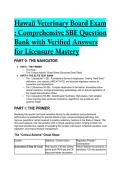
Hawaii Veterinary Board Exam
: Comprehensive SBE Question
Bank with Verified Answers
for Licensure Mastery
PART 0: THE NAVIGATOR
● PART I: THE PRIMER
○ The Hook
○ The "Critical Axioms" Cheat Sheet (Structured Data Table)
● PART II: THE ELITE TEST BANK
○ Tier 1 (Questions 1–28) - Foundational Syntax & Application: Testing "Hard Deck"
definitions, core statutes (HRS 471/472), and absolute regulatory metrics for
quarantine and telemedicine.
○ Tier 2 (Questions 29–58) - Complex Application & Simulation: Immediate-action
clinical scenarios, ecological toxinology, parasitology, and on-the-job application of
the Hawaii Administrative Rules.
○ Tier 3 (Questions 59–88) - Grandmaster Synthesis: High-stakes, multi-variable
crises requiring deep structural compliance, algorithmic risk avoidance, and
systemic triage.
PART I: THE PRIMER
Mastering this specific test bank translates directly to elite academic and professional
performance by embedding the precise statutory logic, unique ecological pathology, and
rigorous quarantine metrics required to practice veterinary medicine in the State of Hawaii. This
document replaces rote memorization with a clinical operating system, forging scholars into
high-level practitioners capable of navigating the complex intersection of federal mandates, local
legislation, and tropical disease management.
The "Critical Axioms" Cheat Sheet
Domain Statutory / Clinical Axiom Regulatory Penalty /
Consequence
Quarantine (5-Day-Or-Less) Pets require a 30-day waiting Failure defaults the animal to a
period post-FAVN test and 30 mandatory 120-day quarantine.
days post-rabies vaccination
,Domain Statutory / Clinical Axiom Regulatory Penalty /
Consequence
before arrival.
Tick Treatment (Entry) Must use a product equivalent Denial of expedited entry and
to Fipronil within 14 days of immediate quarantine hold.
arrival. Selamectin (Revolution)
is explicitly banned.
Telemedicine (HRS 471-2.5) Prescribing medication requires Statutory violation of practice
an established, in-person acts; potential license
Veterinarian-Client-Patient revocation.
Relationship (VCPR).
Cruelty Reporting (HRS Absolute mandate to report Practitioners are granted
471-18) suspected animal cruelty and absolute civil immunity for
staged dogfights to law good-faith reporting.
enforcement.
Toxinology / Parasitology Rhinella marina (Cane Toad) Acute cardiac arrest (Toad);
causes digitalis-like toxicity; Chronic cholangiohepatitis
Platynosomum concinnum (Fluke).
causes biliary hyperplasia.
Controlled Substances (NED) Dual registration is required; Inability to legally prescribe,
practitioners must obtain a administer, or dispense
Hawaii CSR before receiving a controlled substances.
DEA registration.
PART II: THE ELITE TEST BANK
Tier 1: Foundational Syntax & Application
Q1: An imported dog arrives at the Daniel K. Inouye International Airport. The animal's passing
OIE-FAVN rabies antibody test was recorded by the laboratory 21 days prior to arrival. Based on
Hawaii Department of Agriculture quarantine principles, which action is the MOST ACCURATE?
A) The dog is eligible for immediate release under the 5-Day-Or-Less program. B) The dog must
be held in quarantine for 9 days until the 30-day threshold is met. C) The dog must be placed in
a mandatory 120-day quarantine. D) The dog is granted entry if a titer is re-drawn at the airport.
● The Answer: C (The dog must be placed in a mandatory 120-day quarantine.)
● Distractor Analysis:
○ A is incorrect: The strict 30-day waiting period post-FAVN has not been satisfied.
○ B is incorrect: The program does not allow cumulative "wait-out" periods in state
custody to satisfy pre-arrival requirements.
○ D is incorrect: Airport titers do not retroactively fulfill the 30-day pre-arrival mandate.
The Mentor's Analysis: Time is an absolute metric in island rabies prevention. Missing the
30-day post-FAVN window voids the expedited entry privileges completely.
Professional/Academic Intuition: The 30-day FAVN waiting period is a hard deck; failure
immediately defaults to maximum holding.
Q2: To qualify for the Hawaii 5-Day-Or-Less quarantine program, a feline patient must be
treated with a long-acting topical tick product within 14 days of arrival. Which product is strictly
PROHIBITED for this purpose by the State of Hawaii? A) Fipronil B) Permethrin C) Selamectin
, D) Imidacloprid
● The Answer: C (Selamectin)
● Distractor Analysis:
○ A is incorrect: Fipronil is the gold-standard comparative metric for tick efficacy in
Hawaii.
○ B is incorrect: Permethrin is an acceptable active ingredient for dogs, though toxic
to cats.
○ D is incorrect: Imidacloprid is acceptable when properly formulated with a tick-killing
agent.
The Mentor's Analysis: Hawaii strictly regulates specific parasiticides to prevent the introduction
of foreign tick vectors. The state has explicitly determined that Selamectin (Revolution) lacks the
required efficacy for quarantine clearance. Professional/Academic Intuition: Revolution is
explicitly banned for quarantine tick clearance.
Q3: A veterinarian licensed in California moves to Hawaii and applies for a temporary permit to
practice while awaiting the next state board examination. According to HAR 16-101, what is the
MAXIMUM operational duration of this temporary permit? A) 3 months B) 6 months C) 11
months D) 24 months
● The Answer: C (11 months)
● Distractor Analysis:
○ A is incorrect: This duration is too short to bridge the gap between bi-annual board
examinations.
○ B is incorrect: A common novice assumption for temporary licensure.
○ D is incorrect: Permits are strictly non-renewable and cannot span two full years.
The Mentor's Analysis: The state grants a strict, non-renewable window to bridge the gap
between application and examination under the supervision of a Hawaii-licensed veterinarian.
Professional/Academic Intuition: Temporary permits terminate immediately upon exam
failure or at 11 months, whichever occurs FIRST.
Q4: Under HRS Chapter 472, a Registered Veterinary Technician (RVT) is preparing to intubate
a canine patient for a routine ovariohysterectomy. What level of supervision is legally
MANDATED for this procedure? A) General supervision B) Indirect supervision C) Direct
supervision D) Telesupervision
● The Answer: C (Direct supervision)
● Distractor Analysis:
○ A is incorrect: General supervision lacks the proximity required for an airway
procedure.
○ B is incorrect: Indirect supervision implies the veterinarian is off-site, which is illegal
for intubation.
○ D is incorrect: Telesupervision cannot physically intervene if the airway is
compromised.
The Mentor's Analysis: High-risk physiological procedures demand immediate physical
proximity. "Direct supervision" signifies the licensed veterinarian is located within the same
immediate building or complex. Professional/Academic Intuition: The more critical the airway,
the closer the veterinarian must be.
Q5: A practitioner establishes a virtual-only telemedicine clinic in Honolulu. They diagnose a
dog with a localized staphylococcal pyoderma via video consultation and prescribe cephalexin.
Why does this action explicitly violate HRS 471-2.5? A) Cephalexin is a regulated controlled
substance. B) Video resolution cannot definitively identify bacterial morphology. C) Prescribing
medications requires a VCPR established via in-person examination. D) Virtual clinics must be
: Comprehensive SBE Question
Bank with Verified Answers
for Licensure Mastery
PART 0: THE NAVIGATOR
● PART I: THE PRIMER
○ The Hook
○ The "Critical Axioms" Cheat Sheet (Structured Data Table)
● PART II: THE ELITE TEST BANK
○ Tier 1 (Questions 1–28) - Foundational Syntax & Application: Testing "Hard Deck"
definitions, core statutes (HRS 471/472), and absolute regulatory metrics for
quarantine and telemedicine.
○ Tier 2 (Questions 29–58) - Complex Application & Simulation: Immediate-action
clinical scenarios, ecological toxinology, parasitology, and on-the-job application of
the Hawaii Administrative Rules.
○ Tier 3 (Questions 59–88) - Grandmaster Synthesis: High-stakes, multi-variable
crises requiring deep structural compliance, algorithmic risk avoidance, and
systemic triage.
PART I: THE PRIMER
Mastering this specific test bank translates directly to elite academic and professional
performance by embedding the precise statutory logic, unique ecological pathology, and
rigorous quarantine metrics required to practice veterinary medicine in the State of Hawaii. This
document replaces rote memorization with a clinical operating system, forging scholars into
high-level practitioners capable of navigating the complex intersection of federal mandates, local
legislation, and tropical disease management.
The "Critical Axioms" Cheat Sheet
Domain Statutory / Clinical Axiom Regulatory Penalty /
Consequence
Quarantine (5-Day-Or-Less) Pets require a 30-day waiting Failure defaults the animal to a
period post-FAVN test and 30 mandatory 120-day quarantine.
days post-rabies vaccination
,Domain Statutory / Clinical Axiom Regulatory Penalty /
Consequence
before arrival.
Tick Treatment (Entry) Must use a product equivalent Denial of expedited entry and
to Fipronil within 14 days of immediate quarantine hold.
arrival. Selamectin (Revolution)
is explicitly banned.
Telemedicine (HRS 471-2.5) Prescribing medication requires Statutory violation of practice
an established, in-person acts; potential license
Veterinarian-Client-Patient revocation.
Relationship (VCPR).
Cruelty Reporting (HRS Absolute mandate to report Practitioners are granted
471-18) suspected animal cruelty and absolute civil immunity for
staged dogfights to law good-faith reporting.
enforcement.
Toxinology / Parasitology Rhinella marina (Cane Toad) Acute cardiac arrest (Toad);
causes digitalis-like toxicity; Chronic cholangiohepatitis
Platynosomum concinnum (Fluke).
causes biliary hyperplasia.
Controlled Substances (NED) Dual registration is required; Inability to legally prescribe,
practitioners must obtain a administer, or dispense
Hawaii CSR before receiving a controlled substances.
DEA registration.
PART II: THE ELITE TEST BANK
Tier 1: Foundational Syntax & Application
Q1: An imported dog arrives at the Daniel K. Inouye International Airport. The animal's passing
OIE-FAVN rabies antibody test was recorded by the laboratory 21 days prior to arrival. Based on
Hawaii Department of Agriculture quarantine principles, which action is the MOST ACCURATE?
A) The dog is eligible for immediate release under the 5-Day-Or-Less program. B) The dog must
be held in quarantine for 9 days until the 30-day threshold is met. C) The dog must be placed in
a mandatory 120-day quarantine. D) The dog is granted entry if a titer is re-drawn at the airport.
● The Answer: C (The dog must be placed in a mandatory 120-day quarantine.)
● Distractor Analysis:
○ A is incorrect: The strict 30-day waiting period post-FAVN has not been satisfied.
○ B is incorrect: The program does not allow cumulative "wait-out" periods in state
custody to satisfy pre-arrival requirements.
○ D is incorrect: Airport titers do not retroactively fulfill the 30-day pre-arrival mandate.
The Mentor's Analysis: Time is an absolute metric in island rabies prevention. Missing the
30-day post-FAVN window voids the expedited entry privileges completely.
Professional/Academic Intuition: The 30-day FAVN waiting period is a hard deck; failure
immediately defaults to maximum holding.
Q2: To qualify for the Hawaii 5-Day-Or-Less quarantine program, a feline patient must be
treated with a long-acting topical tick product within 14 days of arrival. Which product is strictly
PROHIBITED for this purpose by the State of Hawaii? A) Fipronil B) Permethrin C) Selamectin
, D) Imidacloprid
● The Answer: C (Selamectin)
● Distractor Analysis:
○ A is incorrect: Fipronil is the gold-standard comparative metric for tick efficacy in
Hawaii.
○ B is incorrect: Permethrin is an acceptable active ingredient for dogs, though toxic
to cats.
○ D is incorrect: Imidacloprid is acceptable when properly formulated with a tick-killing
agent.
The Mentor's Analysis: Hawaii strictly regulates specific parasiticides to prevent the introduction
of foreign tick vectors. The state has explicitly determined that Selamectin (Revolution) lacks the
required efficacy for quarantine clearance. Professional/Academic Intuition: Revolution is
explicitly banned for quarantine tick clearance.
Q3: A veterinarian licensed in California moves to Hawaii and applies for a temporary permit to
practice while awaiting the next state board examination. According to HAR 16-101, what is the
MAXIMUM operational duration of this temporary permit? A) 3 months B) 6 months C) 11
months D) 24 months
● The Answer: C (11 months)
● Distractor Analysis:
○ A is incorrect: This duration is too short to bridge the gap between bi-annual board
examinations.
○ B is incorrect: A common novice assumption for temporary licensure.
○ D is incorrect: Permits are strictly non-renewable and cannot span two full years.
The Mentor's Analysis: The state grants a strict, non-renewable window to bridge the gap
between application and examination under the supervision of a Hawaii-licensed veterinarian.
Professional/Academic Intuition: Temporary permits terminate immediately upon exam
failure or at 11 months, whichever occurs FIRST.
Q4: Under HRS Chapter 472, a Registered Veterinary Technician (RVT) is preparing to intubate
a canine patient for a routine ovariohysterectomy. What level of supervision is legally
MANDATED for this procedure? A) General supervision B) Indirect supervision C) Direct
supervision D) Telesupervision
● The Answer: C (Direct supervision)
● Distractor Analysis:
○ A is incorrect: General supervision lacks the proximity required for an airway
procedure.
○ B is incorrect: Indirect supervision implies the veterinarian is off-site, which is illegal
for intubation.
○ D is incorrect: Telesupervision cannot physically intervene if the airway is
compromised.
The Mentor's Analysis: High-risk physiological procedures demand immediate physical
proximity. "Direct supervision" signifies the licensed veterinarian is located within the same
immediate building or complex. Professional/Academic Intuition: The more critical the airway,
the closer the veterinarian must be.
Q5: A practitioner establishes a virtual-only telemedicine clinic in Honolulu. They diagnose a
dog with a localized staphylococcal pyoderma via video consultation and prescribe cephalexin.
Why does this action explicitly violate HRS 471-2.5? A) Cephalexin is a regulated controlled
substance. B) Video resolution cannot definitively identify bacterial morphology. C) Prescribing
medications requires a VCPR established via in-person examination. D) Virtual clinics must be


