

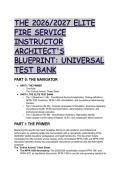
THE 2026/2027 ELITE
FIRE SERVICE
INSTRUCTOR
ARCHITECT'S
BLUEPRINT: UNIVERSAL
TEST BANK
PART 0: THE NAVIGATOR
● PART I: THE PRIMER
○ The Hook
○ The "Critical Axioms" Cheat Sheet
● PART II: THE ELITE TEST BANK
○ Tier 1 (Questions 1–28) - Foundational Syntax & Application: Testing definitions,
NFPA 1020 transitions, NFPA 1400 consolidation, and foundational adult learning
theories.
○ Tier 2 (Questions 29–58) - Complex Application & Simulation: Scenarios regarding
occupational health, PFAS decontamination, administrative compliance, and
instructional design execution.
○ Tier 3 (Questions 59–88) - Grandmaster Synthesis: High-stakes liability,
multi-variable live-fire safety (Chapters 16-21), and catastrophic failure aversion.
PART I: THE PRIMER
Mastering this specific test bank translates directly to elite academic and professional
performance by replacing brittle rote memorization with a mechanistic understanding of the
2026/2027 global regulatory, pedagogical, and legal frameworks. This document forges
candidates into elite scholars whose mastery of the consolidated NFPA 1020 and NFPA 1400
standards translates directly into unassailable instructional competence and absolute liability
protection.
The "Critical Axioms" Cheat Sheet:
● The NFPA 1020 Ascendancy: The 2025/2026 consolidation erased NFPA 1041 and
NFPA 1021 as standalone documents. NFPA 1020 is now the sole governing standard for
, Fire Instructor, Fire Officer, and the newly established EMS Officer Job Performance
Requirements (JPRs).
● The NFPA 1400 Consolidation & Fire Dynamics: NFPA 1403 (Live Fire) has been
absorbed into the 2026 edition of NFPA 1400 (Chapters 16–21). Additionally, the global
terminology has shifted from "Fire Behavior" to Fire Dynamics to accurately reflect the
complex relationship between fuel, heat, ventilation, and compartmentation.
● The 2026 PFAS & Occupational Health Mandate: 2026 marks strict deadlines for PFAS
reporting under the Toxic Substances Control Act (TSCA) and the mandatory phasing out
of toxic firefighting foam/turnout gear.
● Adult Learning (Andragogy) Superiority: Elite instruction relies on cognitive and
constructivist theories, moving away from pedagogy. Adult learners require self-directed,
experience-based, and problem-centric instruction.
Axiom Category Legacy Standard Current Elite Standard Legal/Professional
(Pre-2025) (2026+) Consequence of
Failure
Professional NFPA 1041 / NFPA NFPA 1020 Invalid JPRs; Training
Qualifications 1021 outside the scope of
practice.
Live Fire & Training NFPA 1403 / NFPA NFPA 1400 Criminal negligence;
1402 (Consolidated) structural failure; Line
of Duty Death.
Terminology Fire Behavior Fire Dynamics Tactical misalignment
with modern
combustion physics.
Health Law General Duty Clause Strict PFAS/TSCA Strict liability for
Mandates cancer/toxic exposure
negligence.
PART II: THE ELITE TEST BANK
Tier 1 (Questions 1–28) - Foundational Syntax & Application
Q1: A training division updates its certification manuals for 2026. A senior officer insists on
referencing NFPA 1041 for Instructor I competencies. Based on the principles of the NFPA
Emergency Response and Responder Safety (ERRS) consolidation, which conclusion is the
MOST ACCURATE? A) The officer is technically correct; NFPA 1041 remains an active,
standalone standard for civilian instructors. B) NFPA 1041 only applies to adjunct instructors
teaching non-live-fire practical skills. C) NFPA 1020 is the active, consolidated standard
replacing NFPA 1041 and NFPA 1021. D) The jurisdiction relies exclusively on OSHA 1910,
rendering NFPA professional standards optional.
● The Answer: C (NFPA 1020 is the active, consolidated standard replacing NFPA 1041
and NFPA 1021)
● Distractor Analysis:
○ A is incorrect: NFPA 1041 was sunset and absorbed during the ERRS consolidation
project.
○ B is incorrect: Legacy standards do not differentiate between adjunct and lead in
this manner.
○ D is incorrect: OSHA governs general workplace safety, not specific instructional
, JPRs.
The Mentor's Analysis: Validation of JPRs must rely on active frameworks. By utilizing NFPA
1020, the instructor bypasses the common trap of relying on retired legacy codes. Professional
Intuition: Never base legal compliance on sunset standards; NFPA 1020 is the definitive
Instructor source code.
Q2: An instructor updates a lesson plan, changing the module title from "Fire Behavior" to "Fire
Dynamics." Based on the principles of the NFPA 1400 (2026) rollout, which rationale BEST
justifies this action? A) "Fire Dynamics" is a localized legal term required for civil immunity. B)
The term reinforces that fire is influenced by the dynamic relationship between fuel, heat,
ventilation, and compartmentation. C) "Fire Behavior" is exclusively reserved for wildland
firefighting applications. D) "Fire Dynamics" specifically refers to the chemical degradation of
PFAS in turnout gear.
● The Answer: B (The term reinforces that fire is influenced by the dynamic relationship
between fuel, heat, ventilation, and compartmentation)
● Distractor Analysis:
○ A is incorrect: This is a global scientific terminology shift, not a localized legal
shield. * C is incorrect: The change applies universally across all structural and
wildland disciplines.
○ D is incorrect: PFAS degradation is an occupational health issue, not the definition
of fire dynamics.
The Mentor's Analysis: Terminology dictates operational mindset. By adopting Fire Dynamics,
the instructor accurately conveys the physics of modern combustion. Professional Intuition:
Fire does not "behave"; it reacts dynamically to environmental variables.
Q3: A lead instructor designs a course around problem-solving scenarios rather than standard
lectures, asking students to draw on their prior field experience. Based on adult learning
theories, which framework is PRIMARILY being applied? A) Pedagogy B) Behavioral
Conditioning C) Andragogy D) Rote Memorization
● The Answer: C (Andragogy)
● Distractor Analysis:
○ A is incorrect: Pedagogy is teacher-centric and designed for children.
○ B is incorrect: Behavioral conditioning focuses on stimulus-response, not complex
problem-solving.
○ D is incorrect: Rote memorization is the antithesis of experience-based adult
learning.
The Mentor's Analysis: Adult learners require relevance and autonomy. By utilizing Andragogy,
the instructor leverages the students' existing field experience. Professional Intuition: Adults
learn by solving problems relevant to their survival, not by absorbing lectures.
Q4: Under the consolidated NFPA 1020 standard, a new certification track introduces
division-level management JPRs for personnel who may not possess firefighting prerequisites.
Which specific discipline does this affect? A) Hazardous Materials Technician B) Emergency
Medical Services (EMS) Officer III C) Live Fire Instructor-in-Charge D) Aviation Rescue
Firefighter
● The Answer: B (Emergency Medical Services (EMS) Officer III)
● Distractor Analysis:
○ A is incorrect: Hazmat is governed by NFPA 470.
○ C is incorrect: Live Fire Instructors require strict structural firefighting prerequisites.
○ D is incorrect: ARFF requires firefighting operational background.
The Mentor's Analysis: The fire service is adapting to all-hazards models. By establishing EMS
, Officer JPRs within NFPA 1020, departments certify medical leaders without burdensome
suppression prerequisites. Professional Intuition: NFPA 1020 unifies Fire, EMS, and
Instructor disciplines under one management standard.
Q5: An instructor observes a student struggling to operate a new hydraulic rescue tool. The
instructor asks the student to compare the tool's mechanics to an older model they previously
mastered. Which adult learning theory is the instructor utilizing? A) Cognitive Theory B)
Connectivism C) Constructivist Theory D) Humanist Theory
● The Answer: C (Constructivist Theory)
● Distractor Analysis:
○ A is incorrect: Cognitive theory focuses on internal mental processing, whereas this
explicitly builds new knowledge upon past physical experience. * B is incorrect:
Connectivism deals primarily with technology and network-based learning. * D is
incorrect: Humanist theory focuses on self-actualization and personal growth.
The Mentor's Analysis: Students learn fastest when bridging the known to the unknown. By
utilizing Constructivist Theory, the instructor helps the student build new operational pathways
over existing frameworks. Professional Intuition: Always anchor new psychomotor skills to
a student's prior operational mastery.
Q6: A training officer is responsible for managing the department's training records. Based on
the guidelines of NFPA 1401, what is the PRIMARY purpose of maintaining these records? A)
To justify the department's annual overtime budget to the municipality. B) To provide a
framework for managing the training function and establishing legal documentation. C) To rank
firefighters for internal promotional exams. D) To track the fuel consumption of apparatus during
training evolutions.
● The Answer: B (To provide a framework for managing the training function and
establishing legal documentation)
● Distractor Analysis:
○ A is incorrect: While records aid budgets, their primary purpose under NFPA 1401 is
functional management and legal compliance.
○ C is incorrect: Promotional ranking is a secondary HR function.
○ D is incorrect: Apparatus fuel is tracked under logistics/fleet standards.
The Mentor's Analysis: Documentation is the ultimate shield against liability. By strictly following
NFPA 1401, the AHJ ensures that all personnel are objectively verified as competent.
Professional Intuition: If a training event is not documented to standard, legally, it never
happened.
Q7: Following the 2026 integration of NFPA 1403 into the consolidated NFPA 1400 standard, a
training officer is planning a live-fire evolution. Which factor must FIRST be confirmed regarding
the training structure? A) The presence of thermal imaging cameras for all students. B) The
structural integrity and classification of the building. C) The availability of synthetic fuel
packages. D) The establishment of a media staging area.
● The Answer: B (The structural integrity and classification of the building)
● Distractor Analysis:
○ A is incorrect: While beneficial, structural integrity supersedes equipment
availability.
○ C is incorrect: Synthetic fuels are strictly prohibited in Class A live-fire training.
○ D is incorrect: Public relations are secondary to absolute life safety.
The Mentor's Analysis: Environmental safety dictates operational authorization. By confirming
structural integrity first, the instructor prevents catastrophic collapse. Professional Intuition:
Never introduce live fire into an unverified compartment.
FIRE SERVICE
INSTRUCTOR
ARCHITECT'S
BLUEPRINT: UNIVERSAL
TEST BANK
PART 0: THE NAVIGATOR
● PART I: THE PRIMER
○ The Hook
○ The "Critical Axioms" Cheat Sheet
● PART II: THE ELITE TEST BANK
○ Tier 1 (Questions 1–28) - Foundational Syntax & Application: Testing definitions,
NFPA 1020 transitions, NFPA 1400 consolidation, and foundational adult learning
theories.
○ Tier 2 (Questions 29–58) - Complex Application & Simulation: Scenarios regarding
occupational health, PFAS decontamination, administrative compliance, and
instructional design execution.
○ Tier 3 (Questions 59–88) - Grandmaster Synthesis: High-stakes liability,
multi-variable live-fire safety (Chapters 16-21), and catastrophic failure aversion.
PART I: THE PRIMER
Mastering this specific test bank translates directly to elite academic and professional
performance by replacing brittle rote memorization with a mechanistic understanding of the
2026/2027 global regulatory, pedagogical, and legal frameworks. This document forges
candidates into elite scholars whose mastery of the consolidated NFPA 1020 and NFPA 1400
standards translates directly into unassailable instructional competence and absolute liability
protection.
The "Critical Axioms" Cheat Sheet:
● The NFPA 1020 Ascendancy: The 2025/2026 consolidation erased NFPA 1041 and
NFPA 1021 as standalone documents. NFPA 1020 is now the sole governing standard for
, Fire Instructor, Fire Officer, and the newly established EMS Officer Job Performance
Requirements (JPRs).
● The NFPA 1400 Consolidation & Fire Dynamics: NFPA 1403 (Live Fire) has been
absorbed into the 2026 edition of NFPA 1400 (Chapters 16–21). Additionally, the global
terminology has shifted from "Fire Behavior" to Fire Dynamics to accurately reflect the
complex relationship between fuel, heat, ventilation, and compartmentation.
● The 2026 PFAS & Occupational Health Mandate: 2026 marks strict deadlines for PFAS
reporting under the Toxic Substances Control Act (TSCA) and the mandatory phasing out
of toxic firefighting foam/turnout gear.
● Adult Learning (Andragogy) Superiority: Elite instruction relies on cognitive and
constructivist theories, moving away from pedagogy. Adult learners require self-directed,
experience-based, and problem-centric instruction.
Axiom Category Legacy Standard Current Elite Standard Legal/Professional
(Pre-2025) (2026+) Consequence of
Failure
Professional NFPA 1041 / NFPA NFPA 1020 Invalid JPRs; Training
Qualifications 1021 outside the scope of
practice.
Live Fire & Training NFPA 1403 / NFPA NFPA 1400 Criminal negligence;
1402 (Consolidated) structural failure; Line
of Duty Death.
Terminology Fire Behavior Fire Dynamics Tactical misalignment
with modern
combustion physics.
Health Law General Duty Clause Strict PFAS/TSCA Strict liability for
Mandates cancer/toxic exposure
negligence.
PART II: THE ELITE TEST BANK
Tier 1 (Questions 1–28) - Foundational Syntax & Application
Q1: A training division updates its certification manuals for 2026. A senior officer insists on
referencing NFPA 1041 for Instructor I competencies. Based on the principles of the NFPA
Emergency Response and Responder Safety (ERRS) consolidation, which conclusion is the
MOST ACCURATE? A) The officer is technically correct; NFPA 1041 remains an active,
standalone standard for civilian instructors. B) NFPA 1041 only applies to adjunct instructors
teaching non-live-fire practical skills. C) NFPA 1020 is the active, consolidated standard
replacing NFPA 1041 and NFPA 1021. D) The jurisdiction relies exclusively on OSHA 1910,
rendering NFPA professional standards optional.
● The Answer: C (NFPA 1020 is the active, consolidated standard replacing NFPA 1041
and NFPA 1021)
● Distractor Analysis:
○ A is incorrect: NFPA 1041 was sunset and absorbed during the ERRS consolidation
project.
○ B is incorrect: Legacy standards do not differentiate between adjunct and lead in
this manner.
○ D is incorrect: OSHA governs general workplace safety, not specific instructional
, JPRs.
The Mentor's Analysis: Validation of JPRs must rely on active frameworks. By utilizing NFPA
1020, the instructor bypasses the common trap of relying on retired legacy codes. Professional
Intuition: Never base legal compliance on sunset standards; NFPA 1020 is the definitive
Instructor source code.
Q2: An instructor updates a lesson plan, changing the module title from "Fire Behavior" to "Fire
Dynamics." Based on the principles of the NFPA 1400 (2026) rollout, which rationale BEST
justifies this action? A) "Fire Dynamics" is a localized legal term required for civil immunity. B)
The term reinforces that fire is influenced by the dynamic relationship between fuel, heat,
ventilation, and compartmentation. C) "Fire Behavior" is exclusively reserved for wildland
firefighting applications. D) "Fire Dynamics" specifically refers to the chemical degradation of
PFAS in turnout gear.
● The Answer: B (The term reinforces that fire is influenced by the dynamic relationship
between fuel, heat, ventilation, and compartmentation)
● Distractor Analysis:
○ A is incorrect: This is a global scientific terminology shift, not a localized legal
shield. * C is incorrect: The change applies universally across all structural and
wildland disciplines.
○ D is incorrect: PFAS degradation is an occupational health issue, not the definition
of fire dynamics.
The Mentor's Analysis: Terminology dictates operational mindset. By adopting Fire Dynamics,
the instructor accurately conveys the physics of modern combustion. Professional Intuition:
Fire does not "behave"; it reacts dynamically to environmental variables.
Q3: A lead instructor designs a course around problem-solving scenarios rather than standard
lectures, asking students to draw on their prior field experience. Based on adult learning
theories, which framework is PRIMARILY being applied? A) Pedagogy B) Behavioral
Conditioning C) Andragogy D) Rote Memorization
● The Answer: C (Andragogy)
● Distractor Analysis:
○ A is incorrect: Pedagogy is teacher-centric and designed for children.
○ B is incorrect: Behavioral conditioning focuses on stimulus-response, not complex
problem-solving.
○ D is incorrect: Rote memorization is the antithesis of experience-based adult
learning.
The Mentor's Analysis: Adult learners require relevance and autonomy. By utilizing Andragogy,
the instructor leverages the students' existing field experience. Professional Intuition: Adults
learn by solving problems relevant to their survival, not by absorbing lectures.
Q4: Under the consolidated NFPA 1020 standard, a new certification track introduces
division-level management JPRs for personnel who may not possess firefighting prerequisites.
Which specific discipline does this affect? A) Hazardous Materials Technician B) Emergency
Medical Services (EMS) Officer III C) Live Fire Instructor-in-Charge D) Aviation Rescue
Firefighter
● The Answer: B (Emergency Medical Services (EMS) Officer III)
● Distractor Analysis:
○ A is incorrect: Hazmat is governed by NFPA 470.
○ C is incorrect: Live Fire Instructors require strict structural firefighting prerequisites.
○ D is incorrect: ARFF requires firefighting operational background.
The Mentor's Analysis: The fire service is adapting to all-hazards models. By establishing EMS
, Officer JPRs within NFPA 1020, departments certify medical leaders without burdensome
suppression prerequisites. Professional Intuition: NFPA 1020 unifies Fire, EMS, and
Instructor disciplines under one management standard.
Q5: An instructor observes a student struggling to operate a new hydraulic rescue tool. The
instructor asks the student to compare the tool's mechanics to an older model they previously
mastered. Which adult learning theory is the instructor utilizing? A) Cognitive Theory B)
Connectivism C) Constructivist Theory D) Humanist Theory
● The Answer: C (Constructivist Theory)
● Distractor Analysis:
○ A is incorrect: Cognitive theory focuses on internal mental processing, whereas this
explicitly builds new knowledge upon past physical experience. * B is incorrect:
Connectivism deals primarily with technology and network-based learning. * D is
incorrect: Humanist theory focuses on self-actualization and personal growth.
The Mentor's Analysis: Students learn fastest when bridging the known to the unknown. By
utilizing Constructivist Theory, the instructor helps the student build new operational pathways
over existing frameworks. Professional Intuition: Always anchor new psychomotor skills to
a student's prior operational mastery.
Q6: A training officer is responsible for managing the department's training records. Based on
the guidelines of NFPA 1401, what is the PRIMARY purpose of maintaining these records? A)
To justify the department's annual overtime budget to the municipality. B) To provide a
framework for managing the training function and establishing legal documentation. C) To rank
firefighters for internal promotional exams. D) To track the fuel consumption of apparatus during
training evolutions.
● The Answer: B (To provide a framework for managing the training function and
establishing legal documentation)
● Distractor Analysis:
○ A is incorrect: While records aid budgets, their primary purpose under NFPA 1401 is
functional management and legal compliance.
○ C is incorrect: Promotional ranking is a secondary HR function.
○ D is incorrect: Apparatus fuel is tracked under logistics/fleet standards.
The Mentor's Analysis: Documentation is the ultimate shield against liability. By strictly following
NFPA 1401, the AHJ ensures that all personnel are objectively verified as competent.
Professional Intuition: If a training event is not documented to standard, legally, it never
happened.
Q7: Following the 2026 integration of NFPA 1403 into the consolidated NFPA 1400 standard, a
training officer is planning a live-fire evolution. Which factor must FIRST be confirmed regarding
the training structure? A) The presence of thermal imaging cameras for all students. B) The
structural integrity and classification of the building. C) The availability of synthetic fuel
packages. D) The establishment of a media staging area.
● The Answer: B (The structural integrity and classification of the building)
● Distractor Analysis:
○ A is incorrect: While beneficial, structural integrity supersedes equipment
availability.
○ C is incorrect: Synthetic fuels are strictly prohibited in Class A live-fire training.
○ D is incorrect: Public relations are secondary to absolute life safety.
The Mentor's Analysis: Environmental safety dictates operational authorization. By confirming
structural integrity first, the instructor prevents catastrophic collapse. Professional Intuition:
Never introduce live fire into an unverified compartment.


