

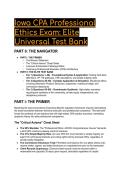
Iowa CPA Professional
Ethics Exam: Elite
Universal Test Bank
PART 0: THE NAVIGATOR
● PART I: THE PRIMER
○ The Mission Statement
○ The "Critical Axioms" Cheat Sheet
○ Licensure & Education Pathways Matrix
○ Continuing Professional Education (CPE) Architecture
● PART II: THE ELITE TEST BANK
○ Tier 1 (Questions 1–28) - Foundational Syntax & Application: Testing hard-deck
definitions, HF 778 pathways, CPE calculations, and simple majority rules.
○ Tier 2 (Questions 29–58) - Complex Application & Simulation: Situational ethics
involving Alternative Practice Structures, subpoenas, mobility privilege, and
commission disclosures.
○ Tier 3 (Questions 59–88) - Grandmaster Synthesis: High-stakes scenarios
requiring the synthesis of firm ownership, private equity independence, and
disciplinary protocols.
PART I: THE PRIMER
Mastering the Iowa Accountancy Examining Board's regulatory framework requires internalizing
the exact boundaries between technical execution and professional compliance. This test bank
forces the synthesis of raw statutory text with high-stakes CPA practice scenarios, translating
academic theory into elite professional competence.
The "Critical Axioms" Cheat Sheet
● The 90% Mandate: The "Professional Ethics: AICPA's Comprehensive Course" demands
a strict 90% minimum passing score for licensure.
● The 51% Simple Majority Rule: An Iowa CPA firm must maintain a simple majority (at
least 51%) of financial interests and voting rights held by licensed CPAs, regardless of
private equity integration.
● The Commission Disclosure Triad: Permitted commissions (for non-attest clients only)
require written, signed, and dated disclosure on a separate form prior to the transaction.
● Client Records Supremacy: Client-provided records must be returned within a
reasonable time (typically 30 days) upon request, absolutely regardless of unpaid
, accounting fees.
● Implied Consent via Mobility: Practicing across borders under a practice privilege
carries automatic consent to the host state's jurisdiction and disciplinary authority.
HF 778 Licensure Pathways Matrix (Effective July 2026)
The 2026 legislative update to Iowa Code modernized the entrance pathways, explicitly trading
academic volume for practical experience.
Pathway Type Minimum Degree Required Required Examination
Academic Credits Experience Requirement
Graduate N/A (Master's Master's Degree 1 Year (2,000 Uniform CPA
Pathway level) hours) Exam
Traditional 150 Semester Bachelor's Degree 1 Year (2,000 Uniform CPA
Pathway Credits hours) Exam
120-Credit 120 Semester Bachelor's Degree 2 Years (4,000 Uniform CPA
Pathway Credits hours) Exam
Continuing Professional Education (CPE) Architecture
Licensees self-select their completion dates (Dec 31 or June 30) prior to the July 1 renewal,
measured in 50-minute contact hours.
Requirement Category Volume Timeframe Applicability &
Conditions
Total CPE 120 Hours Triennial All active CPAs and
LPAs (phase-in applies
to rookies).
Ethics 4 Hours Triennial Must cover regulatory
or behavioral ethics.
Financial 8 Hours Triennial Required only for those
Presentation supervising or signing
compilations (e.g.,
SSARS).
Non-Technical Limits Max 60 Hours Triennial Limits subjects like
marketing, general
leadership, or
communication.
PART II: THE ELITE TEST BANK
Tier 1: Foundational Syntax & Application
Q1: Effective July 1, 2026, an Iowa candidate graduates with a bachelor's degree totaling 120
semester credits. To achieve CPA licensure under HF 778, which action is the FIRST
requirement? A) Complete one year (2,000 hours) of supervised experience. B) Obtain an
additional 30 semester credits to reach the 150-credit threshold. C) Complete two years (4,000
hours) of supervised experience. D) Register as a Licensed Public Accountant (LPA).
● The Answer: C (Complete two years (4,000 hours) of supervised experience.)
● Distractor Analysis:
, ○ A is incorrect: One year of experience applies exclusively to the 150-credit or
graduate pathways.
○ B is incorrect: HF 778 explicitly designed the 120-credit pathway to bypass the
150-credit threshold entirely.
○ D is incorrect: LPAs represent a distinct licensure category, not a probationary tier
for CPAs.
The Mentor's Analysis: The 2026 legislative update instituted a strict mathematical exchange:
reduced academic volume necessitates doubled practical apprenticeship.
Professional/Academic Intuition: Under HF 778, 120 credits strictly dictate 24 months of
experience.
Q2: An applicant passes the Uniform CPA Exam and completes the AICPA Comprehensive
Ethics Course with an 88%. Based on Iowa Code Chapter 542, which conclusion is MOST
ACCURATE? A) The application is approved because 88% exceeds the standard 75% CPA
Exam passing score. B) The application is denied because the ethics exam requires a minimum
passing score of 90%. C) The application is approved conditionally, pending a Board interview.
D) The application is denied because the ethics exam must be administered directly by the
state.
● The Answer: B (The application is denied because the ethics exam requires a minimum
passing score of 90%.)
● Distractor Analysis:
○ A is incorrect: The Uniform CPA Exam requires a 75, but the ethics exam utilizes a
higher standard.
○ C is incorrect: Conditional approvals for failed ethics scores are not codified in Iowa
administrative law.
○ D is incorrect: Iowa mandates the specific AICPA Comprehensive Course, not a
localized state exam.
The Mentor's Analysis: Technical competence permits a margin of error; ethical competence
demands near-perfection. The Board establishes a rigid 90% threshold for ethics.
Professional/Academic Intuition: The AICPA ethics exam operates on an elite 90% hard
deck.
Q3: A CPA firm operating in Des Moines seeks to admit a non-licensed Data Scientist as a firm
partner. Under Iowa Code section 542.7, which action regarding ownership is the MOST
ACCURATE? A) The firm must deny the partnership; only licensed CPAs may own equity. B)
The data scientist may become a partner, provided CPAs retain a simple majority (51%) of
financial interests and voting rights. C) The data scientist may become a partner but is restricted
to a maximum 20% ownership stake. D) The firm must reclassify as an Alternative Practice
Structure (APS).
● The Answer: B (The data scientist may become a partner, provided CPAs retain a simple
majority (51%) of financial interests and voting rights.)
● Distractor Analysis:
○ A is incorrect: Iowa law explicitly permits non-licensee owners who are active
participants in the firm.
○ C is incorrect: No 20% cap exists; non-licensees can own up to a combined 49%.
○ D is incorrect: Standard CPA firms can admit non-licensees without adopting a
formal APS umbrella.
The Mentor's Analysis: Multidisciplinary expertise is vital, but professional control is
non-negotiable. Non-CPAs may share profits, but CPAs must hold the ultimate voting authority.
Professional/Academic Intuition: Ownership may be shared, but voting control remains a
, CPA monopoly.
Q4: An Iowa CPA in their third year of licensure is calculating their triennial CPE requirements.
They must complete 120 total hours. What is the IMMEDIATELY required minimum allocation
for ethics training? A) Two hours annually. B) Four hours within the three-year renewal period.
C) Eight hours within the three-year renewal period. D) Ethics is recommended but not strictly
required if no attest work is performed.
● The Answer: B (Four hours within the three-year renewal period.)
● Distractor Analysis:
○ A is incorrect: The requirement is tracked triennially, not annualized.
○ C is incorrect: Eight hours applies to financial statement presentation (SSARS), not
ethics.
○ D is incorrect: Ethics CPE is mandatory for all active licensees, irrespective of
service type.
The Mentor's Analysis: The Board mandates constant ethical calibration. While practitioners can
shift technical CPE, the 4-hour ethics requirement must land inside the specific three-year
reporting window. Professional/Academic Intuition: Four hours of ethics per triennial cycle is
the unbreakable baseline.
Q5: An out-of-state CPA firm, holding an active license in Nebraska, wishes to perform an audit
for an Iowa-headquartered client. The firm has no physical office in Iowa. Under Iowa Code
section 542.20, the firm : A) Must apply for a temporary practice permit and pay a fee to the
Iowa Board. B) Must establish a physical branch in Iowa within 30 days. C) May perform the
audit under practice privilege without notice or fee, provided their home state license is
substantially equivalent. D) Cannot perform the audit; attest services are strictly reserved for
Iowa-licensed firms.
● The Answer: C (May perform the audit under practice privilege without notice or fee,
provided their home state license is substantially equivalent.)
● Distractor Analysis:
○ A is incorrect: Iowa utilizes a "no notice, no fee" practice privilege system for
equivalent jurisdictions.
○ B is incorrect: Maintaining a physical office in Iowa actually nullifies the privilege
and triggers formal permit requirements.
○ D is incorrect: Out-of-state firms can perform attest work in Iowa via practice
privilege.
The Mentor's Analysis: Mobility frameworks are designed to eliminate administrative friction for
equivalent professionals. Absent a physical footprint, firms operate freely under implied consent.
Professional/Academic Intuition: Cross-border mobility requires host-state compliance, not
host-state paperwork.
Q6: An Iowa Licensed Public Accountant (LPA) is approached by a bank to provide assurance
on a business's financial statements. Which action is MOST ACCURATE regarding the LPA's
scope of practice? A) The LPA may perform an audit if they utilize a CPA as a concurring
reviewer. B) The LPA may perform a review, but not an audit. C) The LPA is strictly limited to
performing compilations and cannot express any assurance. D) The LPA may perform any
attest service if their firm has passed a peer review.
● The Answer: C (The LPA is strictly limited to performing compilations and cannot express
any assurance.)
● Distractor Analysis:
○ A is incorrect: LPAs are statutorily barred from performing audits, regardless of
supervision.
Ethics Exam: Elite
Universal Test Bank
PART 0: THE NAVIGATOR
● PART I: THE PRIMER
○ The Mission Statement
○ The "Critical Axioms" Cheat Sheet
○ Licensure & Education Pathways Matrix
○ Continuing Professional Education (CPE) Architecture
● PART II: THE ELITE TEST BANK
○ Tier 1 (Questions 1–28) - Foundational Syntax & Application: Testing hard-deck
definitions, HF 778 pathways, CPE calculations, and simple majority rules.
○ Tier 2 (Questions 29–58) - Complex Application & Simulation: Situational ethics
involving Alternative Practice Structures, subpoenas, mobility privilege, and
commission disclosures.
○ Tier 3 (Questions 59–88) - Grandmaster Synthesis: High-stakes scenarios
requiring the synthesis of firm ownership, private equity independence, and
disciplinary protocols.
PART I: THE PRIMER
Mastering the Iowa Accountancy Examining Board's regulatory framework requires internalizing
the exact boundaries between technical execution and professional compliance. This test bank
forces the synthesis of raw statutory text with high-stakes CPA practice scenarios, translating
academic theory into elite professional competence.
The "Critical Axioms" Cheat Sheet
● The 90% Mandate: The "Professional Ethics: AICPA's Comprehensive Course" demands
a strict 90% minimum passing score for licensure.
● The 51% Simple Majority Rule: An Iowa CPA firm must maintain a simple majority (at
least 51%) of financial interests and voting rights held by licensed CPAs, regardless of
private equity integration.
● The Commission Disclosure Triad: Permitted commissions (for non-attest clients only)
require written, signed, and dated disclosure on a separate form prior to the transaction.
● Client Records Supremacy: Client-provided records must be returned within a
reasonable time (typically 30 days) upon request, absolutely regardless of unpaid
, accounting fees.
● Implied Consent via Mobility: Practicing across borders under a practice privilege
carries automatic consent to the host state's jurisdiction and disciplinary authority.
HF 778 Licensure Pathways Matrix (Effective July 2026)
The 2026 legislative update to Iowa Code modernized the entrance pathways, explicitly trading
academic volume for practical experience.
Pathway Type Minimum Degree Required Required Examination
Academic Credits Experience Requirement
Graduate N/A (Master's Master's Degree 1 Year (2,000 Uniform CPA
Pathway level) hours) Exam
Traditional 150 Semester Bachelor's Degree 1 Year (2,000 Uniform CPA
Pathway Credits hours) Exam
120-Credit 120 Semester Bachelor's Degree 2 Years (4,000 Uniform CPA
Pathway Credits hours) Exam
Continuing Professional Education (CPE) Architecture
Licensees self-select their completion dates (Dec 31 or June 30) prior to the July 1 renewal,
measured in 50-minute contact hours.
Requirement Category Volume Timeframe Applicability &
Conditions
Total CPE 120 Hours Triennial All active CPAs and
LPAs (phase-in applies
to rookies).
Ethics 4 Hours Triennial Must cover regulatory
or behavioral ethics.
Financial 8 Hours Triennial Required only for those
Presentation supervising or signing
compilations (e.g.,
SSARS).
Non-Technical Limits Max 60 Hours Triennial Limits subjects like
marketing, general
leadership, or
communication.
PART II: THE ELITE TEST BANK
Tier 1: Foundational Syntax & Application
Q1: Effective July 1, 2026, an Iowa candidate graduates with a bachelor's degree totaling 120
semester credits. To achieve CPA licensure under HF 778, which action is the FIRST
requirement? A) Complete one year (2,000 hours) of supervised experience. B) Obtain an
additional 30 semester credits to reach the 150-credit threshold. C) Complete two years (4,000
hours) of supervised experience. D) Register as a Licensed Public Accountant (LPA).
● The Answer: C (Complete two years (4,000 hours) of supervised experience.)
● Distractor Analysis:
, ○ A is incorrect: One year of experience applies exclusively to the 150-credit or
graduate pathways.
○ B is incorrect: HF 778 explicitly designed the 120-credit pathway to bypass the
150-credit threshold entirely.
○ D is incorrect: LPAs represent a distinct licensure category, not a probationary tier
for CPAs.
The Mentor's Analysis: The 2026 legislative update instituted a strict mathematical exchange:
reduced academic volume necessitates doubled practical apprenticeship.
Professional/Academic Intuition: Under HF 778, 120 credits strictly dictate 24 months of
experience.
Q2: An applicant passes the Uniform CPA Exam and completes the AICPA Comprehensive
Ethics Course with an 88%. Based on Iowa Code Chapter 542, which conclusion is MOST
ACCURATE? A) The application is approved because 88% exceeds the standard 75% CPA
Exam passing score. B) The application is denied because the ethics exam requires a minimum
passing score of 90%. C) The application is approved conditionally, pending a Board interview.
D) The application is denied because the ethics exam must be administered directly by the
state.
● The Answer: B (The application is denied because the ethics exam requires a minimum
passing score of 90%.)
● Distractor Analysis:
○ A is incorrect: The Uniform CPA Exam requires a 75, but the ethics exam utilizes a
higher standard.
○ C is incorrect: Conditional approvals for failed ethics scores are not codified in Iowa
administrative law.
○ D is incorrect: Iowa mandates the specific AICPA Comprehensive Course, not a
localized state exam.
The Mentor's Analysis: Technical competence permits a margin of error; ethical competence
demands near-perfection. The Board establishes a rigid 90% threshold for ethics.
Professional/Academic Intuition: The AICPA ethics exam operates on an elite 90% hard
deck.
Q3: A CPA firm operating in Des Moines seeks to admit a non-licensed Data Scientist as a firm
partner. Under Iowa Code section 542.7, which action regarding ownership is the MOST
ACCURATE? A) The firm must deny the partnership; only licensed CPAs may own equity. B)
The data scientist may become a partner, provided CPAs retain a simple majority (51%) of
financial interests and voting rights. C) The data scientist may become a partner but is restricted
to a maximum 20% ownership stake. D) The firm must reclassify as an Alternative Practice
Structure (APS).
● The Answer: B (The data scientist may become a partner, provided CPAs retain a simple
majority (51%) of financial interests and voting rights.)
● Distractor Analysis:
○ A is incorrect: Iowa law explicitly permits non-licensee owners who are active
participants in the firm.
○ C is incorrect: No 20% cap exists; non-licensees can own up to a combined 49%.
○ D is incorrect: Standard CPA firms can admit non-licensees without adopting a
formal APS umbrella.
The Mentor's Analysis: Multidisciplinary expertise is vital, but professional control is
non-negotiable. Non-CPAs may share profits, but CPAs must hold the ultimate voting authority.
Professional/Academic Intuition: Ownership may be shared, but voting control remains a
, CPA monopoly.
Q4: An Iowa CPA in their third year of licensure is calculating their triennial CPE requirements.
They must complete 120 total hours. What is the IMMEDIATELY required minimum allocation
for ethics training? A) Two hours annually. B) Four hours within the three-year renewal period.
C) Eight hours within the three-year renewal period. D) Ethics is recommended but not strictly
required if no attest work is performed.
● The Answer: B (Four hours within the three-year renewal period.)
● Distractor Analysis:
○ A is incorrect: The requirement is tracked triennially, not annualized.
○ C is incorrect: Eight hours applies to financial statement presentation (SSARS), not
ethics.
○ D is incorrect: Ethics CPE is mandatory for all active licensees, irrespective of
service type.
The Mentor's Analysis: The Board mandates constant ethical calibration. While practitioners can
shift technical CPE, the 4-hour ethics requirement must land inside the specific three-year
reporting window. Professional/Academic Intuition: Four hours of ethics per triennial cycle is
the unbreakable baseline.
Q5: An out-of-state CPA firm, holding an active license in Nebraska, wishes to perform an audit
for an Iowa-headquartered client. The firm has no physical office in Iowa. Under Iowa Code
section 542.20, the firm : A) Must apply for a temporary practice permit and pay a fee to the
Iowa Board. B) Must establish a physical branch in Iowa within 30 days. C) May perform the
audit under practice privilege without notice or fee, provided their home state license is
substantially equivalent. D) Cannot perform the audit; attest services are strictly reserved for
Iowa-licensed firms.
● The Answer: C (May perform the audit under practice privilege without notice or fee,
provided their home state license is substantially equivalent.)
● Distractor Analysis:
○ A is incorrect: Iowa utilizes a "no notice, no fee" practice privilege system for
equivalent jurisdictions.
○ B is incorrect: Maintaining a physical office in Iowa actually nullifies the privilege
and triggers formal permit requirements.
○ D is incorrect: Out-of-state firms can perform attest work in Iowa via practice
privilege.
The Mentor's Analysis: Mobility frameworks are designed to eliminate administrative friction for
equivalent professionals. Absent a physical footprint, firms operate freely under implied consent.
Professional/Academic Intuition: Cross-border mobility requires host-state compliance, not
host-state paperwork.
Q6: An Iowa Licensed Public Accountant (LPA) is approached by a bank to provide assurance
on a business's financial statements. Which action is MOST ACCURATE regarding the LPA's
scope of practice? A) The LPA may perform an audit if they utilize a CPA as a concurring
reviewer. B) The LPA may perform a review, but not an audit. C) The LPA is strictly limited to
performing compilations and cannot express any assurance. D) The LPA may perform any
attest service if their firm has passed a peer review.
● The Answer: C (The LPA is strictly limited to performing compilations and cannot express
any assurance.)
● Distractor Analysis:
○ A is incorrect: LPAs are statutorily barred from performing audits, regardless of
supervision.


