

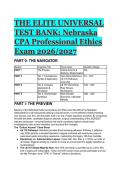
THE ELITE UNIVERSAL
TEST BANK: Nebraska
CPA Professional Ethics
Exam 2026/2027
PART 0: THE NAVIGATOR
Section Cognitive Tier Focus Area Question Range
PART I The Preview Critical Axioms & N/A
Statutory Modernization
PART II Tier 1: Foundational Hard Deck Definitions, Q1 – Q15
Syntax & Application LB 718 Pathways,
Licensing
PART II Tier 2: Complex LB 707 Ownership, Q16 – Q35
Application & Peer Review,
Simulation Workspaces
PART II Tier 3: Grandmaster Multi-Variable Q36 – Q60
Synthesis Scenarios, Interstate
Mobility
PART I: THE PREVIEW
Mastery of the Nebraska Public Accountancy Act (PAA) and Title 288 of the Nebraska
Administrative Code transcends passing a required exam; it is the definitive shield protecting
your license, your firm, and the public trust in an era of rapid regulatory evolution. By conquering
this elite test bank, candidates forge an absolute, surgical understanding of the 2026/2027
statutory landscape—ensuring flawless real-world compliance against critical board
investigations, peer review mandates, and structural firm changes.
The "Critical Axioms" Cheat Sheet
● LB 718 Pathways: Nebraska provides three licensing pathways. Pathway 3 (effective
July 2026) permits a standard Bachelor’s degree combined with exactly two years of
supervised public accounting experience, modernizing the legacy 150-hour mandate.
● Disciplinary vs. Administrative Lapses: Under Neb. Rev. Stat. § 1-137(9), an order of
revocation triggered strictly by a failure to renew an annual permit is legally classified as
nondisciplinary.
● The LB 707 Simple Majority Rule: Non-CPA ownership is permitted up to a strict 49%
limit of equity and voting rights. These non-CPA owners must actively participate and use
the title Principal, never "CPA" or "Partner" without a disclaimer.
, ● The 5-Year Commission Rule: If permitted under Title 288 Chapter 5, written disclosures
for commissions or referral fees must be executed in duplicate, signed by the client, and
retained for exactly five years.
● Workspace vs. Office Protocol: A temporary "workspace" must be registered with the
Nebraska Board of Public Accountancy (NBPA) exactly 10 days prior to opening and
cannot be advertised on permanent exterior signage.
Nebraska CPA Licensure Pathways (LB 718)
Pathway Academic Requirement Experience Required Examination
(Public Accounting)
Pathway 1 Master's Degree 1 Year (2,000 hours) Uniform CPA Exam
Pathway 2 Bachelor's + 30 Hours 1 Year (2,000 hours) Uniform CPA Exam
Pathway 3 Bachelor's Degree 2 Years (4,000 hours) Uniform CPA Exam
PART II: THE ELITE TEST BANK
Tier 1: Foundational Syntax & Application
Q1: Under the modernized 2026 Nebraska LB 718 statutes (Pathway 3), a candidate graduates
with a standard 120-credit Bachelor’s degree containing all required accounting and business
coursework. To achieve full CPA licensure without earning additional academic credits, what is
the EXACT experience requirement the candidate must fulfill? A) One year (2,000 hours) of
supervised experience in a public accounting firm. B) Two years (4,000 hours) of supervised
experience in private industry. C) Two years (4,000 hours) of supervised experience in a public
accounting firm. D) Three years (6,000 hours) of supervised experience in government auditing.
● The Answer: C (Two years (4,000 hours) of supervised experience in a public accounting
firm.)
● Distractor Analysis:
○ A is incorrect: One year of experience pairs strictly with the legacy 150-credit or
Master's degree pathways (Pathways 1 and 2).
○ B is incorrect: While private industry experience is valid, utilizing private/academic
experience universally bumps the statutory requirement to three years (6,000
hours) for standard pathways.
○ D is incorrect: Three years is the requirement for private industry or academia, not
the baseline for the new Bachelor's plus public accounting pathway.
The Mentor's Analysis: LB 718 redefined entry into the profession by balancing academic
burden with practical rigor. If a candidate foregoes the 150-hour requirement, the state demands
an extended, intensive public accounting apprenticeship. Professional/Academic Intuition:
The baseline equation for Pathway 3 is 120 Credits + 2 Years Public Accounting = CPA
Licensure.
Q2: A Nebraska CPA candidate enrolls in the AICPA’s Professional Ethics: The AICPA's
Comprehensive Course. To fulfill the Nebraska Board of Public Accountancy (NBPA) licensure
requirements, what is the MINIMUM passing score the candidate must achieve on this specific
open-book examination? A) 75% B) 80% C) 90% D) 95%
● The Answer: C (90%)
● Distractor Analysis:
○ A is incorrect: 75% is the threshold for the four core sections of the Uniform CPA
, Examination, not the AICPA Ethics Exam.
○ B is incorrect: 80% is a common threshold in continuing professional education
(CPE) course assessments, not initial licensure ethics exams.
○ D is incorrect: 95% exceeds the statutory mandate; 90% is the exact required
passing grade.
The Mentor's Analysis: Technical competence tolerates a 75% margin of error; ethical
competence demands near perfection. The NBPA requires a 90% score to prove the candidate
can methodically navigate and apply the AICPA Code of Professional Conduct.
Professional/Academic Intuition: The core CPA Exam requires competence (75%); the Ethics
Exam requires mastery (90%).
Q3: A Nebraska candidate is enrolled in their final semester of college and wishes to sit for their
FIRST section of the Uniform CPA Examination. Under NBPA rules, within what timeframe must
the candidate complete their educational requirements relative to their examination date? A)
Within 60 days of the examination date. B) Within 120 days of the examination date. C) Within
150 days of the examination date. D) Prior to receiving their initial Notice to Schedule (NTS).
● The Answer: B (Within 120 days of the examination date.)
● Distractor Analysis:
○ A is incorrect: 60 days is an arbitrary window not supported by Nebraska statutes.
○ C is incorrect: 150 days is the deadline to submit the final official transcripts to CPA
Examination Services (CPAES) after taking the exam, not the window for
completing the education itself.
○ D is incorrect: The 120-day rule specifically acts as an exception to allow
candidates to receive their NTS and test before final graduation.
The Mentor's Analysis: The Board accelerates entry into the profession by allowing candidates
to test during their final semester. However, this is a strict provisional window.
Professional/Academic Intuition: Education must be completed within 120 days of the test
date; transcripts proving completion must arrive within 150 days.
Q4: A licensed Nebraska CPA fails to renew their Active Permit to Practice by the expiration
deadline. Following notice and hearing, the NBPA issues an order of revocation. Under Neb.
Rev. Stat. § 1-137(9) as amended by LB 718, how is this specific revocation legally classified?
A) As a Class IV felony. B) As an act discreditable to the profession. C) As a formal disciplinary
action subject to interstate reporting. D) As a nondisciplinary administrative action.
● The Answer: D (As a nondisciplinary administrative action.)
● Distractor Analysis:
○ A is incorrect: Lapsing a permit is an administrative failure, not a criminal statutory
offense.
○ B is incorrect: Acts Discreditable involve ethical breaches (e.g., retaining client
records, discrimination), not simple renewal lapses.
○ C is incorrect: LB 718 specifically amended the statutes to protect CPAs from
having administrative lapses classified as permanent disciplinary black marks on
their interstate records.
The Mentor's Analysis: The 2026 legislative overhaul recognized that forgetting to pay a
renewal fee does not indicate a lack of ethical fitness. Revocations strictly for failure to renew
under subdivision (9) are explicitly shielded as nondisciplinary. Professional/Academic
Intuition: Distinguish the nature of the failure: Administrative lapses yield nondisciplinary
revocations; ethical breaches yield formal disciplinary action.
Q5: A Nebraska CPA firm performs an audit for a local municipality. Under Title 288, Chapter
13, the firm must enroll in an approved peer review program. When is the firm's INITIAL peer
TEST BANK: Nebraska
CPA Professional Ethics
Exam 2026/2027
PART 0: THE NAVIGATOR
Section Cognitive Tier Focus Area Question Range
PART I The Preview Critical Axioms & N/A
Statutory Modernization
PART II Tier 1: Foundational Hard Deck Definitions, Q1 – Q15
Syntax & Application LB 718 Pathways,
Licensing
PART II Tier 2: Complex LB 707 Ownership, Q16 – Q35
Application & Peer Review,
Simulation Workspaces
PART II Tier 3: Grandmaster Multi-Variable Q36 – Q60
Synthesis Scenarios, Interstate
Mobility
PART I: THE PREVIEW
Mastery of the Nebraska Public Accountancy Act (PAA) and Title 288 of the Nebraska
Administrative Code transcends passing a required exam; it is the definitive shield protecting
your license, your firm, and the public trust in an era of rapid regulatory evolution. By conquering
this elite test bank, candidates forge an absolute, surgical understanding of the 2026/2027
statutory landscape—ensuring flawless real-world compliance against critical board
investigations, peer review mandates, and structural firm changes.
The "Critical Axioms" Cheat Sheet
● LB 718 Pathways: Nebraska provides three licensing pathways. Pathway 3 (effective
July 2026) permits a standard Bachelor’s degree combined with exactly two years of
supervised public accounting experience, modernizing the legacy 150-hour mandate.
● Disciplinary vs. Administrative Lapses: Under Neb. Rev. Stat. § 1-137(9), an order of
revocation triggered strictly by a failure to renew an annual permit is legally classified as
nondisciplinary.
● The LB 707 Simple Majority Rule: Non-CPA ownership is permitted up to a strict 49%
limit of equity and voting rights. These non-CPA owners must actively participate and use
the title Principal, never "CPA" or "Partner" without a disclaimer.
, ● The 5-Year Commission Rule: If permitted under Title 288 Chapter 5, written disclosures
for commissions or referral fees must be executed in duplicate, signed by the client, and
retained for exactly five years.
● Workspace vs. Office Protocol: A temporary "workspace" must be registered with the
Nebraska Board of Public Accountancy (NBPA) exactly 10 days prior to opening and
cannot be advertised on permanent exterior signage.
Nebraska CPA Licensure Pathways (LB 718)
Pathway Academic Requirement Experience Required Examination
(Public Accounting)
Pathway 1 Master's Degree 1 Year (2,000 hours) Uniform CPA Exam
Pathway 2 Bachelor's + 30 Hours 1 Year (2,000 hours) Uniform CPA Exam
Pathway 3 Bachelor's Degree 2 Years (4,000 hours) Uniform CPA Exam
PART II: THE ELITE TEST BANK
Tier 1: Foundational Syntax & Application
Q1: Under the modernized 2026 Nebraska LB 718 statutes (Pathway 3), a candidate graduates
with a standard 120-credit Bachelor’s degree containing all required accounting and business
coursework. To achieve full CPA licensure without earning additional academic credits, what is
the EXACT experience requirement the candidate must fulfill? A) One year (2,000 hours) of
supervised experience in a public accounting firm. B) Two years (4,000 hours) of supervised
experience in private industry. C) Two years (4,000 hours) of supervised experience in a public
accounting firm. D) Three years (6,000 hours) of supervised experience in government auditing.
● The Answer: C (Two years (4,000 hours) of supervised experience in a public accounting
firm.)
● Distractor Analysis:
○ A is incorrect: One year of experience pairs strictly with the legacy 150-credit or
Master's degree pathways (Pathways 1 and 2).
○ B is incorrect: While private industry experience is valid, utilizing private/academic
experience universally bumps the statutory requirement to three years (6,000
hours) for standard pathways.
○ D is incorrect: Three years is the requirement for private industry or academia, not
the baseline for the new Bachelor's plus public accounting pathway.
The Mentor's Analysis: LB 718 redefined entry into the profession by balancing academic
burden with practical rigor. If a candidate foregoes the 150-hour requirement, the state demands
an extended, intensive public accounting apprenticeship. Professional/Academic Intuition:
The baseline equation for Pathway 3 is 120 Credits + 2 Years Public Accounting = CPA
Licensure.
Q2: A Nebraska CPA candidate enrolls in the AICPA’s Professional Ethics: The AICPA's
Comprehensive Course. To fulfill the Nebraska Board of Public Accountancy (NBPA) licensure
requirements, what is the MINIMUM passing score the candidate must achieve on this specific
open-book examination? A) 75% B) 80% C) 90% D) 95%
● The Answer: C (90%)
● Distractor Analysis:
○ A is incorrect: 75% is the threshold for the four core sections of the Uniform CPA
, Examination, not the AICPA Ethics Exam.
○ B is incorrect: 80% is a common threshold in continuing professional education
(CPE) course assessments, not initial licensure ethics exams.
○ D is incorrect: 95% exceeds the statutory mandate; 90% is the exact required
passing grade.
The Mentor's Analysis: Technical competence tolerates a 75% margin of error; ethical
competence demands near perfection. The NBPA requires a 90% score to prove the candidate
can methodically navigate and apply the AICPA Code of Professional Conduct.
Professional/Academic Intuition: The core CPA Exam requires competence (75%); the Ethics
Exam requires mastery (90%).
Q3: A Nebraska candidate is enrolled in their final semester of college and wishes to sit for their
FIRST section of the Uniform CPA Examination. Under NBPA rules, within what timeframe must
the candidate complete their educational requirements relative to their examination date? A)
Within 60 days of the examination date. B) Within 120 days of the examination date. C) Within
150 days of the examination date. D) Prior to receiving their initial Notice to Schedule (NTS).
● The Answer: B (Within 120 days of the examination date.)
● Distractor Analysis:
○ A is incorrect: 60 days is an arbitrary window not supported by Nebraska statutes.
○ C is incorrect: 150 days is the deadline to submit the final official transcripts to CPA
Examination Services (CPAES) after taking the exam, not the window for
completing the education itself.
○ D is incorrect: The 120-day rule specifically acts as an exception to allow
candidates to receive their NTS and test before final graduation.
The Mentor's Analysis: The Board accelerates entry into the profession by allowing candidates
to test during their final semester. However, this is a strict provisional window.
Professional/Academic Intuition: Education must be completed within 120 days of the test
date; transcripts proving completion must arrive within 150 days.
Q4: A licensed Nebraska CPA fails to renew their Active Permit to Practice by the expiration
deadline. Following notice and hearing, the NBPA issues an order of revocation. Under Neb.
Rev. Stat. § 1-137(9) as amended by LB 718, how is this specific revocation legally classified?
A) As a Class IV felony. B) As an act discreditable to the profession. C) As a formal disciplinary
action subject to interstate reporting. D) As a nondisciplinary administrative action.
● The Answer: D (As a nondisciplinary administrative action.)
● Distractor Analysis:
○ A is incorrect: Lapsing a permit is an administrative failure, not a criminal statutory
offense.
○ B is incorrect: Acts Discreditable involve ethical breaches (e.g., retaining client
records, discrimination), not simple renewal lapses.
○ C is incorrect: LB 718 specifically amended the statutes to protect CPAs from
having administrative lapses classified as permanent disciplinary black marks on
their interstate records.
The Mentor's Analysis: The 2026 legislative overhaul recognized that forgetting to pay a
renewal fee does not indicate a lack of ethical fitness. Revocations strictly for failure to renew
under subdivision (9) are explicitly shielded as nondisciplinary. Professional/Academic
Intuition: Distinguish the nature of the failure: Administrative lapses yield nondisciplinary
revocations; ethical breaches yield formal disciplinary action.
Q5: A Nebraska CPA firm performs an audit for a local municipality. Under Title 288, Chapter
13, the firm must enroll in an approved peer review program. When is the firm's INITIAL peer


