

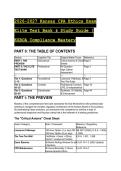
2026-2027 Kansas CPA Ethics Exam
Elite Test Bank & Study Guide |
KSBOA Compliance Mastery
PART 0: THE TABLE OF CONTENTS
Section Cognitive Tier Subject Matter Focus Reference
PART I: THE Instructional Critical Axioms & Cheat Page 2
PREVIEW Sheets
PART II: THE ELITE Professional 60-Question Page 3
TEST BANK High-Caliber
Assessment
--- --- --- ---
Tier 1: Questions Foundational Licensure, Pathways, & Page 3
1–15 Two-Tier Rules
Tier 2: Questions Complex Professional Conduct, Page 19
16–35 CPE, & Independence
Tier 3: Questions Grandmaster Synthesis, AI, Mobility, Page 44
36–60 & Enforcement
PART I: THE PREVIEW
Mastery of this comprehensive test bank represents the final threshold for elite professionals
seeking to navigate the complex regulatory architecture of the Kansas Board of Accountancy.
By internalizing these scenarios, you transcend rote compliance to achieve a state of
professional skepticism and fiduciary clarity that is the hallmark of a leading practitioner.
The "Critical Axioms" Cheat Sheet
Axiom Category Rule / Framework Statutory / Regulatory
Reference
Licensure Pathways 150-Hour Option (1 yr exp) OR HB 2573 (2026), K.S.A. 1-302a,
120-Hour Option (2 yrs exp) 1-302b
The Two-Tier Wall Certificate = Exam + Ethics; K.S.A. 1-301, 1-308
Permit = License to Practice
Exam Stamina 30-Month Rolling Window for all K.A.R. 74-1-3 (2024 Update)
4 Sections
CPE Maintenance 80 Hours Biennially; 2 Hours K.A.R. 74-4-7
Kansas-Specific Ethics
,Axiom Category Rule / Framework Statutory / Regulatory
Reference
Independence Cap 15% Revenue Threshold AICPA ET 1.230.040, K.A.R.
(5-year lookback for 74-5-101
safeguards)
PART II: THE ELITE TEST BANK
Tier 1: Foundational Syntax & Application (Questions 1–15)
Q1: A candidate in Wichita successfully passes all four sections of the Uniform CPA
Examination and achieves a score of 92% on the AICPA Professional Ethics course. The
candidate has currently completed six months of full-time experience in a public accounting firm.
According to the foundational two-tier architecture of the Kansas Accountancy Act, which
conclusion regarding the candidate’s status is MOST ACCURATE? A) The candidate is
immediately eligible for a Kansas CPA Permit to Practice and may sign audit reports. B) The
candidate is eligible to apply for a Kansas CPA Certificate and may use the "CPA" title as a
credential in non-public accounting employment. C) The candidate must wait until they complete
2,000 hours of experience before they can apply for the initial Certificate. D) The candidate is
automatically granted a "Practice Privilege" and may offer tax services to the public.
● The Answer: B (The candidate is eligible to apply for a Kansas CPA Certificate and may
use the "CPA" title as a credential in non-public accounting employment.)
● Distractor Analysis:
○ A is incorrect because the Permit to Practice requires at least one year of verified
experience under the 150-hour path or two years under the new alternative path;
six months is insufficient for full licensure.
○ C is incorrect because the Kansas Board of Accountancy issues the Certificate
upon the completion of the exam and ethics requirement; the work experience is
the secondary trigger for the Permit, not the Certificate itself.
○ D is incorrect because "Practice Privileges" are typically reserved for out-of-state
CPAs under mobility rules; a local candidate must hold a valid Kansas Permit to
offer services to the public.
The Mentor's Analysis: Kansas remains a resolute "Two-Tier" jurisdiction, creating a clear
legal firewall between academic mastery and professional authority. The Certificate is your
"Diploma of Achievement," but the Permit is your "License to Operate." Professional/Academic
Intuition: Certificates are static credentials; Permits are active licenses. Never conflate the
two when communicating your status to the public.
Q2: Following the landmark passage of House Bill 2573 in April 2026, the Kansas Board of
Accountancy updated the pathways for licensure. A student graduates from a Kansas university
with 120 credit hours and a concentration in accounting. Based on the NEW ALTERNATIVE
PATHWAY, what must this candidate provide to secure a Permit to Practice? A) Evidence of a
Master’s degree from an accredited institution. B) Verification of two years of professional
accounting experience by an active CPA. C) A score of 95% or higher on the Uniform CPA
Examination. D) Proof of five years of residency within the state of Kansas.
● The Answer: B (Verification of two years of professional accounting experience by an
active CPA.)
● Distractor Analysis:
○ A is incorrect because the entire purpose of the HB 2573 alternative is to provide a
, viable route for those without the 150-hour Master’s level education, provided they
compensate with additional experience.
○ C is incorrect because the passing score for all exam sections remains 75; the
Board does not escalate score requirements for alternative pathways.
○ D is incorrect because while Kansas has residency requirements for exam eligibility,
the duration of residency is not a substitute for the technical experience mandates
of the new law.
The Mentor's Analysis: HB 2573 is the Board’s response to the evolving national landscape of
professional entry. By allowing a 120-hour + 2-year experience model, Kansas acknowledges
that professional maturity is forged as effectively in the field as in the classroom.
Professional/Academic Intuition: Experience is the new 30. The trade-off between the
150-hour rule and the 120-hour rule is exactly one year of additional verified clinical practice.
Q3: A candidate passes their first section of the CPA Exam (AUD) on January 15, 2026. Under
the 2024-2027 regulatory updates to K.A.R. 74-1-3, what is the FINAL DATE by which the
candidate must pass the remaining three sections to avoid the expiration of their AUD credit? A)
July 15, 2027 (18 months). B) July 15, 2028 (30 months). C) January 15, 2029 (36 months). D)
December 31, 2027 (End of the next biennial period).
● The Answer: B (July 15, 2028 (30 months).)
● Distractor Analysis:
○ A is incorrect as it represents the legacy 18-month standard that was superseded
by the Board’s adoption of the 30-month rolling window in alignment with the
Uniform Accountancy Act.
○ C is incorrect because while some jurisdictions discussed a 36-month window,
Kansas codified the 30-month limit in its recent permanent regulations.
○ D is incorrect because exam credits expire based on the specific release date of the
score, not the arbitrary end of a calendar or biennial period.
The Mentor's Analysis: The expansion from 18 to 30 months is a "grace protocol" recognizing
the rigors of the Core + Discipline model. However, do not let this expanded timeline invite
complacency; the rolling nature of the window remains a ruthless mechanic of the licensure
process. Professional/Academic Intuition: 30 months is a marathon, not a sprint. Monitor
your score release dates with the same precision you apply to a client’s general ledger.
Q4: A Permit Holder in Topeka is calculating their Continuing Professional Education (CPE) for
the upcoming biennial renewal. They have completed 80 hours of technical accounting courses,
including 4 hours of a course titled "Ethics in the Federal Tax Practice: Circular 230." According
to the KSBOA Newsletter and K.A.R. 74-4-7, which statement is MOST ACCURATE? A) The
Permit Holder has met all requirements for renewal. B) The Permit Holder is deficient because
Circular 230 ethics do not satisfy the Kansas-specific ethics requirement. C) The Permit Holder
has exceeded the ethics requirement and may carry over 2 hours of ethics to the next period. D)
The Permit Holder is only required to have 1 hour of ethics if they work in private industry.
● The Answer: B (The Permit Holder is deficient because Circular 230 ethics do not satisfy
the Kansas-specific ethics requirement.)
● Distractor Analysis:
○ A is incorrect because the Board explicitly states that Circular 230 tax ethics, while
valuable for technical credit, do not meet the mandated 2-hour requirement for
ethics "directly related to the practice of public accountancy".
○ C is incorrect because while carryover is permitted for total hours (up to 20), ethics
hours must be earned anew each biennial period to ensure contemporary
compliance.
Elite Test Bank & Study Guide |
KSBOA Compliance Mastery
PART 0: THE TABLE OF CONTENTS
Section Cognitive Tier Subject Matter Focus Reference
PART I: THE Instructional Critical Axioms & Cheat Page 2
PREVIEW Sheets
PART II: THE ELITE Professional 60-Question Page 3
TEST BANK High-Caliber
Assessment
--- --- --- ---
Tier 1: Questions Foundational Licensure, Pathways, & Page 3
1–15 Two-Tier Rules
Tier 2: Questions Complex Professional Conduct, Page 19
16–35 CPE, & Independence
Tier 3: Questions Grandmaster Synthesis, AI, Mobility, Page 44
36–60 & Enforcement
PART I: THE PREVIEW
Mastery of this comprehensive test bank represents the final threshold for elite professionals
seeking to navigate the complex regulatory architecture of the Kansas Board of Accountancy.
By internalizing these scenarios, you transcend rote compliance to achieve a state of
professional skepticism and fiduciary clarity that is the hallmark of a leading practitioner.
The "Critical Axioms" Cheat Sheet
Axiom Category Rule / Framework Statutory / Regulatory
Reference
Licensure Pathways 150-Hour Option (1 yr exp) OR HB 2573 (2026), K.S.A. 1-302a,
120-Hour Option (2 yrs exp) 1-302b
The Two-Tier Wall Certificate = Exam + Ethics; K.S.A. 1-301, 1-308
Permit = License to Practice
Exam Stamina 30-Month Rolling Window for all K.A.R. 74-1-3 (2024 Update)
4 Sections
CPE Maintenance 80 Hours Biennially; 2 Hours K.A.R. 74-4-7
Kansas-Specific Ethics
,Axiom Category Rule / Framework Statutory / Regulatory
Reference
Independence Cap 15% Revenue Threshold AICPA ET 1.230.040, K.A.R.
(5-year lookback for 74-5-101
safeguards)
PART II: THE ELITE TEST BANK
Tier 1: Foundational Syntax & Application (Questions 1–15)
Q1: A candidate in Wichita successfully passes all four sections of the Uniform CPA
Examination and achieves a score of 92% on the AICPA Professional Ethics course. The
candidate has currently completed six months of full-time experience in a public accounting firm.
According to the foundational two-tier architecture of the Kansas Accountancy Act, which
conclusion regarding the candidate’s status is MOST ACCURATE? A) The candidate is
immediately eligible for a Kansas CPA Permit to Practice and may sign audit reports. B) The
candidate is eligible to apply for a Kansas CPA Certificate and may use the "CPA" title as a
credential in non-public accounting employment. C) The candidate must wait until they complete
2,000 hours of experience before they can apply for the initial Certificate. D) The candidate is
automatically granted a "Practice Privilege" and may offer tax services to the public.
● The Answer: B (The candidate is eligible to apply for a Kansas CPA Certificate and may
use the "CPA" title as a credential in non-public accounting employment.)
● Distractor Analysis:
○ A is incorrect because the Permit to Practice requires at least one year of verified
experience under the 150-hour path or two years under the new alternative path;
six months is insufficient for full licensure.
○ C is incorrect because the Kansas Board of Accountancy issues the Certificate
upon the completion of the exam and ethics requirement; the work experience is
the secondary trigger for the Permit, not the Certificate itself.
○ D is incorrect because "Practice Privileges" are typically reserved for out-of-state
CPAs under mobility rules; a local candidate must hold a valid Kansas Permit to
offer services to the public.
The Mentor's Analysis: Kansas remains a resolute "Two-Tier" jurisdiction, creating a clear
legal firewall between academic mastery and professional authority. The Certificate is your
"Diploma of Achievement," but the Permit is your "License to Operate." Professional/Academic
Intuition: Certificates are static credentials; Permits are active licenses. Never conflate the
two when communicating your status to the public.
Q2: Following the landmark passage of House Bill 2573 in April 2026, the Kansas Board of
Accountancy updated the pathways for licensure. A student graduates from a Kansas university
with 120 credit hours and a concentration in accounting. Based on the NEW ALTERNATIVE
PATHWAY, what must this candidate provide to secure a Permit to Practice? A) Evidence of a
Master’s degree from an accredited institution. B) Verification of two years of professional
accounting experience by an active CPA. C) A score of 95% or higher on the Uniform CPA
Examination. D) Proof of five years of residency within the state of Kansas.
● The Answer: B (Verification of two years of professional accounting experience by an
active CPA.)
● Distractor Analysis:
○ A is incorrect because the entire purpose of the HB 2573 alternative is to provide a
, viable route for those without the 150-hour Master’s level education, provided they
compensate with additional experience.
○ C is incorrect because the passing score for all exam sections remains 75; the
Board does not escalate score requirements for alternative pathways.
○ D is incorrect because while Kansas has residency requirements for exam eligibility,
the duration of residency is not a substitute for the technical experience mandates
of the new law.
The Mentor's Analysis: HB 2573 is the Board’s response to the evolving national landscape of
professional entry. By allowing a 120-hour + 2-year experience model, Kansas acknowledges
that professional maturity is forged as effectively in the field as in the classroom.
Professional/Academic Intuition: Experience is the new 30. The trade-off between the
150-hour rule and the 120-hour rule is exactly one year of additional verified clinical practice.
Q3: A candidate passes their first section of the CPA Exam (AUD) on January 15, 2026. Under
the 2024-2027 regulatory updates to K.A.R. 74-1-3, what is the FINAL DATE by which the
candidate must pass the remaining three sections to avoid the expiration of their AUD credit? A)
July 15, 2027 (18 months). B) July 15, 2028 (30 months). C) January 15, 2029 (36 months). D)
December 31, 2027 (End of the next biennial period).
● The Answer: B (July 15, 2028 (30 months).)
● Distractor Analysis:
○ A is incorrect as it represents the legacy 18-month standard that was superseded
by the Board’s adoption of the 30-month rolling window in alignment with the
Uniform Accountancy Act.
○ C is incorrect because while some jurisdictions discussed a 36-month window,
Kansas codified the 30-month limit in its recent permanent regulations.
○ D is incorrect because exam credits expire based on the specific release date of the
score, not the arbitrary end of a calendar or biennial period.
The Mentor's Analysis: The expansion from 18 to 30 months is a "grace protocol" recognizing
the rigors of the Core + Discipline model. However, do not let this expanded timeline invite
complacency; the rolling nature of the window remains a ruthless mechanic of the licensure
process. Professional/Academic Intuition: 30 months is a marathon, not a sprint. Monitor
your score release dates with the same precision you apply to a client’s general ledger.
Q4: A Permit Holder in Topeka is calculating their Continuing Professional Education (CPE) for
the upcoming biennial renewal. They have completed 80 hours of technical accounting courses,
including 4 hours of a course titled "Ethics in the Federal Tax Practice: Circular 230." According
to the KSBOA Newsletter and K.A.R. 74-4-7, which statement is MOST ACCURATE? A) The
Permit Holder has met all requirements for renewal. B) The Permit Holder is deficient because
Circular 230 ethics do not satisfy the Kansas-specific ethics requirement. C) The Permit Holder
has exceeded the ethics requirement and may carry over 2 hours of ethics to the next period. D)
The Permit Holder is only required to have 1 hour of ethics if they work in private industry.
● The Answer: B (The Permit Holder is deficient because Circular 230 ethics do not satisfy
the Kansas-specific ethics requirement.)
● Distractor Analysis:
○ A is incorrect because the Board explicitly states that Circular 230 tax ethics, while
valuable for technical credit, do not meet the mandated 2-hour requirement for
ethics "directly related to the practice of public accountancy".
○ C is incorrect because while carryover is permitted for total hours (up to 20), ethics
hours must be earned anew each biennial period to ensure contemporary
compliance.


