

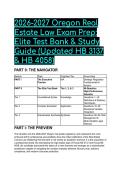
2026-2027 Oregon Real
Estate Law Exam Prep:
Elite Test Bank & Study
Guide (Updated HB 3137
& HB 4058)
PART 0: THE NAVIGATOR
Section Topic Cognitive Tier Focus Area
PART I The Executive N/A Strategic Regulatory
Preview Fundamentals &
Axioms
PART II The Elite Test Bank Tier 1, 2, & 3 60-Question
High-Performance
Gauntlet
Tier 1 Foundational Syntax Knowledge Questions 1–15:
Definitions & Statutory
Hard-Decks
Tier 2 Complex Simulation Application Questions 16–35:
Situational Variable
Integration
Tier 3 Grandmaster Synthesis Synthesis Questions 36–60: Risk
Management &
Multi-Variable Legal
Defense
PART I: THE PREVIEW
The transition into the 2026-2027 Oregon real estate regulatory cycle represents the most
profound shift in professional accountability since the initial codification of the Real Estate
License Law. Mastering this test bank is not merely an academic exercise; it is the acquisition of
a professional shield. By internalizing the high-stakes logic of House Bill 3137 and House Bill
4058, the candidate transcends the status of a mere licensee and emerges as a sophisticated
practitioner capable of navigating the complex interplay between fiduciary duty, statutory
compliance, and modern consumer protection.
,The current legal landscape in Oregon is characterized by a "Centralized Liability" model. With
the formal introduction of the Managing Principal Broker (MPB) role, the state has eliminated the
ambiguity of oversight. Every Registered Business Name (RBN) must now have a singular point
of ultimate accountability—a "CEO" of compliance who is legally responsible for every contract
signed and every dollar deposited within their firm. Simultaneously, the legislature has moved to
aggressively regulate the "shadow market" of wholesaling through HB 4058, ensuring that
equitable interests are disclosed with the same rigor as fee simple transfers.
The Regulatory Ecosystem: Authority and Enforcement
Unlike other jurisdictions that might allow for a decentralized approach to brokerage
management, Oregon Revised Statutes (ORS) Chapter 696 and the associated Oregon
Administrative Rules (OAR) Chapter 863 mandate a rigid hierarchy. This hierarchy is designed
to protect the "Ascertainable Loss" provisions of the Unlawful Trade Practices Act (UTPA), which
serves as the enforcement hammer for the Oregon Department of Justice.
Asset Class / Domain Regulatory Authority Primary Statutory Key Financial
Framework Safeguard
Residential Real Oregon Real Estate ORS 696 & OAR 863 Managing Principal
Estate Agency (OREA) Broker Oversight
Property Wholesaling Oregon Real Estate HB 4058 (2024 Laws) Mandatory Registration
Agency (OREA) & Disclosure
Tax Foreclosures County Tax Collector / HB 2089 (2025 Laws) 2/3 FMV Minimum Bid
State Treasury & Surplus Return
Client Trust Funds OREA / Licensed OAR 863-015-0255 6-Year Record
Banks Retention
The Critical Axioms Cheat Sheet
● The Seven-Day Review Mandate: An authorized principal broker must review and record
the inspection of every document of agreement (accepted, rejected, or withdrawn) within
exactly SEVEN BANKING DAYS.
● The Non-Delegable Umbrella: While an MPB may delegate supervisory tasks to a
Principal Broker (PB) via a written agreement, the MPB remains ULTIMATELY
RESPONSIBLE for all professional real estate activity conducted under the RBN.
● The 90-Day Wholesaling Definition: Wholesaling is defined by marketing residential
property held via equitable interest or option for fewer than 90 DAYS with an investment
of less than $10,000 in development.
● The 24-Month Representation Cap: Listing and buyer representation agreements are
prohibited from exceeding a term of 24 MONTHS, including all automatic renewals.
● The Fair Housing/LARRC Split: Mandatory continuing education (CE) for active renewal
now requires a 2-HOUR Fair Housing course and a 2-HOUR Law and Rule Required
Course (LARRC).
PART II: THE ELITE TEST BANK
Q1: A licensed real estate broker receives a security deposit check from a prospective tenant on
a Friday at 4:30 PM. The bank is closed on Saturday and Sunday. Monday is a legal state
holiday. According to the definition of BANKING DAYS in OAR 863-015-0003, by what time on
, which day must the broker transmit the check to their principal broker? A) By 5:00 PM on the
following Tuesday. B) Within three banking days, which would be the following Thursday. C)
Within three calendar days, which would be the following Monday. D) Immediately upon receipt,
regardless of the bank's hours.
● The Answer: B (Within three banking days, which would be the following Thursday.)
● Distractor Analysis:
○ A is incorrect: This assumes a 24-hour turnaround which is not required; the statute
provides for three banking days to allow for administrative processing.
○ C is incorrect: The use of "calendar days" is a common novice error. Oregon law
specifically utilizes "banking days" for fund transmittals to exclude weekends and
legal holidays.
○ D is incorrect: While "immediately" is professional, the legal "hard-deck" is three
banking days. Saturday, Sunday, and the Monday holiday do not count toward this
tally.
The Mentor's Analysis: The "Three Banking Day" rule (3-BD) is the operational floor for
fiduciary safety. In this scenario, since Monday is a holiday, the count begins on Tuesday (Day
1), Wednesday (Day 2), and expires on Thursday (Day 3). Professional/Academic Intuition:
In Oregon, time is measured by the bank's clock, not the sun's; weekends and holidays
are a "safe harbor" for transmittal timelines..
---
Q2: Under the 2026 mandates of House Bill 3137, a Registered Business Name (RBN) must
designate one specific individual as the Managing Principal Broker (MPB). If the RBN operates
four branch offices, which statement regarding supervisory control is MOST ACCURATE? A)
Each branch office must have its own independent Managing Principal Broker. B) The MPB
must personally review all documents from all four branches within seven banking days. C) The
MPB may delegate supervisory control to an associated Principal Broker at each branch via a
Written Supervisory Agreement. D) The MPB is only responsible for the main office; branch
offices are supervised by the OREA Commissioner.
● The Answer: C (The MPB may delegate supervisory control to an associated Principal
Broker at each branch via a Written Supervisory Agreement.)
● Distractor Analysis:
○ A is incorrect: An RBN has exactly one MPB who acts as the ultimate authority,
regardless of the number of locations.
○ B is incorrect: The MPB may delegate the task of review to an "authorized principal
broker," though they cannot delegate the ultimate liability for errors.
○ D is incorrect: This reflects a complete misunderstanding of the intracompany
hierarchy; the MPB is the supervisor of all associated offices.
The Mentor's Analysis: HB 3137 introduces the "Authorized Principal Broker" (APB) concept
as a middle-management layer. The MPB remains the "CEO," but the APB handles the granular,
daily compliance at the branch level. Professional/Academic Intuition: Authority can be
delegated through a Written Supervisory Agreement, but the MPB's accountability
umbrella is non-transferable..
Q3: A real estate wholesaler is marketing a property under an equitable interest they have held
for 45 days. They have invested $2,500 in cleaning and minor landscaping. According to the
definition in HB 4058, does this activity constitute "Residential Property Wholesaling"? A) No,
because they have made a significant financial investment in the property. B) Yes, because they
have held the interest for fewer than 90 days and invested less than $10,000. C) No, because
the interest has been held for more than 30 days. D) Yes, but only if they are not a licensed real
Estate Law Exam Prep:
Elite Test Bank & Study
Guide (Updated HB 3137
& HB 4058)
PART 0: THE NAVIGATOR
Section Topic Cognitive Tier Focus Area
PART I The Executive N/A Strategic Regulatory
Preview Fundamentals &
Axioms
PART II The Elite Test Bank Tier 1, 2, & 3 60-Question
High-Performance
Gauntlet
Tier 1 Foundational Syntax Knowledge Questions 1–15:
Definitions & Statutory
Hard-Decks
Tier 2 Complex Simulation Application Questions 16–35:
Situational Variable
Integration
Tier 3 Grandmaster Synthesis Synthesis Questions 36–60: Risk
Management &
Multi-Variable Legal
Defense
PART I: THE PREVIEW
The transition into the 2026-2027 Oregon real estate regulatory cycle represents the most
profound shift in professional accountability since the initial codification of the Real Estate
License Law. Mastering this test bank is not merely an academic exercise; it is the acquisition of
a professional shield. By internalizing the high-stakes logic of House Bill 3137 and House Bill
4058, the candidate transcends the status of a mere licensee and emerges as a sophisticated
practitioner capable of navigating the complex interplay between fiduciary duty, statutory
compliance, and modern consumer protection.
,The current legal landscape in Oregon is characterized by a "Centralized Liability" model. With
the formal introduction of the Managing Principal Broker (MPB) role, the state has eliminated the
ambiguity of oversight. Every Registered Business Name (RBN) must now have a singular point
of ultimate accountability—a "CEO" of compliance who is legally responsible for every contract
signed and every dollar deposited within their firm. Simultaneously, the legislature has moved to
aggressively regulate the "shadow market" of wholesaling through HB 4058, ensuring that
equitable interests are disclosed with the same rigor as fee simple transfers.
The Regulatory Ecosystem: Authority and Enforcement
Unlike other jurisdictions that might allow for a decentralized approach to brokerage
management, Oregon Revised Statutes (ORS) Chapter 696 and the associated Oregon
Administrative Rules (OAR) Chapter 863 mandate a rigid hierarchy. This hierarchy is designed
to protect the "Ascertainable Loss" provisions of the Unlawful Trade Practices Act (UTPA), which
serves as the enforcement hammer for the Oregon Department of Justice.
Asset Class / Domain Regulatory Authority Primary Statutory Key Financial
Framework Safeguard
Residential Real Oregon Real Estate ORS 696 & OAR 863 Managing Principal
Estate Agency (OREA) Broker Oversight
Property Wholesaling Oregon Real Estate HB 4058 (2024 Laws) Mandatory Registration
Agency (OREA) & Disclosure
Tax Foreclosures County Tax Collector / HB 2089 (2025 Laws) 2/3 FMV Minimum Bid
State Treasury & Surplus Return
Client Trust Funds OREA / Licensed OAR 863-015-0255 6-Year Record
Banks Retention
The Critical Axioms Cheat Sheet
● The Seven-Day Review Mandate: An authorized principal broker must review and record
the inspection of every document of agreement (accepted, rejected, or withdrawn) within
exactly SEVEN BANKING DAYS.
● The Non-Delegable Umbrella: While an MPB may delegate supervisory tasks to a
Principal Broker (PB) via a written agreement, the MPB remains ULTIMATELY
RESPONSIBLE for all professional real estate activity conducted under the RBN.
● The 90-Day Wholesaling Definition: Wholesaling is defined by marketing residential
property held via equitable interest or option for fewer than 90 DAYS with an investment
of less than $10,000 in development.
● The 24-Month Representation Cap: Listing and buyer representation agreements are
prohibited from exceeding a term of 24 MONTHS, including all automatic renewals.
● The Fair Housing/LARRC Split: Mandatory continuing education (CE) for active renewal
now requires a 2-HOUR Fair Housing course and a 2-HOUR Law and Rule Required
Course (LARRC).
PART II: THE ELITE TEST BANK
Q1: A licensed real estate broker receives a security deposit check from a prospective tenant on
a Friday at 4:30 PM. The bank is closed on Saturday and Sunday. Monday is a legal state
holiday. According to the definition of BANKING DAYS in OAR 863-015-0003, by what time on
, which day must the broker transmit the check to their principal broker? A) By 5:00 PM on the
following Tuesday. B) Within three banking days, which would be the following Thursday. C)
Within three calendar days, which would be the following Monday. D) Immediately upon receipt,
regardless of the bank's hours.
● The Answer: B (Within three banking days, which would be the following Thursday.)
● Distractor Analysis:
○ A is incorrect: This assumes a 24-hour turnaround which is not required; the statute
provides for three banking days to allow for administrative processing.
○ C is incorrect: The use of "calendar days" is a common novice error. Oregon law
specifically utilizes "banking days" for fund transmittals to exclude weekends and
legal holidays.
○ D is incorrect: While "immediately" is professional, the legal "hard-deck" is three
banking days. Saturday, Sunday, and the Monday holiday do not count toward this
tally.
The Mentor's Analysis: The "Three Banking Day" rule (3-BD) is the operational floor for
fiduciary safety. In this scenario, since Monday is a holiday, the count begins on Tuesday (Day
1), Wednesday (Day 2), and expires on Thursday (Day 3). Professional/Academic Intuition:
In Oregon, time is measured by the bank's clock, not the sun's; weekends and holidays
are a "safe harbor" for transmittal timelines..
---
Q2: Under the 2026 mandates of House Bill 3137, a Registered Business Name (RBN) must
designate one specific individual as the Managing Principal Broker (MPB). If the RBN operates
four branch offices, which statement regarding supervisory control is MOST ACCURATE? A)
Each branch office must have its own independent Managing Principal Broker. B) The MPB
must personally review all documents from all four branches within seven banking days. C) The
MPB may delegate supervisory control to an associated Principal Broker at each branch via a
Written Supervisory Agreement. D) The MPB is only responsible for the main office; branch
offices are supervised by the OREA Commissioner.
● The Answer: C (The MPB may delegate supervisory control to an associated Principal
Broker at each branch via a Written Supervisory Agreement.)
● Distractor Analysis:
○ A is incorrect: An RBN has exactly one MPB who acts as the ultimate authority,
regardless of the number of locations.
○ B is incorrect: The MPB may delegate the task of review to an "authorized principal
broker," though they cannot delegate the ultimate liability for errors.
○ D is incorrect: This reflects a complete misunderstanding of the intracompany
hierarchy; the MPB is the supervisor of all associated offices.
The Mentor's Analysis: HB 3137 introduces the "Authorized Principal Broker" (APB) concept
as a middle-management layer. The MPB remains the "CEO," but the APB handles the granular,
daily compliance at the branch level. Professional/Academic Intuition: Authority can be
delegated through a Written Supervisory Agreement, but the MPB's accountability
umbrella is non-transferable..
Q3: A real estate wholesaler is marketing a property under an equitable interest they have held
for 45 days. They have invested $2,500 in cleaning and minor landscaping. According to the
definition in HB 4058, does this activity constitute "Residential Property Wholesaling"? A) No,
because they have made a significant financial investment in the property. B) Yes, because they
have held the interest for fewer than 90 days and invested less than $10,000. C) No, because
the interest has been held for more than 30 days. D) Yes, but only if they are not a licensed real


