

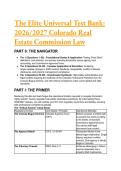
The Elite Universal Test Bank:
2026/2027 Colorado Real
Estate Commission Law
PART 0: THE NAVIGATOR
● Tier 1 (Questions 1–28) - Foundational Syntax & Application: Testing "Hard Deck"
definitions, core statutes, and primary licensing thresholds across agency, trust
accounting, and Commission-approved forms.
● Tier 2 (Questions 29–58) - Complex Application & Simulation: Analyzing
single-variable changes in 2026 contract deadlines, assignability, conflict of interest
disclosures, and property management compliance.
● Tier 3 (Questions 59–88) - Grandmaster Synthesis: High-stakes administrative and
legal conflicts requiring the synthesis of the Colorado Foreclosure Protection Act, the
Conway-Bogue doctrine, and strict ethical compliance under current global and state
standards.
PART I: THE PRIMER
Mastering this elite test bank forges the operational intuition required to navigate Colorado’s
highly specific, heavily regulated real estate landscape seamlessly. By internalizing these
2026/2027 statutes, you will insulate your firm from regulatory injunctions and liability, ensuring
elite professional competence globally.
The "Critical Axioms" Cheat Sheet:
Regulatory Domain Core Statute / Principle Operational Mandate
The Conway-Bogue Doctrine Colorado Supreme Court Brokers possess a limited right
(1957) to practice law strictly by filling
in the blanks of standard,
Commission-approved forms.
You cannot draft legal
documents from scratch.
The Agency Default C.R.S. 12-10-401 Transaction-Broker is the
default legal relationship. Single
Agency requires a written
contract. Dual agency is strictly
illegal in Colorado.
The Fiduciary Firewall CREC Rule 5.11 All Money Belonging to Others
must be deposited into a
properly titled trust/escrow
,Regulatory Domain Core Statute / Principle Operational Mandate
account, even for
non-brokerage services like
managing your own rentals if
ownership exceeds 20%.
The 2026 Assignability Bar 2026 CREC Forms Update Under the 2026 Contract to Buy
and Sell Real Estate, the
contract is explicitly
non-assignable by the buyer
unless explicitly permitted via
Additional Provisions.
The Consent Mandate CREC Rule 6.27 / CP-22 You MUST obtain written,
(2026) Informed Consent from a client
before sharing any confidential
information with your
supervising or employing
broker.
PART II: THE ELITE TEST BANK
Tier 1 - Foundational Syntax & Application
Q1: A broker is hired to list a residential property. Without a written agreement establishing a
specific relationship, the broker begins marketing the home. Based on the principles of Colorado
Brokerage Relationships, which action/conclusion is the MOST ACCURATE?
A) The broker is operating illegally and must halt marketing until an agency contract is signed.
B) The broker is acting as a dual agent by default. C) The broker is legally operating as a
Transaction-Broker. D) The broker is acting as a customer advocate.
● The Answer: C (The broker is legally operating as a Transaction-Broker.)
● Distractor Analysis:
○ A is incorrect: Marketing can commence without an agency contract if operating as
the default transaction-broker.
○ B is incorrect: Dual agency is illegal in Colorado.
○ D is incorrect: A Customer is unrepresented; a broker acts neutrally for the
transaction.
The Mentor's Analysis: Colorado law defaults to neutral facilitation. When facing a lack of written
contract, the immediate priority is assuming transaction-broker status. By utilizing
Transaction-Brokerage, you bypass the trap of assuming fiduciary duties exist automatically.
Professional/Academic Intuition: Agency requires a signature; transaction-brokerage
requires only action.
Q2: A buyer asks their agent to draft a custom addendum detailing a complex lease-back
agreement from scratch. Based on the principles of the Conway-Bogue Doctrine, which action is
the MOST APPROPRIATE?
A) The broker should draft the addendum to fulfill their fiduciary duty of obedience. B) The
broker should draft the addendum but have the employing broker sign it. C) The broker must
advise the buyer to consult legal counsel to draft the addendum. D) The broker should use a
generic form from the internet to satisfy the requirement.
● The Answer: C (The broker must advise the buyer to consult legal counsel to draft the
, addendum.)
● Distractor Analysis:
○ A is incorrect: Fiduciary duty does not override the prohibition against the
unauthorized practice of law.
○ B is incorrect: Employing brokers also cannot draft legal documents from scratch.
○ D is incorrect: Brokers must use Commission-approved forms, not generic internet
forms.
The Mentor's Analysis: Brokers have a limited right to practice law via approved forms. When
facing custom legal drafting, the immediate priority is referring to an attorney. By utilizing Rule
7.1, you bypass the trap of practicing law without a license. Professional/Academic Intuition:
Fill in the blanks; never draft the banks.
Q3: An independent broker owns a 25% stake in an LLC that owns a rental property. The broker
collects a $1,500 security deposit from a new tenant. Based on the principles of Commission
Rule 5.11, which action is the MOST ACCURATE?
A) The broker may deposit the funds into their personal checking account since they are a
part-owner. B) The broker must place the funds in the LLC's operating account. C) The broker
must deposit the funds into a separate Trust or Escrow Account. D) The broker is exempt from
accounting rules because this is a non-brokerage service.
● The Answer: C (The broker must deposit the funds into a separate Trust or Escrow
Account.)
● Distractor Analysis:
○ A is incorrect: Commingling is strictly prohibited regardless of ownership stake.
○ B is incorrect: Security deposits cannot be placed in an operating account.
○ D is incorrect: Rule 5.11 explicitly applies to non-brokerage services when
ownership exceeds 20%.
The Mentor's Analysis: Trust account rules apply beyond standard brokerage. When facing
personal property management (>20%), the immediate priority is isolating funds. By utilizing a
Trust Account, you bypass the trap of commingling. Professional/Academic Intuition: Money
belonging to others always demands a fiduciary vault.
Q4: Under the 2026 Contract to Buy and Sell Real Estate, a buyer wishes to assign their rights
to an LLC they just formed. Based on the principles of the 2026 CREC Forms, which conclusion
is MOST ACCURATE?
A) The contract is freely assignable by default. B) Assignability is permitted if the LLC shares the
same tax ID as the buyer. C) The contract is explicitly non-assignable unless permitted in the
Additional Provisions. D) The buyer must draft a new contract to change the entity.
● The Answer: C (The contract is explicitly non-assignable unless permitted in the
Additional Provisions.)
● Distractor Analysis:
○ A is incorrect: The 2026 contract explicitly reversed the default assignability
standard.
○ B is incorrect: Tax ID parity does not override the contractual restriction.
○ D is incorrect: An amend/extend or assignment clause can be used; drafting a new
contract is inefficient.
The Mentor's Analysis: Contractual control favors the seller's knowledge of the buyer. When
facing an assignment request, the immediate priority is modifying the contract provisions. By
utilizing Additional Provisions, you bypass the trap of assuming default transferability.
Professional/Academic Intuition: In 2026, assignability requires explicit permission.
Q5: A designated broker is representing a seller as a Single Agent. The seller confides they are
, facing bankruptcy and will accept $50,000 below asking. Based on Commission Position 22
(CP-22), which action is IMMEDIATELY required before discussing this with an Employing
Broker?
A) The broker must immediately inform their employing broker to mitigate firm risk. B) The
broker may share this with their employing broker without consent if it's an office policy. C) The
broker must obtain written Informed Consent before sharing this with the employing broker. D)
The broker must disclose this to all potential buyers as an adverse material fact.
● The Answer: C (The broker must obtain written Informed Consent before sharing this with
the employing broker.)
● Distractor Analysis:
○ A is incorrect: Risk mitigation does not override statutory confidentiality without
consent.
○ B is incorrect: Office policies cannot supersede the CP-22 consent mandate.
○ D is incorrect: Financial distress is confidential, not a physical adverse material fact
of the property.
The Mentor's Analysis: Confidentiality isolates the relationship to the designated broker. When
facing the need to supervise, the immediate priority is securing written consent. By utilizing
Informed Consent, you bypass the trap of breaching fiduciary secrecy. Professional/Academic
Intuition: Silence is statutory; sharing requires a signature.
Q6: A team of three brokers works under a single brokerage firm. One team member signs an
Exclusive Right-to-Sell listing as a Single Agent. Based on the principles of Colorado Brokerage
Relationships, which conclusion is MOST ACCURATE?
A) Only the signing broker is bound by agency duties. B) The team may act as
transaction-brokers for the buyer. C) All team members are bound as the designated Single
Agent for the seller. D) The other team members may act as a single agent for the buyer.
● The Answer: C (All team members are bound as the designated Single Agent for the
seller.)
● Distractor Analysis:
○ A is incorrect: Team rules stipulate the relationship binds all members of that team.
○ B is incorrect: A team cannot be an agent for one and a transaction-broker for the
other in the same transaction.
○ D is incorrect: This creates illegal dual agency within the team.
The Mentor's Analysis: Teams operate as a unified entity under agency law. When one team
member commits to a client, the immediate priority is ensuring all members honor that
allegiance. By utilizing Team Agency Parity, you bypass the trap of internal dual agency.
Professional/Academic Intuition: One team, one relationship status.
Q7: A broker is acting as a Transaction-Broker for both the buyer and seller. The buyer asks the
broker to negotiate a lower price because the inspection revealed minor flaws. Based on the
principles of Transaction-Brokerage, which action is MOST APPROPRIATE?
A) The broker must negotiate the lowest price to fulfill their duty of reasonable care. B) The
broker must refuse, as negotiating favors one party over the other. C) The broker must convey
the offer neutrally without advocating for the price reduction. D) The broker must switch to a
Single Agent status immediately.
● The Answer: C (The broker must convey the offer neutrally without advocating for the
price reduction.)
● Distractor Analysis:
○ A is incorrect: Transaction-brokers do not advocate or negotiate on behalf of either
party.
2026/2027 Colorado Real
Estate Commission Law
PART 0: THE NAVIGATOR
● Tier 1 (Questions 1–28) - Foundational Syntax & Application: Testing "Hard Deck"
definitions, core statutes, and primary licensing thresholds across agency, trust
accounting, and Commission-approved forms.
● Tier 2 (Questions 29–58) - Complex Application & Simulation: Analyzing
single-variable changes in 2026 contract deadlines, assignability, conflict of interest
disclosures, and property management compliance.
● Tier 3 (Questions 59–88) - Grandmaster Synthesis: High-stakes administrative and
legal conflicts requiring the synthesis of the Colorado Foreclosure Protection Act, the
Conway-Bogue doctrine, and strict ethical compliance under current global and state
standards.
PART I: THE PRIMER
Mastering this elite test bank forges the operational intuition required to navigate Colorado’s
highly specific, heavily regulated real estate landscape seamlessly. By internalizing these
2026/2027 statutes, you will insulate your firm from regulatory injunctions and liability, ensuring
elite professional competence globally.
The "Critical Axioms" Cheat Sheet:
Regulatory Domain Core Statute / Principle Operational Mandate
The Conway-Bogue Doctrine Colorado Supreme Court Brokers possess a limited right
(1957) to practice law strictly by filling
in the blanks of standard,
Commission-approved forms.
You cannot draft legal
documents from scratch.
The Agency Default C.R.S. 12-10-401 Transaction-Broker is the
default legal relationship. Single
Agency requires a written
contract. Dual agency is strictly
illegal in Colorado.
The Fiduciary Firewall CREC Rule 5.11 All Money Belonging to Others
must be deposited into a
properly titled trust/escrow
,Regulatory Domain Core Statute / Principle Operational Mandate
account, even for
non-brokerage services like
managing your own rentals if
ownership exceeds 20%.
The 2026 Assignability Bar 2026 CREC Forms Update Under the 2026 Contract to Buy
and Sell Real Estate, the
contract is explicitly
non-assignable by the buyer
unless explicitly permitted via
Additional Provisions.
The Consent Mandate CREC Rule 6.27 / CP-22 You MUST obtain written,
(2026) Informed Consent from a client
before sharing any confidential
information with your
supervising or employing
broker.
PART II: THE ELITE TEST BANK
Tier 1 - Foundational Syntax & Application
Q1: A broker is hired to list a residential property. Without a written agreement establishing a
specific relationship, the broker begins marketing the home. Based on the principles of Colorado
Brokerage Relationships, which action/conclusion is the MOST ACCURATE?
A) The broker is operating illegally and must halt marketing until an agency contract is signed.
B) The broker is acting as a dual agent by default. C) The broker is legally operating as a
Transaction-Broker. D) The broker is acting as a customer advocate.
● The Answer: C (The broker is legally operating as a Transaction-Broker.)
● Distractor Analysis:
○ A is incorrect: Marketing can commence without an agency contract if operating as
the default transaction-broker.
○ B is incorrect: Dual agency is illegal in Colorado.
○ D is incorrect: A Customer is unrepresented; a broker acts neutrally for the
transaction.
The Mentor's Analysis: Colorado law defaults to neutral facilitation. When facing a lack of written
contract, the immediate priority is assuming transaction-broker status. By utilizing
Transaction-Brokerage, you bypass the trap of assuming fiduciary duties exist automatically.
Professional/Academic Intuition: Agency requires a signature; transaction-brokerage
requires only action.
Q2: A buyer asks their agent to draft a custom addendum detailing a complex lease-back
agreement from scratch. Based on the principles of the Conway-Bogue Doctrine, which action is
the MOST APPROPRIATE?
A) The broker should draft the addendum to fulfill their fiduciary duty of obedience. B) The
broker should draft the addendum but have the employing broker sign it. C) The broker must
advise the buyer to consult legal counsel to draft the addendum. D) The broker should use a
generic form from the internet to satisfy the requirement.
● The Answer: C (The broker must advise the buyer to consult legal counsel to draft the
, addendum.)
● Distractor Analysis:
○ A is incorrect: Fiduciary duty does not override the prohibition against the
unauthorized practice of law.
○ B is incorrect: Employing brokers also cannot draft legal documents from scratch.
○ D is incorrect: Brokers must use Commission-approved forms, not generic internet
forms.
The Mentor's Analysis: Brokers have a limited right to practice law via approved forms. When
facing custom legal drafting, the immediate priority is referring to an attorney. By utilizing Rule
7.1, you bypass the trap of practicing law without a license. Professional/Academic Intuition:
Fill in the blanks; never draft the banks.
Q3: An independent broker owns a 25% stake in an LLC that owns a rental property. The broker
collects a $1,500 security deposit from a new tenant. Based on the principles of Commission
Rule 5.11, which action is the MOST ACCURATE?
A) The broker may deposit the funds into their personal checking account since they are a
part-owner. B) The broker must place the funds in the LLC's operating account. C) The broker
must deposit the funds into a separate Trust or Escrow Account. D) The broker is exempt from
accounting rules because this is a non-brokerage service.
● The Answer: C (The broker must deposit the funds into a separate Trust or Escrow
Account.)
● Distractor Analysis:
○ A is incorrect: Commingling is strictly prohibited regardless of ownership stake.
○ B is incorrect: Security deposits cannot be placed in an operating account.
○ D is incorrect: Rule 5.11 explicitly applies to non-brokerage services when
ownership exceeds 20%.
The Mentor's Analysis: Trust account rules apply beyond standard brokerage. When facing
personal property management (>20%), the immediate priority is isolating funds. By utilizing a
Trust Account, you bypass the trap of commingling. Professional/Academic Intuition: Money
belonging to others always demands a fiduciary vault.
Q4: Under the 2026 Contract to Buy and Sell Real Estate, a buyer wishes to assign their rights
to an LLC they just formed. Based on the principles of the 2026 CREC Forms, which conclusion
is MOST ACCURATE?
A) The contract is freely assignable by default. B) Assignability is permitted if the LLC shares the
same tax ID as the buyer. C) The contract is explicitly non-assignable unless permitted in the
Additional Provisions. D) The buyer must draft a new contract to change the entity.
● The Answer: C (The contract is explicitly non-assignable unless permitted in the
Additional Provisions.)
● Distractor Analysis:
○ A is incorrect: The 2026 contract explicitly reversed the default assignability
standard.
○ B is incorrect: Tax ID parity does not override the contractual restriction.
○ D is incorrect: An amend/extend or assignment clause can be used; drafting a new
contract is inefficient.
The Mentor's Analysis: Contractual control favors the seller's knowledge of the buyer. When
facing an assignment request, the immediate priority is modifying the contract provisions. By
utilizing Additional Provisions, you bypass the trap of assuming default transferability.
Professional/Academic Intuition: In 2026, assignability requires explicit permission.
Q5: A designated broker is representing a seller as a Single Agent. The seller confides they are
, facing bankruptcy and will accept $50,000 below asking. Based on Commission Position 22
(CP-22), which action is IMMEDIATELY required before discussing this with an Employing
Broker?
A) The broker must immediately inform their employing broker to mitigate firm risk. B) The
broker may share this with their employing broker without consent if it's an office policy. C) The
broker must obtain written Informed Consent before sharing this with the employing broker. D)
The broker must disclose this to all potential buyers as an adverse material fact.
● The Answer: C (The broker must obtain written Informed Consent before sharing this with
the employing broker.)
● Distractor Analysis:
○ A is incorrect: Risk mitigation does not override statutory confidentiality without
consent.
○ B is incorrect: Office policies cannot supersede the CP-22 consent mandate.
○ D is incorrect: Financial distress is confidential, not a physical adverse material fact
of the property.
The Mentor's Analysis: Confidentiality isolates the relationship to the designated broker. When
facing the need to supervise, the immediate priority is securing written consent. By utilizing
Informed Consent, you bypass the trap of breaching fiduciary secrecy. Professional/Academic
Intuition: Silence is statutory; sharing requires a signature.
Q6: A team of three brokers works under a single brokerage firm. One team member signs an
Exclusive Right-to-Sell listing as a Single Agent. Based on the principles of Colorado Brokerage
Relationships, which conclusion is MOST ACCURATE?
A) Only the signing broker is bound by agency duties. B) The team may act as
transaction-brokers for the buyer. C) All team members are bound as the designated Single
Agent for the seller. D) The other team members may act as a single agent for the buyer.
● The Answer: C (All team members are bound as the designated Single Agent for the
seller.)
● Distractor Analysis:
○ A is incorrect: Team rules stipulate the relationship binds all members of that team.
○ B is incorrect: A team cannot be an agent for one and a transaction-broker for the
other in the same transaction.
○ D is incorrect: This creates illegal dual agency within the team.
The Mentor's Analysis: Teams operate as a unified entity under agency law. When one team
member commits to a client, the immediate priority is ensuring all members honor that
allegiance. By utilizing Team Agency Parity, you bypass the trap of internal dual agency.
Professional/Academic Intuition: One team, one relationship status.
Q7: A broker is acting as a Transaction-Broker for both the buyer and seller. The buyer asks the
broker to negotiate a lower price because the inspection revealed minor flaws. Based on the
principles of Transaction-Brokerage, which action is MOST APPROPRIATE?
A) The broker must negotiate the lowest price to fulfill their duty of reasonable care. B) The
broker must refuse, as negotiating favors one party over the other. C) The broker must convey
the offer neutrally without advocating for the price reduction. D) The broker must switch to a
Single Agent status immediately.
● The Answer: C (The broker must convey the offer neutrally without advocating for the
price reduction.)
● Distractor Analysis:
○ A is incorrect: Transaction-brokers do not advocate or negotiate on behalf of either
party.


