

Critical Care Exam 1 Study Guide
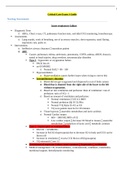
Critical Care Exam 1 Guide Nursing Assessments Acute respiratory failure Diagnostic Tests o ABGs, Chest x-rays, CT, pulmonary function tests, end tidal CO2 monitoring, bronchoscopy. Assessments o Lung sounds, work of breathing, use of accessory muscles, chest expansion, nasal flaring, respiratory rate, pulse ox Interventions o Ineffective airway clearance reposition patient o ARF Causes: pulmonary edema, atelectasis, pneumonia, COPD, asthma, ARDS, thoracic, spinal or head injuries, drug overdose, neuromuscular disorders Type 1 - hypoxemic or oxygenation failure PAO2 less th an 60 MMHG o Normal PaO2 = 80 - 100 Hypoventilation o Hyperventilation causes further issues when trying to correct this Intrapulmonary shunting o Blood did not get oxygenated and dispersed to rest of body system o Blood that is shunted from the right side of the heart to the left without oxygenation. o Based on rate ventilation and perfusion: Rate of ventilation= rate of perfusion; ratio of VQ = 1 o Based on amount of ventilation and perfusion: Normal ventilation (V) IS 4 L/MIN Normal perfusion (Q) IS 5L/Min Normal V/Q Ratio IS 4/5 or 0.8 VQ scan patient must lie for 30 minutes o Tissue hypoxia anaerobic metabolism and lactic acidosis o Normal Cardiac output 600 – 1000 ML/MIN of O2 Low cardiac output decrease O2 blood to tissues anaerobic metabolism production of lactic acid metabolic acidosis Type 2 - hypercapnic or ventilator failure PACO2 50 MM HG Increase in PaCO2 (hypercapnia) due to decrease O2 in body and CO2 can be blown off Increase in ventilation excess CO2 blown off (hypocapnia) VQ mismatch not 1:1 Assessment of respirator failure: most common hypoxemia restlessness Medical management: O2, bronchodilators, corticosteroids, ventilators, transfusion, nutritional support, hemodynamic monitoring 2 HGB 12- 16 Anemic is less than 8 HGB o Respiratory failure causes Failure to ventilate Failure to oxygenate Failure to protect airway Acute Respiratory Distress Syndrome (ARDS) Noncardiogenic pulmonary edema- pulmonary edema not caused by a cardiac problem. Diagnostic criteria o 1. PaO2/FiO2(decimal) ratio of less than 200 – PaO2 divided by Fi02 … 100 divided 21 = Optimal Ratio 476.19 ***Decreasing PA02 levels despite increased FI
Document information
- Uploaded on
- May 12, 2021
- Number of pages
- 28
- Written in
- 2020/2021
- Type
- Exam (elaborations)
- Contains
- Questions & answers


