

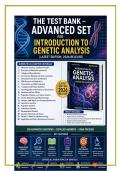
,THE TEST BANK – ADVANCED SET FOR INTRODUCTION TO
GENETIC ANALYSIS (LATEST EDITION, 2026 RELEASE)
Introduction
The Test Bank – Advanced Set for Introduction to Genetic Analysis (Latest Edition, 2026 Release) is a
comprehensive academic resource designed to support deep learning, critical thinking, and mastery of
modern genetics. Covering all Chapters 1 through 20, this advanced test bank provides a structured
collection of high-quality assessment materials aligned with the latest developments and pedagogical
approaches in genetic analysis.
This edition is carefully curated to reflect current scientific understanding, integrating classical genetics
with cutting-edge concepts such as genomics, gene regulation, molecular techniques, and bioinformatics.
Each chapter is supported by a diverse range of questions, including multiple-choice, problem-solving,
data interpretation, and application-based scenarios that challenge learners to go beyond memorization
and develop analytical proficiency.
The Advanced Set is particularly tailored for higher-level undergraduate and graduate students, as well as
educators seeking rigorous evaluation tools. It emphasizes conceptual clarity, experimental reasoning, and
real-world relevance, preparing users for both academic success and practical engagement in the field of
genetics.
By encompassing all major topics—from Mendelian inheritance and chromosome behavior to DNA
replication, gene expression, mutation, and genetic technologies—this test bank serves as a complete
companion for thorough review and assessment. Whether used for exam preparation, teaching support, or
self-study, it offers a robust framework for mastering the principles and applications of genetic analysis in
today’s rapidly evolving scientific landscape.
Preface
The Test Bank – Advanced Set for Introduction to Genetic Analysis (Latest Edition, 2026 Release) has
been developed with a clear purpose: to provide a rigorous, comprehensive, and thoughtfully structured
assessment resource that reflects the evolving landscape of genetics education. As the field continues to
expand—bridging classical principles with modern genomic technologies—there is an increasing need for
evaluation tools that not only test knowledge but also cultivate analytical depth and scientific reasoning.
This advanced test bank is designed to accompany the full scope of Chapters 1 through 20, ensuring
complete topic coverage and alignment with contemporary curricula. Each chapter has been carefully
constructed to reinforce key concepts while encouraging learners to engage with genetic problems in a
meaningful and applied manner. The questions progress in complexity, enabling users to build confidence
before tackling more challenging, integrative scenarios that mirror real-world genetic analysis.
A central goal of this resource is to move beyond rote learning. Emphasis is placed on interpretation of
experimental data, critical evaluation of hypotheses, and application of genetic principles to novel
contexts. In doing so, this test bank supports the development of skills essential for academic
advancement, research, and professional practice in the biological sciences.
,This edition also incorporates updated content reflective of recent advances in genomics, molecular
biology, and computational approaches. By integrating these developments, the test bank remains relevant
and forward-looking, equipping users with the knowledge and skills required in modern genetics.
Educators will find this resource valuable for designing assessments that challenge and inspire students,
while learners can use it as a powerful tool for self-evaluation and mastery. It is our hope that this
Advanced Set not only supports academic success but also fosters a deeper appreciation for the
complexity and significance of genetic analysis.
Table of Contents
Test Bank – Advanced Set for Introduction to Genetic Analysis ( – Griffiths et al., 2026 Release)
Chapter 1: Genetics and the Organism
Fundamental concepts, model organisms, and the scope of genetics
Chapter 2: Patterns of Inheritance
Mendelian inheritance, monohybrid and dihybrid crosses
Chapter 3: Extensions of Mendelian Genetics
Gene interactions, incomplete dominance, codominance, and epistasis
Chapter 4: The Chromosomal Basis of Inheritance
Chromosome theory, linkage, and cytological mapping
Chapter 5: Genetic Linkage, Recombination, and Mapping
Crossing over, recombination frequencies, and genetic maps
Chapter 6: Chromosome Structure and Variation
Structural rearrangements and chromosomal mutations
Chapter 7: DNA Structure and Replication
DNA composition, semiconservative replication, and enzymes involved
Chapter 8: Gene Expression: Transcription
RNA synthesis, promoters, and transcriptional control
Chapter 9: Gene Expression: Translation
Protein synthesis, ribosomes, and the genetic code
Chapter 10: Gene Regulation
Regulatory mechanisms in prokaryotes and eukaryotes
Chapter 11: Genome Structure and Organization
Genome composition, repetitive DNA, and chromosome organization
Chapter 12: Genomics and Bioinformatics
Sequencing technologies, genome analysis, and databases
Chapter 13: Recombinant DNA Technology
Cloning, vectors, PCR, and genome editing tools
Chapter 14: Mutation, DNA Repair, and Transposable Elements
Types of mutations, repair pathways, and mobile DNA
, Chapter 15: Quantitative Genetics
Polygenic traits, environmental effects, and heritability
Chapter 16: Population Genetics
Hardy–Weinberg equilibrium, genetic drift, and gene flow
Chapter 17: Evolutionary Genetics
Natural selection, molecular evolution, and speciation
Chapter 18: Developmental Genetics
Genetic control of development and differentiation
Chapter 19: Genetics of Bacteria and Viruses
Microbial genetics, gene transfer, and viral systems
Chapter 20: Genetics in Medicine and Biotechnology
Human genetics, disease applications, and ethical considerations
Chapter 1: Genetics and the Organism
Advanced Test Bank – Questions with Detailed Answers and Rationales
Question 1
A researcher chooses Saccharomyces cerevisiae over Homo sapiens to study gene regulation. Which of
the following is the most scientifically justified reason for this choice?
A. Yeast has more genes than humans
B. Yeast cells are larger and easier to observe
C. Yeast has conserved molecular pathways and short generation time
D. Yeast lacks a nucleus, simplifying gene expression
Answer: C
Rationale:
The primary reason scientists use S. cerevisiae is its conserved cellular and molecular mechanisms
shared with eukaryotes, including humans, combined with a rapid generation time and ease of genetic
manipulation. Option A is incorrect (humans have more genes). Option B is not the main reason. Option
D is false because yeast is a eukaryote with a nucleus. The concept emphasizes model organisms as
tools for extrapolating biological principles.
Question 2
Which statement best explains why genetics is considered a unifying discipline in biology?
A. It focuses only on inheritance patterns
B. It integrates molecular, cellular, and evolutionary processes
C. It replaces the need for other biological sciences
D. It is limited to DNA structure studies
Answer: B
GENETIC ANALYSIS (LATEST EDITION, 2026 RELEASE)
Introduction
The Test Bank – Advanced Set for Introduction to Genetic Analysis (Latest Edition, 2026 Release) is a
comprehensive academic resource designed to support deep learning, critical thinking, and mastery of
modern genetics. Covering all Chapters 1 through 20, this advanced test bank provides a structured
collection of high-quality assessment materials aligned with the latest developments and pedagogical
approaches in genetic analysis.
This edition is carefully curated to reflect current scientific understanding, integrating classical genetics
with cutting-edge concepts such as genomics, gene regulation, molecular techniques, and bioinformatics.
Each chapter is supported by a diverse range of questions, including multiple-choice, problem-solving,
data interpretation, and application-based scenarios that challenge learners to go beyond memorization
and develop analytical proficiency.
The Advanced Set is particularly tailored for higher-level undergraduate and graduate students, as well as
educators seeking rigorous evaluation tools. It emphasizes conceptual clarity, experimental reasoning, and
real-world relevance, preparing users for both academic success and practical engagement in the field of
genetics.
By encompassing all major topics—from Mendelian inheritance and chromosome behavior to DNA
replication, gene expression, mutation, and genetic technologies—this test bank serves as a complete
companion for thorough review and assessment. Whether used for exam preparation, teaching support, or
self-study, it offers a robust framework for mastering the principles and applications of genetic analysis in
today’s rapidly evolving scientific landscape.
Preface
The Test Bank – Advanced Set for Introduction to Genetic Analysis (Latest Edition, 2026 Release) has
been developed with a clear purpose: to provide a rigorous, comprehensive, and thoughtfully structured
assessment resource that reflects the evolving landscape of genetics education. As the field continues to
expand—bridging classical principles with modern genomic technologies—there is an increasing need for
evaluation tools that not only test knowledge but also cultivate analytical depth and scientific reasoning.
This advanced test bank is designed to accompany the full scope of Chapters 1 through 20, ensuring
complete topic coverage and alignment with contemporary curricula. Each chapter has been carefully
constructed to reinforce key concepts while encouraging learners to engage with genetic problems in a
meaningful and applied manner. The questions progress in complexity, enabling users to build confidence
before tackling more challenging, integrative scenarios that mirror real-world genetic analysis.
A central goal of this resource is to move beyond rote learning. Emphasis is placed on interpretation of
experimental data, critical evaluation of hypotheses, and application of genetic principles to novel
contexts. In doing so, this test bank supports the development of skills essential for academic
advancement, research, and professional practice in the biological sciences.
,This edition also incorporates updated content reflective of recent advances in genomics, molecular
biology, and computational approaches. By integrating these developments, the test bank remains relevant
and forward-looking, equipping users with the knowledge and skills required in modern genetics.
Educators will find this resource valuable for designing assessments that challenge and inspire students,
while learners can use it as a powerful tool for self-evaluation and mastery. It is our hope that this
Advanced Set not only supports academic success but also fosters a deeper appreciation for the
complexity and significance of genetic analysis.
Table of Contents
Test Bank – Advanced Set for Introduction to Genetic Analysis ( – Griffiths et al., 2026 Release)
Chapter 1: Genetics and the Organism
Fundamental concepts, model organisms, and the scope of genetics
Chapter 2: Patterns of Inheritance
Mendelian inheritance, monohybrid and dihybrid crosses
Chapter 3: Extensions of Mendelian Genetics
Gene interactions, incomplete dominance, codominance, and epistasis
Chapter 4: The Chromosomal Basis of Inheritance
Chromosome theory, linkage, and cytological mapping
Chapter 5: Genetic Linkage, Recombination, and Mapping
Crossing over, recombination frequencies, and genetic maps
Chapter 6: Chromosome Structure and Variation
Structural rearrangements and chromosomal mutations
Chapter 7: DNA Structure and Replication
DNA composition, semiconservative replication, and enzymes involved
Chapter 8: Gene Expression: Transcription
RNA synthesis, promoters, and transcriptional control
Chapter 9: Gene Expression: Translation
Protein synthesis, ribosomes, and the genetic code
Chapter 10: Gene Regulation
Regulatory mechanisms in prokaryotes and eukaryotes
Chapter 11: Genome Structure and Organization
Genome composition, repetitive DNA, and chromosome organization
Chapter 12: Genomics and Bioinformatics
Sequencing technologies, genome analysis, and databases
Chapter 13: Recombinant DNA Technology
Cloning, vectors, PCR, and genome editing tools
Chapter 14: Mutation, DNA Repair, and Transposable Elements
Types of mutations, repair pathways, and mobile DNA
, Chapter 15: Quantitative Genetics
Polygenic traits, environmental effects, and heritability
Chapter 16: Population Genetics
Hardy–Weinberg equilibrium, genetic drift, and gene flow
Chapter 17: Evolutionary Genetics
Natural selection, molecular evolution, and speciation
Chapter 18: Developmental Genetics
Genetic control of development and differentiation
Chapter 19: Genetics of Bacteria and Viruses
Microbial genetics, gene transfer, and viral systems
Chapter 20: Genetics in Medicine and Biotechnology
Human genetics, disease applications, and ethical considerations
Chapter 1: Genetics and the Organism
Advanced Test Bank – Questions with Detailed Answers and Rationales
Question 1
A researcher chooses Saccharomyces cerevisiae over Homo sapiens to study gene regulation. Which of
the following is the most scientifically justified reason for this choice?
A. Yeast has more genes than humans
B. Yeast cells are larger and easier to observe
C. Yeast has conserved molecular pathways and short generation time
D. Yeast lacks a nucleus, simplifying gene expression
Answer: C
Rationale:
The primary reason scientists use S. cerevisiae is its conserved cellular and molecular mechanisms
shared with eukaryotes, including humans, combined with a rapid generation time and ease of genetic
manipulation. Option A is incorrect (humans have more genes). Option B is not the main reason. Option
D is false because yeast is a eukaryote with a nucleus. The concept emphasizes model organisms as
tools for extrapolating biological principles.
Question 2
Which statement best explains why genetics is considered a unifying discipline in biology?
A. It focuses only on inheritance patterns
B. It integrates molecular, cellular, and evolutionary processes
C. It replaces the need for other biological sciences
D. It is limited to DNA structure studies
Answer: B


