

The Elite Universal Test
Bank: 2026/2027 Advanced
Practice Competency
PART 0: THE NAVIGATOR
● PART I: THE PRIMER
○ The Hook
○ The "Critical Axioms" Cheat Sheet
● PART II: THE ELITE TEST BANK
○ Tier 1 (Questions 1–28): Foundational Syntax & Application
○ Tier 2 (Questions 29–58): Complex Application & Simulation
○ Tier 3 (Questions 59–88): Grandmaster Synthesis
PART I: THE PRIMER
The transition from theoretical consumption to advanced clinical judgment represents the
definitive bottleneck in advanced practice certification. Mastering this specific elite test bank
translates directly to high-level clinical sovereignty, bypassing the liability of apprentice-level rote
memorization to forge practitioners who construct evidence-based solutions.
The "Critical Axioms" Cheat Sheet
The contemporary clinical architect must synthesize foundational pathophysiology with dynamic,
continuously updated guidelines. The table below outlines the non-negotiable updates for the
2026/2027 clinical cycle:
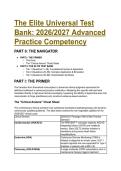
Clinical Domain 2026/2027 Paradigm Shift & Best Practice
Standard
Cardiovascular (AHA/ACC) The PREVENT™ calculator replaces ASCVD,
integrating kidney (UACR) and metabolic
metrics. Early SGLT2 inhibitor initiation is
mandatory during acute heart failure
hospitalizations.
Endocrine (ADA) Continuous Glucose Monitoring (CGM) is
initiated at diagnosis for insulin users; GLP-1
receptor agonists are now supported for Type 1
Diabetes in patients with a BMI >30.
Pulmonary (GOLD/GINA) A single moderate COPD exacerbation prior to
maintenance therapy triggers treatment
,Clinical Domain 2026/2027 Paradigm Shift & Best Practice
Standard
escalation; Dupilumab is indicated for Type 2
inflammation. Asthma relies on Track 1
(ICS-formoterol).
Geriatrics (Beers Criteria) Absolute avoidance of first-generation
antihistamines, tricyclic antidepressants
(TCAs), and non-benzodiazepine hypnotics in
older adults; Nitrofurantoin >90 days is a
high-risk flag.
Women's Health & STIs Cervical cancer screening transitions to 5-year
primary HPV testing. Lentocilin serves as the
temporary imported substitute for Bicillin L-A in
syphilis management.
PART II: THE ELITE TEST BANK
Tier 1 - Foundational Syntax & Application
Q1: An older adult patient develops generalized edema. Laboratory findings reveal severe
hypoalbuminemia. Based on the Starling equation, which physiological shift is PRIMARILY
responsible for the fluid accumulation? A) Increased capillary hydrostatic pressure B)
Decreased capillary oncotic pressure C) Increased interstitial hydrostatic pressure D)
Decreased capillary permeability
● The Answer: B (Decreased capillary oncotic pressure)
● Distractor Analysis:
○ A is incorrect: Increased hydrostatic pressure occurs in heart failure, not
hypoalbuminemia.
○ C is incorrect: Elevated interstitial hydrostatic pressure opposes fluid leaving the
capillary.
○ D is incorrect: Decreased permeability would retain fluid intravascularly.
The Mentor's Analysis: Albumin maintains plasma oncotic pull; its loss causes fluid to leak into
the interstitium. When facing peripheral edema, the immediate priority is identifying the pressure
gradient failure. By utilizing the Starling principle, the clinician bypasses the common trap of
assuming all edema is cardiogenic. Professional/Academic Intuition: Hypoalbuminemia
directly reduces the capillary oncotic pressure (πc) pulling force.
Q2: During a physical assessment for scoliosis, the patient bends forward and the spinal
curvature straightens completely. Which conclusion is MOST ACCURATE? A) The patient has
functional scoliosis. B) The patient has structural scoliosis. C) The patient has ankylosing
spondylitis. D) The patient has an acute vertebral fracture.
● The Answer: A (The patient has functional scoliosis.)
● Distractor Analysis:
○ B is incorrect: Structural scoliosis curvature remains present during forward flexion.
○ C is incorrect: Ankylosing spondylitis presents with severe restriction of lumbar
flexion, not a disappearing curve.
○ D is incorrect: A fracture presents with point tenderness and muscle spasm, not a
straightening curve.
The Mentor's Analysis: The Adam's Forward Bend Test differentiates spinal conditions. When
,facing spinal asymmetry, the immediate priority is structural evaluation. By utilizing flexion
dynamics, the clinician bypasses the common trap of over-diagnosing fixed deformities.
Professional/Academic Intuition: If the curve straightens upon flexion, the scoliosis is
functional and non-structural.
Q3: A patient taking a high-dose corticosteroid for a severe exacerbation experiences significant
metabolic changes. Which side effect is MOST LIKELY to occur? A) Severe hypoglycemia B)
Unexplained weight loss C) Hyperglycemia D) Profound bradycardia
● The Answer: C (Hyperglycemia)
● Distractor Analysis:
○ A is incorrect: Steroids induce gluconeogenesis, causing hyperglycemia, not
hypoglycemia.
○ B is incorrect: Steroids typically cause weight gain and fluid retention.
○ D is incorrect: Steroids do not directly cause bradycardia; they may cause agitation
or tachycardia.
The Mentor's Analysis: Corticosteroids possess significant endocrine side effects. When facing
systemic steroid administration, the immediate priority is metabolic monitoring. By utilizing
counter-regulatory principles, the clinician bypasses the common trap of missing iatrogenic
diabetes. Professional/Academic Intuition: Always anticipate and monitor for
glucocorticoid-induced hyperglycemia in susceptible patients.
Q4: A pediatric patient presents with round patches of alopecia and scaling on the scalp. Which
diagnosis is MOST ACCURATE? A) Tinea corporis B) Psoriasis C) Tinea capitis D) Alopecia
areata
● The Answer: C (Tinea capitis)
● Distractor Analysis:
○ A is incorrect: Tinea corporis affects the body, not the scalp.
○ B is incorrect: Psoriasis presents with thick, silvery plaques, not typical round
scaling alopecia.
○ D is incorrect: Alopecia areata presents with smooth hair loss without scaling or
inflammation.
The Mentor's Analysis: Dermatological assessment relies on specific morphological clues.
When facing pediatric hair loss, the immediate priority is identifying fungal signatures. By
utilizing lesion morphology, the clinician bypasses the common trap of misdiagnosing
autoimmune alopecia. Professional/Academic Intuition: Scaling alopecia in a pediatric patient
is tinea capitis until proven otherwise.
Q5: A caregiver is suspected of intentionally inducing illness in a child to gain medical attention.
Which diagnosis is MOST APPROPRIATE? A) Munchausen Syndrome by Proxy B)
Generalized Anxiety Disorder C) Malingering D) Somatic Symptom Disorder
● The Answer: A (Munchausen Syndrome by Proxy)
● Distractor Analysis:
○ B is incorrect: Anxiety does not involve the intentional induction of injury in a
dependent.
○ C is incorrect: Malingering involves feigning illness for external secondary gain
(e.g., money), not emotional attention.
○ D is incorrect: Somatic symptom disorder involves genuine distress over perceived
symptoms, not fabricated trauma.
The Mentor's Analysis: Psychiatric assessment requires distinguishing intent. When facing
unexplained pediatric trauma, the immediate priority is safeguarding the dependent. By utilizing
psychological profiling, the clinician bypasses the common trap of assuming organic illness.
, Professional/Academic Intuition: Munchausen Syndrome by Proxy involves deliberate harm
to a dependent solely for caregiver attention.
Q6: Based on the 2026 AHA guidelines, which screening is now recommended for all patients
presenting with stage 2 or resistant hypertension? A) Renal ultrasound B) Primary
aldosteronism screening C) 24-hour urine for metanephrines D) Genetic testing for hypertrophic
cardiomyopathy
● The Answer: B (Primary aldosteronism screening)
● Distractor Analysis:
○ A is incorrect: Renal ultrasound is used for suspected renal artery stenosis, not a
universal screen.
○ C is incorrect: Metanephrines test for pheochromocytoma, which is rare and
requires specific episodic symptoms.
○ D is incorrect: HCM screening is not related to primary resistant hypertension
management.
The Mentor's Analysis: Secondary causes of hypertension are frequently underdiagnosed.
When facing resistant hypertension, the immediate priority is ruling out endocrine drivers. By
utilizing aldosterone screening, the clinician bypasses the common trap of endless medication
titration. Professional/Academic Intuition: The 2026 AHA update mandates primary
aldosteronism screening for all resistant hypertension cases.
Q7: According to Dunphy's Circle of Caring model, which action is the FIRST prerequisite for
effective advanced practice nursing intervention? A) Establishing a comprehensive ICD-10
diagnostic code B) Delegating tasks to the interprofessional team C) Actualizing an authentic,
caring presence D) Implementing a linear "if-then" medical algorithm
● The Answer: C (Actualizing an authentic, caring presence)
● Distractor Analysis:
○ A is incorrect: The model critiques the healthcare system's overreliance on billing
codes over holistic care.
○ B is incorrect: While collaborative, delegation is not the foundational prerequisite.
○ D is incorrect: The model explicitly rejects linear, apprentice-level algorithms in
favor of synthesized care.
The Mentor's Analysis: Advanced practice requires bridging the medical and nursing paradigms.
When facing complex patient encounters, the immediate priority is establishing therapeutic trust.
By utilizing an authentic presence, the clinician bypasses the common trap of sterile clinical
detachment. Professional/Academic Intuition: Authentic caring is the operational container
that makes high-fidelity medical intervention possible.
Q8: A 68-year-old patient with major depressive disorder is prescribed amitriptyline. Based on
the 2026 Beers Criteria, which action is MOST APPROPRIATE? A) Maintain the dose to
prevent depression relapse. B) Discontinue the medication due to high anticholinergic risk. C)
Switch the patient to a first-generation antihistamine for sleep. D) Increase the dose to achieve
a faster therapeutic index.
● The Answer: B (Discontinue the medication due to high anticholinergic risk.)
● Distractor Analysis:
○ A is incorrect: TCAs are high-risk medications in older adults and should generally
be avoided.
○ C is incorrect: First-generation antihistamines are also explicitly restricted under the
Beers Criteria.
○ D is incorrect: Increasing the dose amplifies the severe risk of delirium and falls.
The Mentor's Analysis: Geriatric prescribing requires aggressive deprescribing of harmful
Bank: 2026/2027 Advanced
Practice Competency
PART 0: THE NAVIGATOR
● PART I: THE PRIMER
○ The Hook
○ The "Critical Axioms" Cheat Sheet
● PART II: THE ELITE TEST BANK
○ Tier 1 (Questions 1–28): Foundational Syntax & Application
○ Tier 2 (Questions 29–58): Complex Application & Simulation
○ Tier 3 (Questions 59–88): Grandmaster Synthesis
PART I: THE PRIMER
The transition from theoretical consumption to advanced clinical judgment represents the
definitive bottleneck in advanced practice certification. Mastering this specific elite test bank
translates directly to high-level clinical sovereignty, bypassing the liability of apprentice-level rote
memorization to forge practitioners who construct evidence-based solutions.
The "Critical Axioms" Cheat Sheet
The contemporary clinical architect must synthesize foundational pathophysiology with dynamic,
continuously updated guidelines. The table below outlines the non-negotiable updates for the
2026/2027 clinical cycle:
Clinical Domain 2026/2027 Paradigm Shift & Best Practice
Standard
Cardiovascular (AHA/ACC) The PREVENT™ calculator replaces ASCVD,
integrating kidney (UACR) and metabolic
metrics. Early SGLT2 inhibitor initiation is
mandatory during acute heart failure
hospitalizations.
Endocrine (ADA) Continuous Glucose Monitoring (CGM) is
initiated at diagnosis for insulin users; GLP-1
receptor agonists are now supported for Type 1
Diabetes in patients with a BMI >30.
Pulmonary (GOLD/GINA) A single moderate COPD exacerbation prior to
maintenance therapy triggers treatment
,Clinical Domain 2026/2027 Paradigm Shift & Best Practice
Standard
escalation; Dupilumab is indicated for Type 2
inflammation. Asthma relies on Track 1
(ICS-formoterol).
Geriatrics (Beers Criteria) Absolute avoidance of first-generation
antihistamines, tricyclic antidepressants
(TCAs), and non-benzodiazepine hypnotics in
older adults; Nitrofurantoin >90 days is a
high-risk flag.
Women's Health & STIs Cervical cancer screening transitions to 5-year
primary HPV testing. Lentocilin serves as the
temporary imported substitute for Bicillin L-A in
syphilis management.
PART II: THE ELITE TEST BANK
Tier 1 - Foundational Syntax & Application
Q1: An older adult patient develops generalized edema. Laboratory findings reveal severe
hypoalbuminemia. Based on the Starling equation, which physiological shift is PRIMARILY
responsible for the fluid accumulation? A) Increased capillary hydrostatic pressure B)
Decreased capillary oncotic pressure C) Increased interstitial hydrostatic pressure D)
Decreased capillary permeability
● The Answer: B (Decreased capillary oncotic pressure)
● Distractor Analysis:
○ A is incorrect: Increased hydrostatic pressure occurs in heart failure, not
hypoalbuminemia.
○ C is incorrect: Elevated interstitial hydrostatic pressure opposes fluid leaving the
capillary.
○ D is incorrect: Decreased permeability would retain fluid intravascularly.
The Mentor's Analysis: Albumin maintains plasma oncotic pull; its loss causes fluid to leak into
the interstitium. When facing peripheral edema, the immediate priority is identifying the pressure
gradient failure. By utilizing the Starling principle, the clinician bypasses the common trap of
assuming all edema is cardiogenic. Professional/Academic Intuition: Hypoalbuminemia
directly reduces the capillary oncotic pressure (πc) pulling force.
Q2: During a physical assessment for scoliosis, the patient bends forward and the spinal
curvature straightens completely. Which conclusion is MOST ACCURATE? A) The patient has
functional scoliosis. B) The patient has structural scoliosis. C) The patient has ankylosing
spondylitis. D) The patient has an acute vertebral fracture.
● The Answer: A (The patient has functional scoliosis.)
● Distractor Analysis:
○ B is incorrect: Structural scoliosis curvature remains present during forward flexion.
○ C is incorrect: Ankylosing spondylitis presents with severe restriction of lumbar
flexion, not a disappearing curve.
○ D is incorrect: A fracture presents with point tenderness and muscle spasm, not a
straightening curve.
The Mentor's Analysis: The Adam's Forward Bend Test differentiates spinal conditions. When
,facing spinal asymmetry, the immediate priority is structural evaluation. By utilizing flexion
dynamics, the clinician bypasses the common trap of over-diagnosing fixed deformities.
Professional/Academic Intuition: If the curve straightens upon flexion, the scoliosis is
functional and non-structural.
Q3: A patient taking a high-dose corticosteroid for a severe exacerbation experiences significant
metabolic changes. Which side effect is MOST LIKELY to occur? A) Severe hypoglycemia B)
Unexplained weight loss C) Hyperglycemia D) Profound bradycardia
● The Answer: C (Hyperglycemia)
● Distractor Analysis:
○ A is incorrect: Steroids induce gluconeogenesis, causing hyperglycemia, not
hypoglycemia.
○ B is incorrect: Steroids typically cause weight gain and fluid retention.
○ D is incorrect: Steroids do not directly cause bradycardia; they may cause agitation
or tachycardia.
The Mentor's Analysis: Corticosteroids possess significant endocrine side effects. When facing
systemic steroid administration, the immediate priority is metabolic monitoring. By utilizing
counter-regulatory principles, the clinician bypasses the common trap of missing iatrogenic
diabetes. Professional/Academic Intuition: Always anticipate and monitor for
glucocorticoid-induced hyperglycemia in susceptible patients.
Q4: A pediatric patient presents with round patches of alopecia and scaling on the scalp. Which
diagnosis is MOST ACCURATE? A) Tinea corporis B) Psoriasis C) Tinea capitis D) Alopecia
areata
● The Answer: C (Tinea capitis)
● Distractor Analysis:
○ A is incorrect: Tinea corporis affects the body, not the scalp.
○ B is incorrect: Psoriasis presents with thick, silvery plaques, not typical round
scaling alopecia.
○ D is incorrect: Alopecia areata presents with smooth hair loss without scaling or
inflammation.
The Mentor's Analysis: Dermatological assessment relies on specific morphological clues.
When facing pediatric hair loss, the immediate priority is identifying fungal signatures. By
utilizing lesion morphology, the clinician bypasses the common trap of misdiagnosing
autoimmune alopecia. Professional/Academic Intuition: Scaling alopecia in a pediatric patient
is tinea capitis until proven otherwise.
Q5: A caregiver is suspected of intentionally inducing illness in a child to gain medical attention.
Which diagnosis is MOST APPROPRIATE? A) Munchausen Syndrome by Proxy B)
Generalized Anxiety Disorder C) Malingering D) Somatic Symptom Disorder
● The Answer: A (Munchausen Syndrome by Proxy)
● Distractor Analysis:
○ B is incorrect: Anxiety does not involve the intentional induction of injury in a
dependent.
○ C is incorrect: Malingering involves feigning illness for external secondary gain
(e.g., money), not emotional attention.
○ D is incorrect: Somatic symptom disorder involves genuine distress over perceived
symptoms, not fabricated trauma.
The Mentor's Analysis: Psychiatric assessment requires distinguishing intent. When facing
unexplained pediatric trauma, the immediate priority is safeguarding the dependent. By utilizing
psychological profiling, the clinician bypasses the common trap of assuming organic illness.
, Professional/Academic Intuition: Munchausen Syndrome by Proxy involves deliberate harm
to a dependent solely for caregiver attention.
Q6: Based on the 2026 AHA guidelines, which screening is now recommended for all patients
presenting with stage 2 or resistant hypertension? A) Renal ultrasound B) Primary
aldosteronism screening C) 24-hour urine for metanephrines D) Genetic testing for hypertrophic
cardiomyopathy
● The Answer: B (Primary aldosteronism screening)
● Distractor Analysis:
○ A is incorrect: Renal ultrasound is used for suspected renal artery stenosis, not a
universal screen.
○ C is incorrect: Metanephrines test for pheochromocytoma, which is rare and
requires specific episodic symptoms.
○ D is incorrect: HCM screening is not related to primary resistant hypertension
management.
The Mentor's Analysis: Secondary causes of hypertension are frequently underdiagnosed.
When facing resistant hypertension, the immediate priority is ruling out endocrine drivers. By
utilizing aldosterone screening, the clinician bypasses the common trap of endless medication
titration. Professional/Academic Intuition: The 2026 AHA update mandates primary
aldosteronism screening for all resistant hypertension cases.
Q7: According to Dunphy's Circle of Caring model, which action is the FIRST prerequisite for
effective advanced practice nursing intervention? A) Establishing a comprehensive ICD-10
diagnostic code B) Delegating tasks to the interprofessional team C) Actualizing an authentic,
caring presence D) Implementing a linear "if-then" medical algorithm
● The Answer: C (Actualizing an authentic, caring presence)
● Distractor Analysis:
○ A is incorrect: The model critiques the healthcare system's overreliance on billing
codes over holistic care.
○ B is incorrect: While collaborative, delegation is not the foundational prerequisite.
○ D is incorrect: The model explicitly rejects linear, apprentice-level algorithms in
favor of synthesized care.
The Mentor's Analysis: Advanced practice requires bridging the medical and nursing paradigms.
When facing complex patient encounters, the immediate priority is establishing therapeutic trust.
By utilizing an authentic presence, the clinician bypasses the common trap of sterile clinical
detachment. Professional/Academic Intuition: Authentic caring is the operational container
that makes high-fidelity medical intervention possible.
Q8: A 68-year-old patient with major depressive disorder is prescribed amitriptyline. Based on
the 2026 Beers Criteria, which action is MOST APPROPRIATE? A) Maintain the dose to
prevent depression relapse. B) Discontinue the medication due to high anticholinergic risk. C)
Switch the patient to a first-generation antihistamine for sleep. D) Increase the dose to achieve
a faster therapeutic index.
● The Answer: B (Discontinue the medication due to high anticholinergic risk.)
● Distractor Analysis:
○ A is incorrect: TCAs are high-risk medications in older adults and should generally
be avoided.
○ C is incorrect: First-generation antihistamines are also explicitly restricted under the
Beers Criteria.
○ D is incorrect: Increasing the dose amplifies the severe risk of delirium and falls.
The Mentor's Analysis: Geriatric prescribing requires aggressive deprescribing of harmful


