

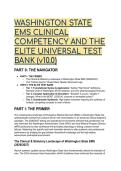
WASHINGTON STATE
EMS CLINICAL
COMPETENCY AND THE
ELITE UNIVERSAL TEST
BANK (v10.0)
PART 0: THE NAVIGATOR
● PART I: THE PRIMER
○ The Clinical & Statutory Landscape of Washington State EMS (2026/2027)
○ The "Critical Axioms" Cheat Sheet: Master Structural Logic
● PART II: THE ELITE TEST BANK
○ Tier 1: Foundational Syntax & Application: Testing "Hard Deck" definitions,
Revised Code of Washington (RCW) statutes, and core pharmacological formulas.
○ Tier 2: Complex Application & Simulation: "Situation X occurs. Variable Y
changes. What is the MOST LOGICAL outcome or immediate action?"
○ Tier 3: Grandmaster Synthesis: High-stakes scenarios requiring the synthesis of
multiple, competing concepts to avert a failure.
PART I: THE PRIMER
The contemporary landscape of Emergency Medical Services (EMS) in Washington State has
systematically evolved from protocol-driven rote memorization to an advanced clinical judgment
paradigm. The 2026/2027 testing and operational environments demand that practitioners not
only memorize the Washington Administrative Code (WAC) and local Medical Program Director
(MPD) protocols but also synthesize first-principles physiology to debug complex human
failures. Mastering this specific test bank translates directly to elite academic and professional
performance by bridging the gap between theoretical knowledge and the high-stakes,
autonomous prehospital environment.
The Clinical & Statutory Landscape of Washington State EMS
(2026/2027)
Recent systemic updates across Washington State have fundamentally altered the standard of
care. The 2025 American Heart Association (AHA) Guidelines have reinforced the necessity of
,continuous, high-performance human teams, explicitly advising against the routine use of
mechanical CPR devices in adult out-of-hospital cardiac arrest (OHCA) and mandating a 30:2
compression-to-ventilation ratio prior to advanced airway placement. Furthermore, the State of
Washington Prehospital Trauma Triage Destination Procedure (DOH 530-143) and Cardiac
Triage Destination Procedure (DOH 346-182) have imposed strict mathematical
thresholds—such as Glasgow Coma Scale (GCS) motor scores and Thrombolysis in Myocardial
Infarction (TIMI)-equivalent risk factors—to dictate bypass routing to definitive care.
Pharmacologically, the integration of Ketamine as the sole induction agent for drug-assisted
intubation (DAI), the introduction of Droperidol for behavioral emergencies, and the strict
parameters for Tranexamic Acid (TXA) and Cyanokit (Hydroxocobalamin) administration
demand absolute precision. Clinicians must also navigate complex legal frameworks, including
the absolute mandate to report vulnerable adult and child abuse directly to the Department of
Social and Health Services (DSHS) or law enforcement (RCW 26.44.030, RCW 74.34.035), the
honoring of bright green Portable Orders for Life-Sustaining Treatment (POLST) forms (RCW
43.70.480), and compliance with the Safe Haven newborn laws.
The "Critical Axioms" Cheat Sheet
Core Clinical/Legal Domain Washington Standard / Clinical Real-World Implication
Metric
AHA 2025: CPR Metrics 30:2 ratio maintained until Continuous compressions
advanced airway is placed; without an airway result in
routine mechanical CPR is profound hypoxia. Machines do
contraindicated. Neonatal ratio not replace high-performance
is strictly 3:1. human teams.
Trauma Triage (Red Criteria) Transport to closest Level I or II Definitive surgical intervention
trauma service within 30 mins if dictates survival. Local
GCS motor <6, RR <10 or >29, stabilization of a ruptured
or SpO2 <90%. spleen is a lethal delay.
Cardiac Triage (High Risk) Age ≥ 55 + 3 CAD risk factors, Multiple comorbidities in an
Aspirin in last 7 days, or ≥2 older patient equal a fast-pass
anginal events in 24h. to the Cath Lab, requiring Level
I or II transport.
Stroke Triage (LAMS) FAST positive ➔ Calculate Time is brain. Mechanical
LAMS. If LKW < 24 hrs + LAMS thrombectomy at a specialized
≥ 4 (LVO) ➔ Bypass for center is required for
Thrombectomy Center if ≤ 15 late-presenting large vessel
mins extra travel. occlusions.
TXA Administration Age ≥16, <3 hours from injury, You must stop the fibrinolytic
SBP ≤90 mmHg or HR >110 cascade immediately in
bpm. Dose: 1g IV/IO over 10 hemorrhagic shock; late
mins. administration worsens
mortality.
Sepsis Alert Protocol Suspected infection + ETCO2 < End-tidal CO2 is the ultimate
26 mmHg, MAP < 65 mmHg, or cellular distress signal. Low
HR >90 + RR >22 (qSOFA ETCO2 in a normoventilating
deprecated). patient equals hypoperfusion.
, Core Clinical/Legal Domain Washington Standard / Clinical Real-World Implication
Metric
Mandatory Reporting Must report child/vulnerable Reporting to an ED nurse does
adult abuse directly to DSHS or not fulfill your legal obligation.
Law Enforcement (RCW You are the mandated statutory
26.44..34.035). barrier against further abuse.
POLST Form Legality Bright green form; dictates A valid POLST overrides frantic
end-of-life care legally across family demands. It is an active
all settings (RCW 43.70.480). medical order, not a
suggestion.
Ketamine Integration Ketamine (2 mg/kg) is the Hemodynamic stability during
primary induction agent for DAI. airway management is
4 mg/kg IM for behavioral paramount; Ketamine
agitation. preserves the catecholamine
drive.
PART II: THE ELITE TEST BANK
Tier 1: Foundational Syntax & Application
Q1: You are treating a 45-year-old male in out-of-hospital cardiac arrest (OHCA). Prior to the
placement of an advanced airway, your team is performing manual compressions. Based on the
2025 AHA Guidelines, which compression-to-ventilation ratio is the MOST ACCURATE? A)
Continuous compressions with asynchronous ventilations every 6 seconds B) 15:2 ratio to
maximize oxygenation C) 30:2 ratio with pauses for ventilations to ensure adequate chest rise
D) Mechanical CPR deployment immediately upon patient contact
● The Answer: C (30:2 ratio with pauses for ventilations to ensure adequate chest rise)
● Distractor Analysis:
○ A is incorrect: Asynchronous ventilations are reserved strictly for patients after an
advanced airway is successfully placed.
○ B is incorrect: The 15:2 ratio is the standard for pediatric two-rescuer CPR, not
adult OHCA.
○ D is incorrect: The 2025 AHA Guidelines explicitly advise against the routine use of
mechanical CPR devices, reserving them only for highly specific, challenging
environments.
The Mentor's Analysis: Recent resuscitation science proves that rescuers frequently fail to
deliver adequate tidal volume during continuous compressions without a secure airway. When
facing early OHCA, the immediate priority is synchronous 30:2 compressions to guarantee
alveolar expansion. By utilizing targeted pauses, you bypass the common trap of ventilatory
failure. Professional/Academic Intuition: Air requires space; pause to breathe until the tube
is secure.
Q2: You arrive on scene for a 72-year-old female in a skilled nursing facility. She is pulseless
and apneic. The nursing staff hands you a bright green Washington State form signed by a
physician, with "Part A: DNAR" selected. The patient's daughter is present and screaming to
IMMEDIATELY start CPR. Based on Washington State law (RCW 43.70.480), what is the
MOST APPROPRIATE action? A) Initiate CPR because family preference supersedes the
document on scene B) Contact Medical Control for permission to honor the document C)
Withhold resuscitative efforts and honor the bright green POLST form D) Initiate CPR but
EMS CLINICAL
COMPETENCY AND THE
ELITE UNIVERSAL TEST
BANK (v10.0)
PART 0: THE NAVIGATOR
● PART I: THE PRIMER
○ The Clinical & Statutory Landscape of Washington State EMS (2026/2027)
○ The "Critical Axioms" Cheat Sheet: Master Structural Logic
● PART II: THE ELITE TEST BANK
○ Tier 1: Foundational Syntax & Application: Testing "Hard Deck" definitions,
Revised Code of Washington (RCW) statutes, and core pharmacological formulas.
○ Tier 2: Complex Application & Simulation: "Situation X occurs. Variable Y
changes. What is the MOST LOGICAL outcome or immediate action?"
○ Tier 3: Grandmaster Synthesis: High-stakes scenarios requiring the synthesis of
multiple, competing concepts to avert a failure.
PART I: THE PRIMER
The contemporary landscape of Emergency Medical Services (EMS) in Washington State has
systematically evolved from protocol-driven rote memorization to an advanced clinical judgment
paradigm. The 2026/2027 testing and operational environments demand that practitioners not
only memorize the Washington Administrative Code (WAC) and local Medical Program Director
(MPD) protocols but also synthesize first-principles physiology to debug complex human
failures. Mastering this specific test bank translates directly to elite academic and professional
performance by bridging the gap between theoretical knowledge and the high-stakes,
autonomous prehospital environment.
The Clinical & Statutory Landscape of Washington State EMS
(2026/2027)
Recent systemic updates across Washington State have fundamentally altered the standard of
care. The 2025 American Heart Association (AHA) Guidelines have reinforced the necessity of
,continuous, high-performance human teams, explicitly advising against the routine use of
mechanical CPR devices in adult out-of-hospital cardiac arrest (OHCA) and mandating a 30:2
compression-to-ventilation ratio prior to advanced airway placement. Furthermore, the State of
Washington Prehospital Trauma Triage Destination Procedure (DOH 530-143) and Cardiac
Triage Destination Procedure (DOH 346-182) have imposed strict mathematical
thresholds—such as Glasgow Coma Scale (GCS) motor scores and Thrombolysis in Myocardial
Infarction (TIMI)-equivalent risk factors—to dictate bypass routing to definitive care.
Pharmacologically, the integration of Ketamine as the sole induction agent for drug-assisted
intubation (DAI), the introduction of Droperidol for behavioral emergencies, and the strict
parameters for Tranexamic Acid (TXA) and Cyanokit (Hydroxocobalamin) administration
demand absolute precision. Clinicians must also navigate complex legal frameworks, including
the absolute mandate to report vulnerable adult and child abuse directly to the Department of
Social and Health Services (DSHS) or law enforcement (RCW 26.44.030, RCW 74.34.035), the
honoring of bright green Portable Orders for Life-Sustaining Treatment (POLST) forms (RCW
43.70.480), and compliance with the Safe Haven newborn laws.
The "Critical Axioms" Cheat Sheet
Core Clinical/Legal Domain Washington Standard / Clinical Real-World Implication
Metric
AHA 2025: CPR Metrics 30:2 ratio maintained until Continuous compressions
advanced airway is placed; without an airway result in
routine mechanical CPR is profound hypoxia. Machines do
contraindicated. Neonatal ratio not replace high-performance
is strictly 3:1. human teams.
Trauma Triage (Red Criteria) Transport to closest Level I or II Definitive surgical intervention
trauma service within 30 mins if dictates survival. Local
GCS motor <6, RR <10 or >29, stabilization of a ruptured
or SpO2 <90%. spleen is a lethal delay.
Cardiac Triage (High Risk) Age ≥ 55 + 3 CAD risk factors, Multiple comorbidities in an
Aspirin in last 7 days, or ≥2 older patient equal a fast-pass
anginal events in 24h. to the Cath Lab, requiring Level
I or II transport.
Stroke Triage (LAMS) FAST positive ➔ Calculate Time is brain. Mechanical
LAMS. If LKW < 24 hrs + LAMS thrombectomy at a specialized
≥ 4 (LVO) ➔ Bypass for center is required for
Thrombectomy Center if ≤ 15 late-presenting large vessel
mins extra travel. occlusions.
TXA Administration Age ≥16, <3 hours from injury, You must stop the fibrinolytic
SBP ≤90 mmHg or HR >110 cascade immediately in
bpm. Dose: 1g IV/IO over 10 hemorrhagic shock; late
mins. administration worsens
mortality.
Sepsis Alert Protocol Suspected infection + ETCO2 < End-tidal CO2 is the ultimate
26 mmHg, MAP < 65 mmHg, or cellular distress signal. Low
HR >90 + RR >22 (qSOFA ETCO2 in a normoventilating
deprecated). patient equals hypoperfusion.
, Core Clinical/Legal Domain Washington Standard / Clinical Real-World Implication
Metric
Mandatory Reporting Must report child/vulnerable Reporting to an ED nurse does
adult abuse directly to DSHS or not fulfill your legal obligation.
Law Enforcement (RCW You are the mandated statutory
26.44..34.035). barrier against further abuse.
POLST Form Legality Bright green form; dictates A valid POLST overrides frantic
end-of-life care legally across family demands. It is an active
all settings (RCW 43.70.480). medical order, not a
suggestion.
Ketamine Integration Ketamine (2 mg/kg) is the Hemodynamic stability during
primary induction agent for DAI. airway management is
4 mg/kg IM for behavioral paramount; Ketamine
agitation. preserves the catecholamine
drive.
PART II: THE ELITE TEST BANK
Tier 1: Foundational Syntax & Application
Q1: You are treating a 45-year-old male in out-of-hospital cardiac arrest (OHCA). Prior to the
placement of an advanced airway, your team is performing manual compressions. Based on the
2025 AHA Guidelines, which compression-to-ventilation ratio is the MOST ACCURATE? A)
Continuous compressions with asynchronous ventilations every 6 seconds B) 15:2 ratio to
maximize oxygenation C) 30:2 ratio with pauses for ventilations to ensure adequate chest rise
D) Mechanical CPR deployment immediately upon patient contact
● The Answer: C (30:2 ratio with pauses for ventilations to ensure adequate chest rise)
● Distractor Analysis:
○ A is incorrect: Asynchronous ventilations are reserved strictly for patients after an
advanced airway is successfully placed.
○ B is incorrect: The 15:2 ratio is the standard for pediatric two-rescuer CPR, not
adult OHCA.
○ D is incorrect: The 2025 AHA Guidelines explicitly advise against the routine use of
mechanical CPR devices, reserving them only for highly specific, challenging
environments.
The Mentor's Analysis: Recent resuscitation science proves that rescuers frequently fail to
deliver adequate tidal volume during continuous compressions without a secure airway. When
facing early OHCA, the immediate priority is synchronous 30:2 compressions to guarantee
alveolar expansion. By utilizing targeted pauses, you bypass the common trap of ventilatory
failure. Professional/Academic Intuition: Air requires space; pause to breathe until the tube
is secure.
Q2: You arrive on scene for a 72-year-old female in a skilled nursing facility. She is pulseless
and apneic. The nursing staff hands you a bright green Washington State form signed by a
physician, with "Part A: DNAR" selected. The patient's daughter is present and screaming to
IMMEDIATELY start CPR. Based on Washington State law (RCW 43.70.480), what is the
MOST APPROPRIATE action? A) Initiate CPR because family preference supersedes the
document on scene B) Contact Medical Control for permission to honor the document C)
Withhold resuscitative efforts and honor the bright green POLST form D) Initiate CPR but


