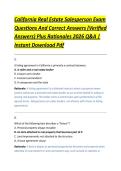
CALIFORNIA REAL ESTATE SALESPERSON EXAMINATION – PRACTICE
QUESTIONS AND CORRECT ANSWERS (VERIFIED ANSWERS) PLUS
RATIONALES 2026 Q&A | INSTANT DOWNLOAD PDF.
*CORE DOMAINS*
*Property Ownership and Land Use*
*Laws of Agency and Ethics*
*Valuation and Market Analysis*
*Financing and Mortgages*
*Transfer of Property and Deeds*
*Practice of Real Estate and Disclosures*
*Contracts and Escrow*
*INTRODUCTION*
*The purpose of this examination is to evaluate the competency and readine
candidates seeking licensure as real estate salespersons in the State of
California. It assesses a broad spectrum of fundamental knowledge, includi
property ownership, agency relationships, and state-specific regulatory
requirements. The assessment is structured using a combination of multiple
questions and complex, scenario-based vignettes designed to simulate real-
real estate transactions. Candidates must demonstrate proficiency in ethic
decision-making and the practical application of legal principles. This ex
emphasizes critical thinking and professional judgment, ensuring that
practitioners can effectively protect the public interest while navigating
complexities of modern real estate markets.*
1. Which of the following is considered real property?
A. Trade fixtures used in a business
B. A promissory note secured by a deed of trust
,C. Stock in a mutual water company
D. Leasehold estates in residential units
🟢 C. Stock in a mutual water company
🔴 RATIONALE: Under California law, stock in a mutual water company is
appurtenant to the land and is therefore defined as real property, whereas trade
fixtures and notes are typically personal property.
2. A broker represents a seller but fails to disclose to a potential buyer that the
property has a known structural defect. This is an example of:
A. Puffing
B. Negative fraud
C. Innocent misrepresentation
D. Caveat emptor
🟢 B. Negative fraud
🔴 RATIONALE: Negative fraud, or deceit, occurs when a licensee remains silent
regarding a material fact that should be disclosed, effectively concealing a defect from
the buyer.
3. In the appraisal of a 40-year-old residential property, the appraiser would likely
give the most weight to which approach?
A. Cost approach
B. Income approach
C. Sales comparison approach
D. Replacement cost approach
,🟢 C. Sales comparison approach
🔴 RATIONALE: The sales comparison approach is the most reliable method for
valuing older residential properties because it relies on recent market data of similar
properties rather than construction costs.
4. An agency relationship is most commonly terminated by:
A. Estoppel
B. Performance
C. Ratification
D. Subordination
🟢 B. Performance
🔴 RATIONALE: Completing the object of the agency, such as closing the sale of the
property, is the natural and most common way to terminate the relationship through
performance.
5. A property owner grants a neighbor the right to use a driveway to reach the
neighbor's garage. This is known as an:
A. Easement in gross
B. Easement appurtenant
C. Encroachment
D. Order of attachment
🟢 B. Easement appurtenant
🔴 RATIONALE: An easement appurtenant "runs with the land" and benefits an
adjacent parcel (the dominant tenement), providing a right of way over the servient
tenement.
, 6. Under the Truth in Lending Act (Regulation Z), which of the following must be
disclosed to a borrower?
A. The appraisal fee
B. The credit report fee
C. The annual percentage rate (APR)
D. The title insurance premium
🟢 C. The annual percentage rate (APR)
🔴 RATIONALE: Regulation Z requires the disclosure of the APR, which represents
the total cost of credit to the consumer expressed as an annual rate.
7. A listing agreement where the seller retains the right to sell the property
personally without paying a commission to the broker is called an:
A. Exclusive Right to Sell Listing
B. Net Listing
C. Exclusive Agency Listing
D. Open Listing
🟢 C. Exclusive Agency Listing
🔴 RATIONALE: In an Exclusive Agency Listing, one broker is authorized to act as
the agent, but the owner can sell the property independently without owing a
commission.
8. Which document is used to transfer title to personal property?
A. Grant deed
B. Quitclaim deed
QUESTIONS AND CORRECT ANSWERS (VERIFIED ANSWERS) PLUS
RATIONALES 2026 Q&A | INSTANT DOWNLOAD PDF.
*CORE DOMAINS*
*Property Ownership and Land Use*
*Laws of Agency and Ethics*
*Valuation and Market Analysis*
*Financing and Mortgages*
*Transfer of Property and Deeds*
*Practice of Real Estate and Disclosures*
*Contracts and Escrow*
*INTRODUCTION*
*The purpose of this examination is to evaluate the competency and readine
candidates seeking licensure as real estate salespersons in the State of
California. It assesses a broad spectrum of fundamental knowledge, includi
property ownership, agency relationships, and state-specific regulatory
requirements. The assessment is structured using a combination of multiple
questions and complex, scenario-based vignettes designed to simulate real-
real estate transactions. Candidates must demonstrate proficiency in ethic
decision-making and the practical application of legal principles. This ex
emphasizes critical thinking and professional judgment, ensuring that
practitioners can effectively protect the public interest while navigating
complexities of modern real estate markets.*
1. Which of the following is considered real property?
A. Trade fixtures used in a business
B. A promissory note secured by a deed of trust
,C. Stock in a mutual water company
D. Leasehold estates in residential units
🟢 C. Stock in a mutual water company
🔴 RATIONALE: Under California law, stock in a mutual water company is
appurtenant to the land and is therefore defined as real property, whereas trade
fixtures and notes are typically personal property.
2. A broker represents a seller but fails to disclose to a potential buyer that the
property has a known structural defect. This is an example of:
A. Puffing
B. Negative fraud
C. Innocent misrepresentation
D. Caveat emptor
🟢 B. Negative fraud
🔴 RATIONALE: Negative fraud, or deceit, occurs when a licensee remains silent
regarding a material fact that should be disclosed, effectively concealing a defect from
the buyer.
3. In the appraisal of a 40-year-old residential property, the appraiser would likely
give the most weight to which approach?
A. Cost approach
B. Income approach
C. Sales comparison approach
D. Replacement cost approach
,🟢 C. Sales comparison approach
🔴 RATIONALE: The sales comparison approach is the most reliable method for
valuing older residential properties because it relies on recent market data of similar
properties rather than construction costs.
4. An agency relationship is most commonly terminated by:
A. Estoppel
B. Performance
C. Ratification
D. Subordination
🟢 B. Performance
🔴 RATIONALE: Completing the object of the agency, such as closing the sale of the
property, is the natural and most common way to terminate the relationship through
performance.
5. A property owner grants a neighbor the right to use a driveway to reach the
neighbor's garage. This is known as an:
A. Easement in gross
B. Easement appurtenant
C. Encroachment
D. Order of attachment
🟢 B. Easement appurtenant
🔴 RATIONALE: An easement appurtenant "runs with the land" and benefits an
adjacent parcel (the dominant tenement), providing a right of way over the servient
tenement.
, 6. Under the Truth in Lending Act (Regulation Z), which of the following must be
disclosed to a borrower?
A. The appraisal fee
B. The credit report fee
C. The annual percentage rate (APR)
D. The title insurance premium
🟢 C. The annual percentage rate (APR)
🔴 RATIONALE: Regulation Z requires the disclosure of the APR, which represents
the total cost of credit to the consumer expressed as an annual rate.
7. A listing agreement where the seller retains the right to sell the property
personally without paying a commission to the broker is called an:
A. Exclusive Right to Sell Listing
B. Net Listing
C. Exclusive Agency Listing
D. Open Listing
🟢 C. Exclusive Agency Listing
🔴 RATIONALE: In an Exclusive Agency Listing, one broker is authorized to act as
the agent, but the owner can sell the property independently without owing a
commission.
8. Which document is used to transfer title to personal property?
A. Grant deed
B. Quitclaim deed