

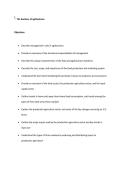
1
. The business of agribusiness
Objectives
Describe management’s role in agribusiness
Provide an overview of the functional responsibilities of management
Describe the unique characteristics of the food and agribusiness industries
Describe the size, scope, and importance of the food production and marketing system
Understand the farm-food marketing bill and what it means to producers and consumers
Provide an overview of the food sector, the production agriculture sector, and the input
supply sector
Outline trends in home and away-from-home food consumption, and trends among the
types of firms that serve these markets
Explore the production agriculture sector, and some of the key changes occurring on U.S.
farms
Outline the major inputs used by the production agriculture sector and key trends in
input use
Understand the types of firms involved in producing and distributing inputs to
production agriculture
,Discussion questions and answers
1. List and define four functions of agribusiness management.
Marketing management involves understanding customer needs and effectively
positioning and selling products and services in the marketplace.
Financial management involves managing the financial resources of the firm in order to
achieve a profit. This includes generating data for making good decisions, analyzing
alternatives, and managing assets, liabilities and owners’ investment in the firm.
Supply chain management involves the production and distribution of products in the
firm.
Operations management focuses on the direction and control of the processes used to
produce goods and services.
Logistics management focuses on the activities involved in storing and transporting
goods and services from manufacturer to buyer.
Human resources management involves managing the human side of the business, both
the mechanics of personnel administration as well as the finer points of motivating
people to offer and contribute their maximum potential.
2. What are five reasons the agribusiness sector may be considered unique? How or why
could agribusiness and firms outside the agribusiness sectors make different decisions in
similar situations?
Choices could include five of the following:
, Food as a product: Because food is a fundamental need for humans and provides the
foundation for economic development, it becomes a critical component of national
security. This results in a unique marketplace for agribusinesses with government
policies playing a bigger role in short-term and long-term growth of different segments
of the industry. Agribusinesses have to plan for changes in the U.S. farm policy as well as
international policies impacting the trade of food products with other countries.
Biological nature of production agriculture: This characteristic means agriculture is
susceptible to forces beyond human control, such as weather, pests, and disease. This
impacts agribusinesses by the amount of risk associated with their businesses, which
non-agribusiness firms do not need to consider.
Seasonal nature of the business: There is seasonality both in the demand and the supply
of agricultural products. With crops, the seasonality of production is apparent in the
harvest cycle. An example of demand seasonality is increased demand for ice cream in
the summer months. Seasonality impacts agribusinesses in many ways that other firms
may not have to consider — from financing decisions throughout the year (both revenue
and expenses are seasonal, though the cycles may not coincide), to human resource
management (hiring of temporary employees), to marketing programs (timing of
implementation).
Uncertainty of the weather: This uncertainty affects all of the players in the market —
from farm input suppliers to food retailers and consumers. Weather can have a large
impact on a firm’s sales, their day-to-day decisions, and the risk associated with doing
business in the agricultural industry.
Types of firms: There is a great variety in size and type of agribusiness firms — from
family farms to giants like ConAgra. The impact of this on agribusinesses is that their
, strategic plan must be flexible enough to compete with and serve the variety of
businesses that they deal with in their market.
Variety of market conditions: The wide range of firm types and risk characteristics results
in a wide variety of market conditions, from perfect competition to duopolies. Again, this
impacts agribusinesses who have to work in several of these types of markets so they
are flexible enough to be able to deal with the types of markets their firm works with.
Rural ties: Agribusiness is the backbone of the rural economy — many rural communities
depend on agribusinesses for jobs and income. Rural ties impact agribusinesses in their
whole approach to the market. The rural market poses logistical challenges, human
resource challenges, and financial challenges that firms in other industries may not have
to contend with.
Government involvement: The government has a fundamental role in food and
agribusiness. Many programs influence commodity prices and/or farm income. To be
successful, agribusinesses must include the impact of government involvement in their
planning process.
3. The food marketing bill continues to grow each year— the proportion of the total
farm-food marketing bill going to the food sector continues to increase. Interpret this trend.
What are the reasons for this increase? How does this marketing bill affect farmers? Explain.
For each dollar consumers spend on food, the proportion that goes to the food sector is slowly
increasing — from 82 percent in 1993 to 84 percent in 2009 (see Figure 1.1). Yet the sheer
magnitude of the food industry relative to the farm sector means that the farm share of the
marketing bill rose from $112 to $187 billion, while the marketing share has increased by $500
billion to $996 billion.
. The business of agribusiness
Objectives
Describe management’s role in agribusiness
Provide an overview of the functional responsibilities of management
Describe the unique characteristics of the food and agribusiness industries
Describe the size, scope, and importance of the food production and marketing system
Understand the farm-food marketing bill and what it means to producers and consumers
Provide an overview of the food sector, the production agriculture sector, and the input
supply sector
Outline trends in home and away-from-home food consumption, and trends among the
types of firms that serve these markets
Explore the production agriculture sector, and some of the key changes occurring on U.S.
farms
Outline the major inputs used by the production agriculture sector and key trends in
input use
Understand the types of firms involved in producing and distributing inputs to
production agriculture
,Discussion questions and answers
1. List and define four functions of agribusiness management.
Marketing management involves understanding customer needs and effectively
positioning and selling products and services in the marketplace.
Financial management involves managing the financial resources of the firm in order to
achieve a profit. This includes generating data for making good decisions, analyzing
alternatives, and managing assets, liabilities and owners’ investment in the firm.
Supply chain management involves the production and distribution of products in the
firm.
Operations management focuses on the direction and control of the processes used to
produce goods and services.
Logistics management focuses on the activities involved in storing and transporting
goods and services from manufacturer to buyer.
Human resources management involves managing the human side of the business, both
the mechanics of personnel administration as well as the finer points of motivating
people to offer and contribute their maximum potential.
2. What are five reasons the agribusiness sector may be considered unique? How or why
could agribusiness and firms outside the agribusiness sectors make different decisions in
similar situations?
Choices could include five of the following:
, Food as a product: Because food is a fundamental need for humans and provides the
foundation for economic development, it becomes a critical component of national
security. This results in a unique marketplace for agribusinesses with government
policies playing a bigger role in short-term and long-term growth of different segments
of the industry. Agribusinesses have to plan for changes in the U.S. farm policy as well as
international policies impacting the trade of food products with other countries.
Biological nature of production agriculture: This characteristic means agriculture is
susceptible to forces beyond human control, such as weather, pests, and disease. This
impacts agribusinesses by the amount of risk associated with their businesses, which
non-agribusiness firms do not need to consider.
Seasonal nature of the business: There is seasonality both in the demand and the supply
of agricultural products. With crops, the seasonality of production is apparent in the
harvest cycle. An example of demand seasonality is increased demand for ice cream in
the summer months. Seasonality impacts agribusinesses in many ways that other firms
may not have to consider — from financing decisions throughout the year (both revenue
and expenses are seasonal, though the cycles may not coincide), to human resource
management (hiring of temporary employees), to marketing programs (timing of
implementation).
Uncertainty of the weather: This uncertainty affects all of the players in the market —
from farm input suppliers to food retailers and consumers. Weather can have a large
impact on a firm’s sales, their day-to-day decisions, and the risk associated with doing
business in the agricultural industry.
Types of firms: There is a great variety in size and type of agribusiness firms — from
family farms to giants like ConAgra. The impact of this on agribusinesses is that their
, strategic plan must be flexible enough to compete with and serve the variety of
businesses that they deal with in their market.
Variety of market conditions: The wide range of firm types and risk characteristics results
in a wide variety of market conditions, from perfect competition to duopolies. Again, this
impacts agribusinesses who have to work in several of these types of markets so they
are flexible enough to be able to deal with the types of markets their firm works with.
Rural ties: Agribusiness is the backbone of the rural economy — many rural communities
depend on agribusinesses for jobs and income. Rural ties impact agribusinesses in their
whole approach to the market. The rural market poses logistical challenges, human
resource challenges, and financial challenges that firms in other industries may not have
to contend with.
Government involvement: The government has a fundamental role in food and
agribusiness. Many programs influence commodity prices and/or farm income. To be
successful, agribusinesses must include the impact of government involvement in their
planning process.
3. The food marketing bill continues to grow each year— the proportion of the total
farm-food marketing bill going to the food sector continues to increase. Interpret this trend.
What are the reasons for this increase? How does this marketing bill affect farmers? Explain.
For each dollar consumers spend on food, the proportion that goes to the food sector is slowly
increasing — from 82 percent in 1993 to 84 percent in 2009 (see Figure 1.1). Yet the sheer
magnitude of the food industry relative to the farm sector means that the farm share of the
marketing bill rose from $112 to $187 billion, while the marketing share has increased by $500
billion to $996 billion.


