Written by students who passed Immediately available after payment Read online or as PDF Wrong document? Swap it for free 4.6 TrustPilot
logo-home
Exam (elaborations)

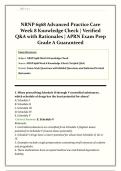
NRNP 6568 Advanced Practice Care Week 8 Knowledge Check | Verified Q&A with Rationales | APRN Exam Prep | Grade A Guaranteed

Rating
-
Sold
-
Pages
7
Grade
A+
Uploaded on
13-04-2026
Written in
2025/2026

INSTANT PDF DOWNLOAD — This is the comprehensive Week 8 knowledge check preparation guide for NRNP 6568 - Advanced Practice Care , featuring verified questions and answers with detailed rationales. Designed for Advanced Practice Registered Nurse (APRN) and Nurse Practitioner (NP) students, this resource consolidates the critical advanced practice concepts required to achieve a Grade A score on the Week 8 knowledge check. The guide is meticulously aligned with APRN curricula, national certification exam blueprints (AANP, ANCC), and evidence-based practice standards. This verified resource provides comprehensive coverage of key NRNP 6568 Week 8 topics, including: Advanced Health Assessment (comprehensive health history, advanced physical examination techniques, diagnostic reasoning, differential diagnosis, clinical decision-making, documentation—SOAP notes, cultural competence in assessment, health promotion and disease prevention, screening guidelines—USPSTF, risk assessment, motivational interviewing, patient education); Advanced Pharmacology (pharmacokinetics and pharmacodynamics across the lifespan, pharmacogenomics, drug interactions, adverse drug reactions, medication safety, evidence-based prescribing, pharmacotherapy for common acute and chronic conditions, polypharmacy in older adults, medication management in pregnancy and lactation, pediatric pharmacotherapy, controlled substances and prescribing regulations, opioid stewardship, antibiotic stewardship); Advanced Pathophysiology (cellular adaptation, injury, and death; inflammation and immunity; fluid, electrolyte, and acid-base balance; genetics and genomics; neoplasia; alterations in body systems—cardiovascular, respiratory, renal, endocrine, gastrointestinal, neurologic, musculoskeletal, integumentary, reproductive; multisystem disorders—shock, sepsis, multiple organ dysfunction syndrome); Evidence-Based Practice (PICOT question formulation, literature search strategies, critical appraisal of research evidence, levels of evidence, systematic reviews and meta-analyses, randomized controlled trials, cohort studies, case-control studies, qualitative research, evidence synthesis, knowledge translation, implementation science, quality improvement methodologies—PDSA, Six Sigma, Lean; practice guidelines, clinical pathways); Healthcare Policy and Advocacy (US healthcare system, Medicare, Medicaid, Affordable Care Act, health policy development, legislative process, advocacy in nursing, health equity, social determinants of health, population health, global health); Leadership and Management (leadership theories—transformational, transactional, servant; management functions—planning, organizing, directing, controlling; delegation, conflict resolution, interprofessional collaboration, team building, change management, quality improvement, patient safety, risk management, healthcare finance, budgeting, resource allocation, strategic planning); Nursing Theory and Research (nursing theorists—Nightingale, Henderson, Orem, Roy, Rogers, Watson, Benner, Parse, Leininger, Pender; theory-guided practice, research methods—quantitative, qualitative, mixed methods; research ethics—IRB, informed consent; research utilization, evidence translation, scholarly writing, grant writing, dissemination—publication, presentation); Ethical and Legal Issues (ethical principles—autonomy, beneficence, nonmaleficence, justice, fidelity, veracity; ethical decision-making frameworks, code of ethics—ANA; legal issues—Nurse Practice Acts, scope of practice, malpractice, negligence, informed consent, confidentiality—HIPAA, advance directives, end-of-life decision-making, futility, withdrawal of life support, organ donation, ethical dilemmas, resource allocation, surrogate decision-making, conscientious objection, moral distress); Advanced Practice Roles (NP roles—FNP, AGNP, PNP, PMHNP, WHNP, ACNP; CNS roles, nurse educator, nurse leader, nurse informaticist, nurse researcher; regulatory framework—state licensure, national certification, DEA registration, prescriptive authority, collaborative agreements; reimbursement—billing, coding, CPT, ICD-10; scope of practice, standards of practice, credentialing, privileging, professional development, lifelong learning). It features exam-style questions including multiple-choice, select-all-that-apply (SATA), and clinical scenario-based questions. Each question includes verified answers with detailed rationales explaining the correct answer and clarifying common misconceptions, along with cognitive level tags (Bloom's Taxonomy: Remember, Understand, Apply, Analyze, Evaluate, Create), textbook page references, and AACN/NONPF competency alignment. DOCUMENT ACCESS: This study guide is available as an instant digital download (PDF) immediately upon purchase. Fully text-searchable, printable, and accessible anytime through your user account. Trusted by thousands of APRN students for NRNP 6568 knowledge check success and national certification preparation.

Show more Read less

Content preview

1|Page


NRNP 6568 Advanced Practice Care
Week 8 Knowledge Check | Verified
Q&A with Rationales | APRN Exam Prep
Grade A Guaranteed
Exam Structure:

Subject: NRNP 6568 Week 8 Knowledge Check

Source: NRNP 6568 Week 8 Knowledge Check (Verified Q&A)

Format: Exam-Style Questions with Bolded Questions and Italicized Vertical

Rationales


1. When prescribing Schedule II through V controlled substances,
which schedule of drugs has the least potential for abuse?
A. Schedule I
B. Schedule II
C. Schedule III
D. Schedule IV
E. Schedule V
Correct Answer: E. Schedule V
Rationale:
1. Controlled substances are classified from Schedule I (highest abuse
potential) to Schedule V (lowest abuse potential).
2. Schedule V drugs have a lower potential for abuse than Schedule II, III, or
IV.
3. Examples include cough preparations containing small amounts of codeine
and pregabalin.
4. These medications have accepted medical use and limited dependence
liability.

, 2|Page


2. St. John's wort will usually interact with all medications except
which one?
A. Celexa (citalopram)
B. Paxil (paroxetine)
C. Elavil (amitriptyline)
D. PPI (proton pump inhibitor)
Correct Answer: D. PPI (proton pump inhibitor)
Rationale:
1. St. John's wort is a potent inducer of the CYP450 enzyme system (especially
CYP3A4).
2. It reduces serum levels of many antidepressants including SSRIs (Celexa,
Paxil) and tricyclics (Elavil).
3. PPIs are primarily metabolized by CYP2C19 and CYP3A4, but clinically
significant interactions are less common.
4. The question asks for the exception — PPIs are generally not listed among
major interactions.

3. What is the initial goal of treatment during an acute phase of a
mood episode?
A. Intense psychotherapy
B. Assess for physical complications
C. Assess medication compliance
D. To assess and address issues of personal safety
Correct Answer: D. To assess and address issues of personal safety
Rationale:
1. The priority during any acute mood episode (mania or severe depression) is
patient safety.
2. Assess for suicidal ideation, homicidal ideation, self-harm, or dangerous
behaviors.
3. Address safety through hospitalization if needed before initiating other
treatments.
4. Physical complications and medication compliance are addressed after
safety is established.

4. Patients with alopecia areata commonly have vitiligo, eczema, and
asthma. True or false?

Document information

Uploaded on
April 13, 2026
Number of pages
7
Written in
2025/2026
Type
Exam (elaborations)
Contains
Questions & answers

Subjects

$12.49
Get access to the full document:

Wrong document? Swap it for free Within 14 days of purchase and before downloading, you can choose a different document. You can simply spend the amount again.
Written by students who passed
Immediately available after payment
Read online or as PDF


Also available in package deal

Thumbnail
Package deal
NRNP 6568 Advanced Practice Care Week 1, 2, 3,5,6,7,8 & 9 Knowledge Check |PACKAGE DEAL
-
8 2026
$ 42.46 More info

Get to know the seller

Seller avatar
Reputation scores are based on the amount of documents a seller has sold for a fee and the reviews they have received for those documents. There are three levels: Bronze, Silver and Gold. The better the reputation, the more your can rely on the quality of the sellers work.
Honours Howard Community College
View profile
Follow You need to be logged in order to follow users or courses
Sold
29
Member since
3 months
Number of followers
1
Documents
396
Last sold
1 day ago

5.0

19 reviews

5
19
4
0
3
0
2
0
1
0

Why students choose Stuvia

Created by fellow students, verified by reviews

Quality you can trust: written by students who passed their tests and reviewed by others who've used these notes.

Didn't get what you expected? Choose another document

No worries! You can instantly pick a different document that better fits what you're looking for.

Pay as you like, start learning right away

No subscription, no commitments. Pay the way you're used to via credit card and download your PDF document instantly.

Student with book image

“Bought, downloaded, and aced it. It really can be that simple.”

Alisha Student

Working on your references?

Create accurate citations in APA, MLA and Harvard with our free citation generator.

Working on your references?

Frequently asked questions