The External Environment
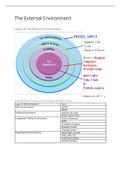
Layers of the Business Environment
An Overview of Tools used to Analyse the Environment
Layer of the Environment Tool
Macro-Environment PESTEL
SPENT
Industry-Environment Industry Life Cycle
Porter’s Five Forces
Competitor / Market-Environment Porter’s Diamond
SWOT
Competitor Analysis
Strategic Groups
Strategy Canvas
Organisational Environment Value Chain Analysis
VRIO / RBV / DC
Intellectual Capital
Portfolio Analysis
,Macro-Level Analysis
PESTEL Analysis
The PESTEL framework categorises environmental factors into key types:
P Politics highlights the role of the state and other political forces.
E Economics refers to macro-economic factors such as exchange rates, business cycles and
differential economic growth rates around the world.
S Social influences include changing cultures and demographics.
T Technological influences refer to influences such as the internet, nanotechnology, or the rise
of composite materials.
E Ecological stands specifically for green environmental issues, such as pollution, waste and
climate change.
L Legal focuses on legislative and regulatory constraints or changes.
Note: Analysing these factors and their interrelationships can produce long and complex lists.
Rather than getting overwhelmed by a multitude of details, it is necessary to identify the key
drivers for change. Key drivers for change are the environmental factors likely to have a high
impact on the future success or failure of strategy.
Scenario Building on PESTEL Analysis
What is Scenario Building?
Scenario analyses are carried out to allow for different possibilities and help prevent managers from
closing their minds to alternatives. Thus, scenarios offer plausible alternative views of how the
business environment might develop in the future.
Scenarios typically build on PESTEL analyses and key drivers for change, but do not offer a single
forecast of how the environment will change. The point is not to predict, but to encourage managers
to be alert to a range of possible futures. For this reason, analyses typically produce three or four
distinct scenarios.
Effective scenario-building can help build strategies that are robust in the face of environmental
change.
The Five Typical Basic Steps of Scenario Building
1. Defining scenario scope. Scope refers to the subject of the scenario analyses and the time
span e.g. a whole industry, or particular geographical regions and markets.
2. Identifying the key drivers for change. Here PESTEL analysis can be used to uncover issues
likely to have a major impact upon the future of the industry, region or market.
3. Developing scenario stories. Having selected opposing key drivers for change, it is necessary
to knit together plausible stories that incorporate both key drivers and other factors into a
coherent whole.
4. Identifying impacts of alternative scenarios on organisations.
5. Establishing early warning systems. Once the various scenarios are drawn up, organisations
should identify indicators that might give early warning about the final direction of the
environmental change, and at the same time monitor these. Effective monitoring of well-
chosen indicators should facilitate prompt and appropriate responses.
, SPENT Analysis
What is it?
S Sociodemographic
P Political, government, legal and regulatory
E Economic
N Natural
T Technological
Sociodemographic Influences
Analysis of the sociodemographic environment is concerned with understanding the potential
impacts of society and social changes on a business, its industry and markets.
For most analyses, analysis of the social environment will require consideration of:
• Social culture (values, attitudes, and beliefs): the cultures of the countries in which a
business operates can be of a particular importance. The culture of a country consists of the
values, attitudes and beliefs of its people, which, in turn, will affect the way they act and
behave. There are Important cultural differences between all countries. Impacts of culture
include:
o Demand for products and services
o Attitudes to work
o Education and training
o Corruption and ethics
o The social role of a business in society
• Demography: concerned with the impact of the size and structure of the population on the
workforce and patterns of demand. The size of the population will be a determinant of the
size of the workforce and the potential size of markets. Whereas the structure will
determine the size of particular segments and also the size of the working population.
• Social structure: refers to the ways in which the social groups in a population are organised
and concerns its impact on attitudes to work and certain products. There are a number of
ways of defining social structure, such as by sociodemographic groupings, by age, gender,
location, population density (the number of people living in each unit of area) in different
areas etc. the social structure will affect people’s lifestyles and expectations and so will
strongly influence their attitudes to work and their demand for particular products.
Political, Government, Legal and Regulatory Influences
The political environment is that part of the macroenvironment that is either under the direct
control or influence of the government and / or the state.
‘Government’ is a loosely defined term and can be considered at three levels:
• National level: the government of a particular country.
• Subnational level: local government based in regions, states etc.
• Supranational (means multinational / worldwide) level: political bodies that exert influence
on several national governments e.g. European Union (EU), United Nations (UN), North
American Free Trade Agreement (NAFTA) etc.
Governments (at whatever level) have direct control or influence, to a greater or lesser extent, over:
Layers of the Business Environment
An Overview of Tools used to Analyse the Environment
Layer of the Environment Tool
Macro-Environment PESTEL
SPENT
Industry-Environment Industry Life Cycle
Porter’s Five Forces
Competitor / Market-Environment Porter’s Diamond
SWOT
Competitor Analysis
Strategic Groups
Strategy Canvas
Organisational Environment Value Chain Analysis
VRIO / RBV / DC
Intellectual Capital
Portfolio Analysis
,Macro-Level Analysis
PESTEL Analysis
The PESTEL framework categorises environmental factors into key types:
P Politics highlights the role of the state and other political forces.
E Economics refers to macro-economic factors such as exchange rates, business cycles and
differential economic growth rates around the world.
S Social influences include changing cultures and demographics.
T Technological influences refer to influences such as the internet, nanotechnology, or the rise
of composite materials.
E Ecological stands specifically for green environmental issues, such as pollution, waste and
climate change.
L Legal focuses on legislative and regulatory constraints or changes.
Note: Analysing these factors and their interrelationships can produce long and complex lists.
Rather than getting overwhelmed by a multitude of details, it is necessary to identify the key
drivers for change. Key drivers for change are the environmental factors likely to have a high
impact on the future success or failure of strategy.
Scenario Building on PESTEL Analysis
What is Scenario Building?
Scenario analyses are carried out to allow for different possibilities and help prevent managers from
closing their minds to alternatives. Thus, scenarios offer plausible alternative views of how the
business environment might develop in the future.
Scenarios typically build on PESTEL analyses and key drivers for change, but do not offer a single
forecast of how the environment will change. The point is not to predict, but to encourage managers
to be alert to a range of possible futures. For this reason, analyses typically produce three or four
distinct scenarios.
Effective scenario-building can help build strategies that are robust in the face of environmental
change.
The Five Typical Basic Steps of Scenario Building
1. Defining scenario scope. Scope refers to the subject of the scenario analyses and the time
span e.g. a whole industry, or particular geographical regions and markets.
2. Identifying the key drivers for change. Here PESTEL analysis can be used to uncover issues
likely to have a major impact upon the future of the industry, region or market.
3. Developing scenario stories. Having selected opposing key drivers for change, it is necessary
to knit together plausible stories that incorporate both key drivers and other factors into a
coherent whole.
4. Identifying impacts of alternative scenarios on organisations.
5. Establishing early warning systems. Once the various scenarios are drawn up, organisations
should identify indicators that might give early warning about the final direction of the
environmental change, and at the same time monitor these. Effective monitoring of well-
chosen indicators should facilitate prompt and appropriate responses.
, SPENT Analysis
What is it?
S Sociodemographic
P Political, government, legal and regulatory
E Economic
N Natural
T Technological
Sociodemographic Influences
Analysis of the sociodemographic environment is concerned with understanding the potential
impacts of society and social changes on a business, its industry and markets.
For most analyses, analysis of the social environment will require consideration of:
• Social culture (values, attitudes, and beliefs): the cultures of the countries in which a
business operates can be of a particular importance. The culture of a country consists of the
values, attitudes and beliefs of its people, which, in turn, will affect the way they act and
behave. There are Important cultural differences between all countries. Impacts of culture
include:
o Demand for products and services
o Attitudes to work
o Education and training
o Corruption and ethics
o The social role of a business in society
• Demography: concerned with the impact of the size and structure of the population on the
workforce and patterns of demand. The size of the population will be a determinant of the
size of the workforce and the potential size of markets. Whereas the structure will
determine the size of particular segments and also the size of the working population.
• Social structure: refers to the ways in which the social groups in a population are organised
and concerns its impact on attitudes to work and certain products. There are a number of
ways of defining social structure, such as by sociodemographic groupings, by age, gender,
location, population density (the number of people living in each unit of area) in different
areas etc. the social structure will affect people’s lifestyles and expectations and so will
strongly influence their attitudes to work and their demand for particular products.
Political, Government, Legal and Regulatory Influences
The political environment is that part of the macroenvironment that is either under the direct
control or influence of the government and / or the state.
‘Government’ is a loosely defined term and can be considered at three levels:
• National level: the government of a particular country.
• Subnational level: local government based in regions, states etc.
• Supranational (means multinational / worldwide) level: political bodies that exert influence
on several national governments e.g. European Union (EU), United Nations (UN), North
American Free Trade Agreement (NAFTA) etc.
Governments (at whatever level) have direct control or influence, to a greater or lesser extent, over: