Written by students who passed Immediately available after payment Read online or as PDF Wrong document? Swap it for free 4.6 TrustPilot
logo-home
Exam (elaborations)

NR-283 Pathophysiology Week 2 Quiz 2026/2027 | Verified Q&A with Rationales | Chamberlain | Pass Guaranteed - A+ Graded

Rating
-
Sold
1
Pages
9
Grade
A+
Uploaded on
10-04-2026
Written in
2025/2026

Pass your NR-283 Pathophysiology Week 2 Quiz at Chamberlain University with this comprehensive resource featuring verified questions, answers, and detailed rationales – all 100% correct and A+ graded for the 2026/2027 curriculum. This A+ Graded resource for the NR-283 Pathophysiology Week 2 Quiz (2026/2027 | Chamberlain University) contains verified questions, answers, and rationales covering every essential topic required for success on the second weekly quiz. Comprehensive Content Coverage Includes: Fluid and Electrolyte Imbalances: Body fluid compartments – intracellular fluid (ICF, 2/3 of body water), extracellular fluid (ECF – interstitial and intravascular, 1/3). Measurement units – osmolality, tonicity, mEq/L. Water balance – thirst mechanism, ADH, aldosterone, natriuretic peptides. Sodium imbalances: Hyponatremia (serum Na 135 mEq/L) – causes (SIADH, heart failure, vomiting, diuretics, water intoxication), manifestations (nausea, confusion, seizures, coma). Hypernatremia (serum Na 145 mEq/L) – causes (diabetes insipidus, dehydration, excessive sodium intake), manifestations (thirst, dry mucous membranes, agitation, hyperreflexia). Potassium imbalances: Hypokalemia (serum K 3.5 mEq/L) – causes (diuretics, vomiting, diarrhea, alkalosis), manifestations (muscle weakness, ileus, U waves, arrhythmias). Hyperkalemia (serum K 5.0 mEq/L) – causes (renal failure, ACE inhibitors, potassium-sparing diuretics, acidosis), manifestations (muscle cramps, paresthesias, peaked T waves, cardiac arrest). Calcium imbalances: Hypocalcemia (serum Ca 8.5 mg/dL) – causes (hypoparathyroidism, vitamin D deficiency, pancreatitis, renal failure), manifestations (tetany, Chvostek's sign, Trousseau's sign, prolonged QT). Hypercalcemia (serum Ca 10.2 mg/dL) – causes (hyperparathyroidism, malignancy, immobilization, thiazides), manifestations (bone pain, kidney stones, constipation, shortened QT, lethargy). Magnesium and phosphate imbalances: Hypomagnesemia (alcoholism, diuretics, diarrhea – neuromuscular irritability), hypermagnesemia (renal failure, laxative abuse – hyporeflexia, hypotension). Hypophosphatemia (refeeding syndrome, alcohol withdrawal – muscle weakness, respiratory failure), hyperphosphatemia (renal failure, tumor lysis – metastatic calcification). Acid-Base Imbalances: Normal pH 7.35-7.45, PaCO2 35-45 mmHg (respiratory component), HCO3 22-26 mEq/L (metabolic component). Henderson-Hasselbalch equation. Primary disorders and compensation: Respiratory acidosis: PaCO2 45, pH 7.35 – causes (COPD, hypoventilation, opioid overdose, pneumonia). Compensation: metabolic alkalosis (increased HCO3, renal retention). Respiratory alkalosis: PaCO2 35, pH 7.45 – causes (hyperventilation, anxiety, pulmonary embolism, high altitude). Compensation: metabolic acidosis (decreased HCO3, renal excretion). Metabolic acidosis: HCO3 22, pH 7.35 – causes (DKA, lactic acidosis, renal failure, diarrhea, methanol/ethylene glycol). Anion gap calculation (Na – Cl – HCO3, normal 8-12). Compensation: respiratory alkalosis (Kussmaul breathing, decreased PaCO2). Metabolic alkalosis: HCO3 26, pH 7.45 – causes (vomiting, NG suction, diuretics, mineralocorticoid excess). Compensation: respiratory acidosis (hypoventilation, increased PaCO2). Mixed disorders and ABG interpretation (e.g., respiratory acidosis with metabolic alkalosis in COPD patient on diuretics). Genetics and Genetic Disorders: DNA structure (double helix, nucleotides – A, T, G, C), genes, chromosomes (23 pairs, autosomes and sex chromosomes), mutations (point mutations, frameshift, trinucleotide repeats). Modes of inheritance: Autosomal dominant (Huntington's disease, Marfan syndrome, familial hypercholesterolemia – one affected allele, variable penetrance), autosomal recessive (cystic fibrosis, sickle cell disease, phenylketonuria – two affected alleles, carrier state), X-linked recessive (hemophilia A and B, Duchenne muscular dystrophy – males affected, females carriers), X-linked dominant (Rett syndrome, fragile X syndrome), mitochondrial inheritance (Leber's hereditary optic neuropathy). Chromosomal abnormalities: Aneuploidy (Down syndrome – trisomy 21, Edwards syndrome – trisomy 18, Patau syndrome – trisomy 13, Turner syndrome – 45,XO, Klinefelter syndrome – 47,XXY). Structural abnormalities (deletions – Cri-du-chat syndrome; translocations – Robertsonian; inversions, duplications, ring chromosomes). Mosaicism. Epigenetics and multifactorial inheritance: Epigenetic modifications (DNA methylation, histone acetylation, imprinting – Prader-Willi, Angelman syndromes). Multifactorial disorders (cleft lip/palate, congenital heart defects, neural tube defects, diabetes, hypertension – gene-environment interactions). Pharmacogenetics (CYP450 variants affecting drug metabolism – codeine, warfarin, clopidogrel). Each question includes a detailed rationale explaining the pathophysiologic mechanism, clinical correlation, and correct answer reasoning – ensuring you understand the "why" behind every correct choice. With fully verified Q&A plus rationales and our Pass Guarantee, this is the definitive tool to ace your Week 2 Quiz on the first attempt. Get instant access now and start studying today.

Show more Read less
Institution
NR-283 Pathophysiology
Course
NR-283 Pathophysiology

Content preview

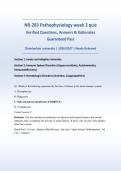
NR-283 Pathophysiology week 2 quiz
Verified Questions, Answers & Rationales
Guaranteed Pass

Chamberlain university | 2026/2027 | Newly Released


Section 1: Innate and Adaptive Immunity
Section 2: Immune System Disorders (Hypersensitivity, Autoimmunity,
Immunodeficiency)
Section 3: Hematologic Disorders (Anemias, Coagulopathies)


Q1: Which of the following represents the first line of defense in the innate immune system?

A. B lymphocytes

B. Phagocytes

C. Skin and mucous membranes [CORRECT]

D. T lymphocytes

Correct Answer: C

Rationale: The skin and mucous membranes are physical and chemical barriers that prevent
pathogen entry, constituting the first line of innate defense. B and T cells are part of the adaptive
(third line) system.

Board Pearl: 1st Line = Barriers (Skin/Mucosa); 2nd Line = Innate Internal (Inflammation); 3rd
Line = Adaptive.

, Q2: A child falls and scrapes their knee. Within hours, the area becomes red, warm, and swollen.
Which innate immune cells are the first to arrive at the site of injury to phagocytose pathogens?

A. Eosinophils

B. Neutrophils [CORRECT]

C. Basophils

D. B cells

Correct Answer: B

Rationale: Neutrophils are the primary phagocytes that arrive first at the site of acute
inflammation to ingest and destroy pathogens.

Board Pearl: "First responders" of inflammation = Neutrophils.


Q3: Which immunoglobulin class is primarily found in mucosal secretions such as saliva, tears,
and breast milk?

A. IgG

B. IgM

C. IgA [CORRECT]

D. IgE

Correct Answer: C

Rationale: IgA is the main antibody class found in mucosal secretions, providing localized
immunity by preventing pathogens from entering the body through epithelial surfaces.

Board Pearl: Mucosal guard = IgA.


Q4: During a primary immune response, which antibody is produced first and indicates a recent
infection?

A. IgG

B. IgM [CORRECT]

C. IgA

D. IgE

Correct Answer: B
.

Written for

Institution
NR-283 Pathophysiology
Course
NR-283 Pathophysiology

Document information

Uploaded on
April 10, 2026
Number of pages
9
Written in
2025/2026
Type
Exam (elaborations)
Contains
Questions & answers

Subjects

$12.00
Get access to the full document:

Wrong document? Swap it for free Within 14 days of purchase and before downloading, you can choose a different document. You can simply spend the amount again.
Written by students who passed
Immediately available after payment
Read online or as PDF


Also available in package deal

Thumbnail
Package deal
NR-283 Pathophysiology Week 1 & Week 2 Quizzes BUNDLE 2026/2027 | Verified Q&A with Rationales | Chamberlain | Pass Guaranteed - A+ Graded
-
2 2026
$ 16.00 More info

Get to know the seller

Seller avatar
Reputation scores are based on the amount of documents a seller has sold for a fee and the reviews they have received for those documents. There are three levels: Bronze, Silver and Gold. The better the reputation, the more your can rely on the quality of the sellers work.
TutorRicks Chamberlain College Of Nursing
View profile
Follow You need to be logged in order to follow users or courses
Sold
322
Member since
2 year
Number of followers
50
Documents
2827
Last sold
1 day ago

3.7

43 reviews

5
22
4
4
3
8
2
1
1
8

Recently viewed by you

Why students choose Stuvia

Created by fellow students, verified by reviews

Quality you can trust: written by students who passed their tests and reviewed by others who've used these notes.

Didn't get what you expected? Choose another document

No worries! You can instantly pick a different document that better fits what you're looking for.

Pay as you like, start learning right away

No subscription, no commitments. Pay the way you're used to via credit card and download your PDF document instantly.

Student with book image

“Bought, downloaded, and aced it. It really can be that simple.”

Alisha Student

Working on your references?

Create accurate citations in APA, MLA and Harvard with our free citation generator.

Working on your references?

Frequently asked questions