

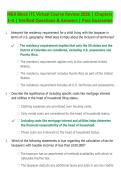
H&R Block ITC Virtual Course Review 2026 | Chapters
1–6 | Verified Questions & Answers | Pass Guarantee
1. Interpret the residency requirement for a child living with the taxpayer in
terms of U.S. geography. What does it imply about the inclusion of territories?
The residency requirement implies that only the 50 states and the
District of Columbia are considered, excluding U.S. possessions and
Puerto Rico.
The residency requirement applies only to the continental United
States.
The residency requirement includes Puerto Rico as part of the United
States.
The residency requirement includes all U.S. territories and possessions.
2. Describe the significance of including specific costs like mortgage interest
and utilities in the head of household filing status.
Clothing expenses are prioritized over housing costs.
Only rental costs are considered for the head of household status.
Including costs like mortgage interest and utilities helps determine
the financial responsibility of the head of household.
These costs are irrelevant to the head of household status.
3. Which of the following statements is true regarding the calculation of tax for
taxpayers with taxable incomes of less than $100,000?
The taxpayer has an assortment of methods availability with which to
calculate his/her tax.
The taxpayer deducts any additional taxes and adds in any tax credits
, to the existing tax liability.
The taxpayer may be penalized for over-payment of estimated taxes.
The taxpayer will generally use the tax tables provided by the IRS.
4. Which of the following is earned income?
Graduation gift from your grandmother.
Social security disability payments.
Dividends.
Self-employed business income.
5. Describe the purpose of Form 1099-INT in the context of tax reporting.
Form 1099-INT is used to report rental income from properties.
Form 1099-INT is used to report capital gains from investments.
Form 1099-INT is used to report interest income earned by
individuals from banks and other financial institutions.
Form 1099-INT is used to report wages paid to employees.
6. What is the standard deduction amount for a single individual who is blind in
2022?
$14,050
$18,800
$12,550
$16,300
7. Ignoring any income limitations, which of the following taxpayers would not
be eligible for the refundable Additional Child Tax Credit?
A married couple that files jointly and claims their 10-year-old
, daughter.
A taxpayer who files Form 2555 and elects to exclude foreign-
earned income from tax.
A taxpayer who files head of household and claims a foster child that
is three years of age.
A widowed taxpayer that has one 18-year-old child and one newborn
that was born in 2022.
8. Which of the following is a requirement for all taxpayers wanting to claim the
Earned Income Credit (EIC)?
Have AGI of less than $21,430 ($27,380 if married filing jointly).
Have a qualifying child that meets the relationship, age, residency, and
joint return tests.
Have a valid social security number.
Be at least 25 years old, but younger than age 65
9. Describe the significance of tax liability in determining eligibility for the
Additional Child Tax Credit.
Tax liability is only considered for single taxpayers.
Tax liability is irrelevant for claiming the Additional Child Tax Credit.
Tax liability only affects the amount of credit received, not eligibility.
Tax liability must be present for a taxpayer to claim the Additional
Child Tax Credit, as the credit is designed to reduce the amount of
tax owed.
10. Which of the following items is considered earned income for the Earned
Income Credit?
Social Security benefits.
1–6 | Verified Questions & Answers | Pass Guarantee
1. Interpret the residency requirement for a child living with the taxpayer in
terms of U.S. geography. What does it imply about the inclusion of territories?
The residency requirement implies that only the 50 states and the
District of Columbia are considered, excluding U.S. possessions and
Puerto Rico.
The residency requirement applies only to the continental United
States.
The residency requirement includes Puerto Rico as part of the United
States.
The residency requirement includes all U.S. territories and possessions.
2. Describe the significance of including specific costs like mortgage interest
and utilities in the head of household filing status.
Clothing expenses are prioritized over housing costs.
Only rental costs are considered for the head of household status.
Including costs like mortgage interest and utilities helps determine
the financial responsibility of the head of household.
These costs are irrelevant to the head of household status.
3. Which of the following statements is true regarding the calculation of tax for
taxpayers with taxable incomes of less than $100,000?
The taxpayer has an assortment of methods availability with which to
calculate his/her tax.
The taxpayer deducts any additional taxes and adds in any tax credits
, to the existing tax liability.
The taxpayer may be penalized for over-payment of estimated taxes.
The taxpayer will generally use the tax tables provided by the IRS.
4. Which of the following is earned income?
Graduation gift from your grandmother.
Social security disability payments.
Dividends.
Self-employed business income.
5. Describe the purpose of Form 1099-INT in the context of tax reporting.
Form 1099-INT is used to report rental income from properties.
Form 1099-INT is used to report capital gains from investments.
Form 1099-INT is used to report interest income earned by
individuals from banks and other financial institutions.
Form 1099-INT is used to report wages paid to employees.
6. What is the standard deduction amount for a single individual who is blind in
2022?
$14,050
$18,800
$12,550
$16,300
7. Ignoring any income limitations, which of the following taxpayers would not
be eligible for the refundable Additional Child Tax Credit?
A married couple that files jointly and claims their 10-year-old
, daughter.
A taxpayer who files Form 2555 and elects to exclude foreign-
earned income from tax.
A taxpayer who files head of household and claims a foster child that
is three years of age.
A widowed taxpayer that has one 18-year-old child and one newborn
that was born in 2022.
8. Which of the following is a requirement for all taxpayers wanting to claim the
Earned Income Credit (EIC)?
Have AGI of less than $21,430 ($27,380 if married filing jointly).
Have a qualifying child that meets the relationship, age, residency, and
joint return tests.
Have a valid social security number.
Be at least 25 years old, but younger than age 65
9. Describe the significance of tax liability in determining eligibility for the
Additional Child Tax Credit.
Tax liability is only considered for single taxpayers.
Tax liability is irrelevant for claiming the Additional Child Tax Credit.
Tax liability only affects the amount of credit received, not eligibility.
Tax liability must be present for a taxpayer to claim the Additional
Child Tax Credit, as the credit is designed to reduce the amount of
tax owed.
10. Which of the following items is considered earned income for the Earned
Income Credit?
Social Security benefits.


