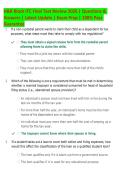
H&R Block ITC Final Test Review 2026 | Questions &
Answers | Latest Update | Exam Prep | 100% Pass
Guarantee
1. If a non-custodial parent wants to claim their child as a dependent for tax
purposes, what steps must they take to comply with tax regulations?
They must obtain a signed release form from the custodial parent
allowing them to claim the child.
They must file a joint tax return with the custodial parent.
They can claim the child without any documentation.
They must prove that they provide more than half of the child's
support.
2. Which of the following is not a requirement that must be met in determining
whether a married taxpayer is considered unmarried for head of household
filing status (i.e., abandoned spouse provision)?
An individual's spouse must not have lived with him or her during the
last six months of the tax year.
For more than half the year, an individual's home must be the main
home of his dependent son or daugher.
An individual must pay more than one-half the cost of keeping up a
home for the tax year.
The taxpayer cannot know where their spouse is living.
3. If a student takes out a loan to cover both tuition and living expenses, how
would this affect the classification of the loan as a qualified student loan?
The loan qualifies only if it is taken out from a government source.
The loan qualifies if it is used for any educational purpose.
, The loan may not qualify if it is not solely for qualified education
expenses.
The loan will always qualify regardless of the expenses covered.
4. What is one of the primary eligibility criteria for claiming the Child Tax Credit?
The child must be a full-time student.
The child must live with the taxpayer for at least six months.
The child must have a Social Security number.
The child must be under the age of 17 at the end of the tax year.
5. Is interest from U.S. Treasury obligations subject to state and local taxation?
Depends on the state
Only partially
Yes
No
6. In 2021, tax filers could claim a Child Tax Credit (CTC) of up to $3,600 per
child under age 6 and up to $3,000 per child ages 6 to 17. The CTC is a fully
refundable credit, where if the credit exceeds taxes owed, families can
receive the excess amount as a tax refund. The CTC is an example of
Government management
Taxing and spending
Education, information, and persuasion
Regulation
,7. Describe the significance of the gross income threshold in determining a
qualifying relative for tax purposes.
The gross income threshold is irrelevant for determining qualifying
relatives.
The gross income threshold ensures that only individuals with
limited financial means can be claimed as qualifying relatives.
The gross income threshold is the same for all taxpayers regardless of
their filing status.
The gross income threshold applies only to children under 18.
8. If a taxpayer receives Form 1099-R with code 7 and no amount in box 2a, how
should they report this on their tax return?
They should report it as a non-taxable distribution.
They should report it as taxable income.
They should report it as an early distribution subject to penalties.
They should ignore it as it is not relevant.
9. What is the Premium Tax Credit?
A credit based on a qualifying child.
A credit for higher education.
A credit for employers who offer health insurance to their employees.
A credit to make health insurance premiums more affordable.
10. Describe the purpose of Form 1099-R in the context of tax reporting for
disability pension payments.
Form 1099-R is a tax form for reporting business income.
, Form 1099-R is a form for reporting wages earned from employment.
Form 1099-R is used to report distributions from pensions,
annuities, retirement plans, or disability payments.
Form 1099-R is used to report capital gains from investments.
11. Barry is a junior at the University of Phoenix. For 2022, he received a Form
1098-T, Tuition Statement, showing his tuition and scholarship amounts.
Assuming all requirements are met, what is the maximum amount Barry could
claim for the American Opportunity Tax Credit?
$1,500
$2,500
$4,000
$2,000
12. Describe the significance of qualifying as unmarried for a married taxpayer
claiming head of household status.
Qualifying as unmarried limits the taxpayer's ability to claim
dependents.
Qualifying as unmarried means the taxpayer cannot claim any credits.
Qualifying as unmarried allows the taxpayer to benefit from a
higher standard deduction and more favorable tax rates.
Qualifying as unmarried requires the taxpayer to file jointly.
13. If a taxpayer qualifies for the qualifying widow(er) status and has two
dependent children, how would this affect their tax filing compared to filing
as single?
They would have to pay higher taxes than if they filed as single.
Answers | Latest Update | Exam Prep | 100% Pass
Guarantee
1. If a non-custodial parent wants to claim their child as a dependent for tax
purposes, what steps must they take to comply with tax regulations?
They must obtain a signed release form from the custodial parent
allowing them to claim the child.
They must file a joint tax return with the custodial parent.
They can claim the child without any documentation.
They must prove that they provide more than half of the child's
support.
2. Which of the following is not a requirement that must be met in determining
whether a married taxpayer is considered unmarried for head of household
filing status (i.e., abandoned spouse provision)?
An individual's spouse must not have lived with him or her during the
last six months of the tax year.
For more than half the year, an individual's home must be the main
home of his dependent son or daugher.
An individual must pay more than one-half the cost of keeping up a
home for the tax year.
The taxpayer cannot know where their spouse is living.
3. If a student takes out a loan to cover both tuition and living expenses, how
would this affect the classification of the loan as a qualified student loan?
The loan qualifies only if it is taken out from a government source.
The loan qualifies if it is used for any educational purpose.
, The loan may not qualify if it is not solely for qualified education
expenses.
The loan will always qualify regardless of the expenses covered.
4. What is one of the primary eligibility criteria for claiming the Child Tax Credit?
The child must be a full-time student.
The child must live with the taxpayer for at least six months.
The child must have a Social Security number.
The child must be under the age of 17 at the end of the tax year.
5. Is interest from U.S. Treasury obligations subject to state and local taxation?
Depends on the state
Only partially
Yes
No
6. In 2021, tax filers could claim a Child Tax Credit (CTC) of up to $3,600 per
child under age 6 and up to $3,000 per child ages 6 to 17. The CTC is a fully
refundable credit, where if the credit exceeds taxes owed, families can
receive the excess amount as a tax refund. The CTC is an example of
Government management
Taxing and spending
Education, information, and persuasion
Regulation
,7. Describe the significance of the gross income threshold in determining a
qualifying relative for tax purposes.
The gross income threshold is irrelevant for determining qualifying
relatives.
The gross income threshold ensures that only individuals with
limited financial means can be claimed as qualifying relatives.
The gross income threshold is the same for all taxpayers regardless of
their filing status.
The gross income threshold applies only to children under 18.
8. If a taxpayer receives Form 1099-R with code 7 and no amount in box 2a, how
should they report this on their tax return?
They should report it as a non-taxable distribution.
They should report it as taxable income.
They should report it as an early distribution subject to penalties.
They should ignore it as it is not relevant.
9. What is the Premium Tax Credit?
A credit based on a qualifying child.
A credit for higher education.
A credit for employers who offer health insurance to their employees.
A credit to make health insurance premiums more affordable.
10. Describe the purpose of Form 1099-R in the context of tax reporting for
disability pension payments.
Form 1099-R is a tax form for reporting business income.
, Form 1099-R is a form for reporting wages earned from employment.
Form 1099-R is used to report distributions from pensions,
annuities, retirement plans, or disability payments.
Form 1099-R is used to report capital gains from investments.
11. Barry is a junior at the University of Phoenix. For 2022, he received a Form
1098-T, Tuition Statement, showing his tuition and scholarship amounts.
Assuming all requirements are met, what is the maximum amount Barry could
claim for the American Opportunity Tax Credit?
$1,500
$2,500
$4,000
$2,000
12. Describe the significance of qualifying as unmarried for a married taxpayer
claiming head of household status.
Qualifying as unmarried limits the taxpayer's ability to claim
dependents.
Qualifying as unmarried means the taxpayer cannot claim any credits.
Qualifying as unmarried allows the taxpayer to benefit from a
higher standard deduction and more favorable tax rates.
Qualifying as unmarried requires the taxpayer to file jointly.
13. If a taxpayer qualifies for the qualifying widow(er) status and has two
dependent children, how would this affect their tax filing compared to filing
as single?
They would have to pay higher taxes than if they filed as single.