Advanced Dysrhythmia with Measurements Assessment
Content Outline
Exam Objective
To measure the overall clinical knowledge of the Cardiac Nurse working in the Acute setting.
Knowledge Domains
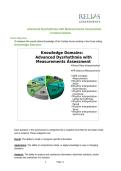
Knowledge Domains:
Advanced Dysrhythmia with
Measurements Assessment
Heart Rate Interpretation
PR Interval Measurement
QRS Complex
8% 8% Measurement
17% 4% Rhythm Interpretation -
9% Atrial
4% 1% Rhythm Interpretation -
1 Heart Blocks
9% 17% Rhythm Interpretation -
13% Junctional
Rhythm Interpretation -
Lethal Arrhythmias
Rhythm Interpretation -
Paced
Rhythm Interpretation -
Sinus
Rhythm Interpretation -
Ventricular
Each question in this assessment is categorized by a cognitive level that the test taker would
use to respond. These categories are:
Recall: The ability to recall or recognize specific information.
Application: The ability to comprehend, relate, or apply knowledge to new or changing
situations.
Analysis: The ability to analyze and synthesize information, determine solutions, and/or
evaluate the usefulness of a solution.
1. Page | 1
, Advanced Dysrhythmia with Measurements Assessment
Content Outline
Content Outline
I. Heart Rate Interpretation
a. Knowledge of anatomy and physiology of the cardiovascular system,
including but not limited to normal cardiac conduction, SA node, AV node,
bundle of His, bundle branches, and Purkinje fibers.
b. Ability to identify electrical conduction abnormalities within specific anatomical
locations in the heart based upon results of ECG waveforms.
c. Knowledge of normal and abnormal heart rates.
d. Ability to identify normal and abnormal heart rates on ECG strip.
e. Knowledge of normal and abnormal components and measurements of the
ECG waveform, including but not limited to P wave, PR interval, QRS
duration, QRS complex, QT interval, and T wave.
f. Ability to identify normal and abnormal components and measurements of the
ECG waveform, including but not limited to P wave, PR interval, QRS
duration, QRS complex, QT interval, and T wave.
g. Knowledge of multiple types of cardiac rhythms and ectopy as seen on the
ECG, including but not limited to sinus bradycardia, sinus tachycardia, sinus
arrhythmia, supraventricular tachycardia (SVT), atrial fibrillation, atrial flutter,
premature atrial contractions (PACs), junctional rhythm, first-degree AV block,
second-degree AV block type I and type II, third-degree AV block, bundle
branch block, premature ventricular contractions (PVCs), idioventricular
rhythm, ventricular tachycardia (VT), ventricular fibrillation (VF), asystole, or
paced rhythm.
h. Ability to recognize and apply in a clinical setting multiple types of cardiac
rhythms and ectopy as seen on the ECG, including but not limited to sinus
bradycardia, sinus tachycardia, sinus arrhythmia, supraventricular
tachycardia (SVT), atrial fibrillation, atrial flutter, premature atrial contractions
(PACs), junctional rhythm, first-degree AV block, second-degree AV block
type I and type II, third-degree AV block, bundle branch block, premature
ventricular contractions (PVCs), idioventricular rhythm, ventricular
tachycardia (VT), ventricular fibrillation (VF), asystole, or paced rhythm.
i. Knowledge of the time intervals on a normal ECG paper grid, including but
not limited to, each small square is 1mm in length and represents 0.04
seconds, each larger square is 5mm in length and represents 0.2 seconds.
j. Ability to determine time and time intervals, based upon the normal ECG
paper grid.
k. Ability to calculate measurements, time intervals, and heart rates WITH
and/or WITHOUT the use of a calculator.
II. PR Interval Measurement
a. Knowledge of anatomy and physiology of the cardiovascular system,
including but not limited to normal cardiac conduction, SA node, AV node,
bundle of His, bundle branches, and Purkinje fibers.
Page | 2
2.
Content Outline
Exam Objective
To measure the overall clinical knowledge of the Cardiac Nurse working in the Acute setting.
Knowledge Domains
Knowledge Domains:
Advanced Dysrhythmia with
Measurements Assessment
Heart Rate Interpretation
PR Interval Measurement
QRS Complex
8% 8% Measurement
17% 4% Rhythm Interpretation -
9% Atrial
4% 1% Rhythm Interpretation -
1 Heart Blocks
9% 17% Rhythm Interpretation -
13% Junctional
Rhythm Interpretation -
Lethal Arrhythmias
Rhythm Interpretation -
Paced
Rhythm Interpretation -
Sinus
Rhythm Interpretation -
Ventricular
Each question in this assessment is categorized by a cognitive level that the test taker would
use to respond. These categories are:
Recall: The ability to recall or recognize specific information.
Application: The ability to comprehend, relate, or apply knowledge to new or changing
situations.
Analysis: The ability to analyze and synthesize information, determine solutions, and/or
evaluate the usefulness of a solution.
1. Page | 1
, Advanced Dysrhythmia with Measurements Assessment
Content Outline
Content Outline
I. Heart Rate Interpretation
a. Knowledge of anatomy and physiology of the cardiovascular system,
including but not limited to normal cardiac conduction, SA node, AV node,
bundle of His, bundle branches, and Purkinje fibers.
b. Ability to identify electrical conduction abnormalities within specific anatomical
locations in the heart based upon results of ECG waveforms.
c. Knowledge of normal and abnormal heart rates.
d. Ability to identify normal and abnormal heart rates on ECG strip.
e. Knowledge of normal and abnormal components and measurements of the
ECG waveform, including but not limited to P wave, PR interval, QRS
duration, QRS complex, QT interval, and T wave.
f. Ability to identify normal and abnormal components and measurements of the
ECG waveform, including but not limited to P wave, PR interval, QRS
duration, QRS complex, QT interval, and T wave.
g. Knowledge of multiple types of cardiac rhythms and ectopy as seen on the
ECG, including but not limited to sinus bradycardia, sinus tachycardia, sinus
arrhythmia, supraventricular tachycardia (SVT), atrial fibrillation, atrial flutter,
premature atrial contractions (PACs), junctional rhythm, first-degree AV block,
second-degree AV block type I and type II, third-degree AV block, bundle
branch block, premature ventricular contractions (PVCs), idioventricular
rhythm, ventricular tachycardia (VT), ventricular fibrillation (VF), asystole, or
paced rhythm.
h. Ability to recognize and apply in a clinical setting multiple types of cardiac
rhythms and ectopy as seen on the ECG, including but not limited to sinus
bradycardia, sinus tachycardia, sinus arrhythmia, supraventricular
tachycardia (SVT), atrial fibrillation, atrial flutter, premature atrial contractions
(PACs), junctional rhythm, first-degree AV block, second-degree AV block
type I and type II, third-degree AV block, bundle branch block, premature
ventricular contractions (PVCs), idioventricular rhythm, ventricular
tachycardia (VT), ventricular fibrillation (VF), asystole, or paced rhythm.
i. Knowledge of the time intervals on a normal ECG paper grid, including but
not limited to, each small square is 1mm in length and represents 0.04
seconds, each larger square is 5mm in length and represents 0.2 seconds.
j. Ability to determine time and time intervals, based upon the normal ECG
paper grid.
k. Ability to calculate measurements, time intervals, and heart rates WITH
and/or WITHOUT the use of a calculator.
II. PR Interval Measurement
a. Knowledge of anatomy and physiology of the cardiovascular system,
including but not limited to normal cardiac conduction, SA node, AV node,
bundle of His, bundle branches, and Purkinje fibers.
Page | 2
2.