

Written by students who passed Immediately available after payment Read online or as PDF Wrong document? Swap it for free 4.6 TrustPilot
logo-home
Document preview thumbnail
Preview 3 out of 29 pages
Exam (elaborations)

NUR 163 Exam 2 2026/2027 | Concepts of Practical Nursing: Care of Elderly Patients | Hondros College | Actual Exam Verified Answers with Detailed Rationales | Grade A | Gerontology & LPN/LVN Nursing Prep | Downloadable PDF

Document preview thumbnail
Preview 3 out of 29 pages

INSTANT PDF DOWNLOAD — This is the comprehensive Exam 2 preparation guide for NUR 163 - Concepts of Practical Nursing: Care of Elderly Patients (2026/2027) at Hondros College of Nursing, featuring actual exam verified answers with detailed rationales. Designed for practical nursing (LPN/LVN) students, this resource consolidates the essential gerontological nursing concepts required to master the NUR 163 Exam 2 and achieve a Grade A. The guide is meticulously aligned with Hondros College curriculum, NCLEX-PN® test plan, and current evidence-based geriatric nursing practice standards. This verified resource provides comprehensive coverage of key NUR 163 Care of Elderly Patients Exam 2 topics, including: Normal Physiological Changes of Aging (integumentary—skin thinning (loss of collagen and elastin, decreased dermal thickness), decreased subcutaneous fat (loss of insulation, padding, contributes to wrinkling, skin tears, pressure injury risk), decreased sweat and sebaceous glands (dry skin (xerosis), decreased thermoregulation (heat intolerance, heat stroke risk), decreased vitamin D synthesis), decreased melanocytes (gray hair, increased photosensitivity, actinic keratosis, skin cancer risk), increased capillary fragility (easy bruising (senile purpura), petechiae, ecchymosis), skin tears (common in elderly due to fragile skin, prevent with gentle handling, use lift sheets, avoid tape (use paper tape, non-adhesive dressings, tubular net bandages), moisturize skin twice daily), pressure injuries (increased risk due to thinning skin, decreased subcutaneous fat, reduced mobility, incontinence, poor nutrition, comorbidities (diabetes, vascular disease), prevention (turn q2h, pressure redistribution surfaces (mattresses, cushions), offload heels, nutrition (protein, calories, vitamins, minerals), incontinence care (frequent changes, barrier creams, skin cleansers)), musculoskeletal—sarcopenia (age-related loss of muscle mass (3-8% per decade after age 30, accelerates after age 60), loss of muscle strength (1.5% per year after age 50), loss of type II (fast-twitch) muscle fibers (power, strength), decreased protein synthesis, decreased physical activity, increased inflammatory cytokines (IL-6, TNF-α)), interventions (resistance exercise (strength training 2-3x/week), adequate protein intake (1.0-1.2 g/kg/day, up to 1.5 g/kg/day in acute illness, injury, malnutrition), vitamin D (800-1000 IU/day), treat underlying conditions), osteoporosis (decreased bone mineral density (loss of 0.5-1% per year after age 40, accelerates in women after menopause (3-5% per year for 5-10 years)), increased fracture risk (hip, spine, wrist, pelvis, proximal humerus), risk factors (female, advanced age, Caucasian/Asian, family history, low body weight, smoking, alcohol, sedentary lifestyle, low calcium/vitamin D, corticosteroids, hypogonadism, hyperthyroidism, malabsorption, chronic kidney disease, rheumatoid arthritis, COPD, anticonvulsants (phenytoin, phenobarbital, carbamazepine), PPIs (long-term), SSRIs), screening (DXA (dual-energy x-ray absorptiometry) recommended for women ≥65, men ≥70, younger with risk factors, T-score (osteoporosis ≤ -2.5, osteopenia -1.0 to -2.5, normal ≥ -1.0)), prevention (calcium (1200 mg/day from diet and supplements, diet preferred (dairy, leafy greens, fortified foods, sardines, salmon with bones, almonds, tofu), supplements calcium carbonate (take with food, less expensive, requires gastric acid), calcium citrate (take without food, better absorption in elderly, achlorhydria, PPIs), do not exceed mg/day (kidney stones, vascular calcification)), vitamin D (800-1000 IU/day (some recommend up to 2000 IU/day for deficiency), weight-bearing exercise (walking, jogging, stair climbing, resistance training), smoking cessation, limit alcohol, fall prevention), treatment (bisphosphonates (alendronate (Fosamax) (once weekly, take with full glass water, remain upright 30-60 minutes, do not lie down, do not eat/drink (except water) for 30-60 minutes after dose, can cause esophagitis, esophageal ulcer, dysphagia, chest pain, heartburn), risedronate (Actonel) (once weekly or monthly), ibandronate (Boniva) (monthly oral, IV every 3 months), zoledronic acid (Reclast) (IV once yearly, most potent, can cause acute phase reaction (fever, myalgias, flu-like symptoms)

Content preview

1|Page


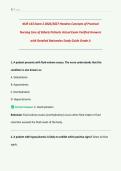
NUR 163 Exam 2 2026/2027 Hondros Concepts of Practical

Nursing Care of Elderly Patients Actual Exam Verified Answers

with Detailed Rationales Study Guide Grade A


1. A patient presents with fluid volume excess. The nurse understands that this

condition is also known as:

A. Dehydration

B. Hypovolemia

C. Overhydration

D. Hypernatremia

Correct Answer: C. Overhydration

Rationale: Fluid volume excess (overhydration) occurs when fluid intake or fluid

retention exceeds the fluid needs of the body.


2. A patient with hypocalcemia is likely to exhibit which positive signs? Select all that

apply.

,2|Page


A. Positive Chvostek's sign

B. Positive Trousseau's sign

C. Muscle twitching

D. Bradycardia

Correct Answer: A, B, C

Rationale: Signs of hypocalcemia include positive Chvostek's sign (facial muscle

twitching when the facial nerve is tapped), positive Trousseau's sign (carpal spasm when

blood pressure cuff is inflated), and muscle twitching.


3. A patient with hyperkalemia requires monitoring for which complication?

A. Hypotension

B. Cardiac dysrhythmias

C. Respiratory alkalosis

D. Hyperglycemia

Correct Answer: B. Cardiac dysrhythmias

Rationale: Hyperkalemia can cause cardiac dysrhythmias, requiring close cardiac

monitoring, ECG, and potassium level checks.


4. Which older adult population is at highest risk for fluid volume excess?

, 3|Page


A. Patients with diabetes

B. Patients with renal failure

C. Patients with hypertension

D. Patients with anemia

Correct Answer: B. Patients with renal failure

Rationale: Older adults with renal failure are at highest risk for fluid volume excess due

to decreased kidney function and fluid retention.


5. Which interventions are appropriate for a patient with fluid volume excess? Select

all that apply.

A. Administering diuretics

B. Monitoring intake and output

C. Assessing daily weights

D. Restricting fluids and sodium

Correct Answer: A, B, C, D

Rationale: Interventions for fluid volume excess include administering diuretics,

monitoring intake and output, assessing daily weights, and restricting fluids and sodium.

Document information

Uploaded on
April 8, 2026
Number of pages
29
Written in
2025/2026
Type
Exam (elaborations)
Contains
Questions & answers
$12.49

Wrong document? Swap it for free Within 14 days of purchase and before downloading, you can choose a different document. You can simply spend the amount again.
Written by students who passed
Immediately available after payment
Read online or as PDF

Seller avatar
Reputation scores are based on the amount of documents a seller has sold for a fee and the reviews they have received for those documents. There are three levels: Bronze, Silver and Gold. The better the reputation, the more your can rely on the quality of the sellers work.
DoctorKen
3.8
(157)
Sold
857
Followers
119
Items
6584
Last sold
9 hours ago


Why students choose Stuvia

Created by fellow students, verified by reviews

Quality you can trust: written by students who passed their tests and reviewed by others who've used these notes.

Didn't get what you expected? Choose another document

No worries! You can instantly pick a different document that better fits what you're looking for.

Pay as you like, start learning right away

No subscription, no commitments. Pay the way you're used to via credit card and download your PDF document instantly.

Student with book image

“Bought, downloaded, and aced it. It really can be that simple.”

Alisha Student

Working on your references?

Create accurate citations in APA, MLA and Harvard with our free citation generator.

Working on your references?

Frequently asked questions

