

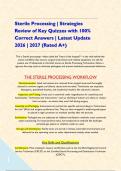
Review of Key Quizzes with 100%
Correct Answers | Latest Update
This is Sterile processing—often called the "heart of the hospital"—is the vital behind-the-
scenes workflow that ensures surgical instruments and medical equipment are safe for
patient use. Professionals in this field, known as Sterile Processing Technicians, follow a
rigorous five-step cycle to eliminate pathogens and prevent healthcare-associated infections.
THE STERILE PROCESSING WORKFLOW
Decontamination: Used instruments are received from surgical areas and thoroughly
cleaned to remove organic soil (blood, tissue) and microbes. Technicians use enzymatic
detergents, specialized brushes, and mechanical washers like ultrasonic cleaners.
Inspection and Testing: Every tool is examined under magnification for cleanliness and
functionality. Technicians test instruments—such as checking if scissors are sharp or clamps
lock correctly—to ensure they won't fail during surgery.
Assembly and Packaging: Instruments are sorted into specific sets according to "Instructions
for Use" (IFUs) and surgeon preference lists. They are then wrapped in medical-grade paper
or placed in rigid containers to maintain sterility after the process.
Sterilization: Packaged sets are subjected to validated sterilization methods, most commonly
steam autoclaving. For heat-sensitive items, low-temperature methods like hydrogen
peroxide gas plasma or ethylene oxide are used.
Storage and Distribution: Sterile items are stored in climate-controlled environments and
delivered to the operating room or other departments exactly when needed.
Key Skills and Qualifications
Certifications: Most employers require certification such as the Certified Registered Central
Service Technician (CRCST) or the Certified Sterile Processing and Distribution Technician
(CSPDT).
1
, Knowledge Base: Understanding of microbiology, anatomy, medical terminology, and
complex sterilization standards (e.g., ANSI/AAMI ST79).
Physical Demands: The role involves standing for long shifts, lifting trays (up to 25 lbs), and
working with high-pressure steam and chemicals while wearing Personal Protective
Equipment (PPE).
Quiz_________________?
...at the beginning and end of each shift -
ANSWER✅
Horizontal work surfaces in the decontamination area should be cleaned and disinfected
Quiz_________________?
1 to 1 1/2 times -
ANSWER✅
When applying instrument marking tape, it should be wrapped ____ times around the
instrument
Quiz_________________?
15 seconds -
ANSWER✅
Minimum length of time Central Service Technicians should scrub their hands during handing
washing
Quiz_________________?
250 degrees F (121 degrees C)
270 degrees F (132.2 - 134 degrees C) -
2
, ANSWER✅
Namethe two most commonly used temperatures for steam sterilization
Quiz_________________?
4 air exchanges per hour -
ANSWER✅
Recommended air exchanges for the clean/sterile storage area of the Central Service
Department
Quiz_________________?
60 - 65 degrees F
(10 - 18 degrees C) -
ANSWER✅
Recommended temperature for the Decontamination area of Central Service
Quiz_________________?
A cord of fibrous tissue that attached a muscle to a bone -
ANSWER✅
Tendon
Quiz_________________?
A succession of progressively more responsible professional positions that serves as the
foundation of a professional development plan -
ANSWER✅
Career Ladder
3
Correct Answers | Latest Update
This is Sterile processing—often called the "heart of the hospital"—is the vital behind-the-
scenes workflow that ensures surgical instruments and medical equipment are safe for
patient use. Professionals in this field, known as Sterile Processing Technicians, follow a
rigorous five-step cycle to eliminate pathogens and prevent healthcare-associated infections.
THE STERILE PROCESSING WORKFLOW
Decontamination: Used instruments are received from surgical areas and thoroughly
cleaned to remove organic soil (blood, tissue) and microbes. Technicians use enzymatic
detergents, specialized brushes, and mechanical washers like ultrasonic cleaners.
Inspection and Testing: Every tool is examined under magnification for cleanliness and
functionality. Technicians test instruments—such as checking if scissors are sharp or clamps
lock correctly—to ensure they won't fail during surgery.
Assembly and Packaging: Instruments are sorted into specific sets according to "Instructions
for Use" (IFUs) and surgeon preference lists. They are then wrapped in medical-grade paper
or placed in rigid containers to maintain sterility after the process.
Sterilization: Packaged sets are subjected to validated sterilization methods, most commonly
steam autoclaving. For heat-sensitive items, low-temperature methods like hydrogen
peroxide gas plasma or ethylene oxide are used.
Storage and Distribution: Sterile items are stored in climate-controlled environments and
delivered to the operating room or other departments exactly when needed.
Key Skills and Qualifications
Certifications: Most employers require certification such as the Certified Registered Central
Service Technician (CRCST) or the Certified Sterile Processing and Distribution Technician
(CSPDT).
1
, Knowledge Base: Understanding of microbiology, anatomy, medical terminology, and
complex sterilization standards (e.g., ANSI/AAMI ST79).
Physical Demands: The role involves standing for long shifts, lifting trays (up to 25 lbs), and
working with high-pressure steam and chemicals while wearing Personal Protective
Equipment (PPE).
Quiz_________________?
...at the beginning and end of each shift -
ANSWER✅
Horizontal work surfaces in the decontamination area should be cleaned and disinfected
Quiz_________________?
1 to 1 1/2 times -
ANSWER✅
When applying instrument marking tape, it should be wrapped ____ times around the
instrument
Quiz_________________?
15 seconds -
ANSWER✅
Minimum length of time Central Service Technicians should scrub their hands during handing
washing
Quiz_________________?
250 degrees F (121 degrees C)
270 degrees F (132.2 - 134 degrees C) -
2
, ANSWER✅
Namethe two most commonly used temperatures for steam sterilization
Quiz_________________?
4 air exchanges per hour -
ANSWER✅
Recommended air exchanges for the clean/sterile storage area of the Central Service
Department
Quiz_________________?
60 - 65 degrees F
(10 - 18 degrees C) -
ANSWER✅
Recommended temperature for the Decontamination area of Central Service
Quiz_________________?
A cord of fibrous tissue that attached a muscle to a bone -
ANSWER✅
Tendon
Quiz_________________?
A succession of progressively more responsible professional positions that serves as the
foundation of a professional development plan -
ANSWER✅
Career Ladder
3


