

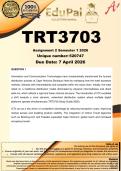
TRT3703
Assignment 2 Semester 1 2026
Unique number: 520747
Due Date: 7 April 2026
QUESTION 1
Information and Communication Technologies have fundamentally transformed the tourism
distribution process at Cape Horizons Boutique Hotel by reshaping how the hotel accesses
markets, interacts with intermediaries and competes within the value chain. Initially, the hotel
relied on a traditional distribution model dominated by physical intermediaries and direct
walk-ins, which reflects a rigid and linear channel structure. The introduction of ICTs enabled
a shift towards a more dynamic, networked distribution system where multiple digital
platforms operate simultaneously (TRT3703 Study Guide 2020).
ICTs act as a key driver of competitive advantage by reducing transaction costs, improving
market access and enabling product visibility. The integration of Online Travel Agencies
such as Booking.com and Expedia expanded Cape Horizons’ global reach and increased
occupancy levels.
Terms of use
By making use of this document you agree to:
Use this document as a guide for learning, comparison and reference purpose,
Terms of use
Not to duplicate, reproduce and/or misrepresent the contents of this document as your own work,
By making use of this document you agree to:
Use this document
Fully accept the consequences
solely as a guide forshould you plagiarise
learning, reference,orand
misuse this document.
comparison purposes,
Ensure originality of your own work, and fully accept the consequences should you plagiarise or misuse this document.
Comply with all relevant standards, guidelines, regulations, and legislation governing academic and written work.
Disclaimer
Great care has been taken in the preparation of this document; however, the contents are provided "as is" without any express or
implied representations or warranties. The author accepts no responsibility or liability for any actions taken based on the
information contained within this document. This document is intended solely for comparison, research, and reference purposes.
Reproduction, resale, or transmission of any part of this document, in any form or by any means, is strictly prohibited.
, +27 81 278 3372
QUESTION 1
Information and Communication Technologies have fundamentally transformed the
tourism distribution process at Cape Horizons Boutique Hotel by reshaping how the
hotel accesses markets, interacts with intermediaries and competes within the value
chain. Initially, the hotel relied on a traditional distribution model dominated by
physical intermediaries and direct walk-ins, which reflects a rigid and linear channel
structure. The introduction of ICTs enabled a shift towards a more dynamic,
networked distribution system where multiple digital platforms operate
simultaneously (TRT3703 Study Guide 2020).
ICTs act as a key driver of competitive advantage by reducing transaction costs,
improving market access and enabling product visibility. The integration of Online
Travel Agencies such as Booking.com and Expedia expanded Cape Horizons’ global
reach and increased occupancy levels. This aligns with the argument that ICT
transforms the value chain by enabling firms to perform multiple distribution functions
more efficiently and competitively (Berne, Garcia-Gonzalez and Mugica 2012). The
hotel’s ability to distribute inventory across multiple platforms demonstrates how ICT
enhances both market power and channel participation. However, the high
commission fees show that competitive advantage is not automatic but must be
strategically managed.
Before ICTs could yield these advantages, Cape Horizons needed to meet certain
prerequisites. These included implementing an integrated Property Management
System, adopting a Channel Manager, and developing a functional booking engine.
Without these foundational systems, ICT adoption would not translate into
operational efficiency or improved customer experience. Porter’s view that
technology alone does not guarantee advantage unless supported by organisational
capability is evident here (Porter 2001). The hotel also needed digital marketing
competence, such as Search Engine Marketing, although its weak performance
shows that capability gaps still exist.
The transition from traditional to digital channels reflects broader re-engineering of
travel intermediation. Disintermediation is evident where the hotel now secures 22
percent of bookings directly through its website, reducing reliance on traditional
Disclaimer
Great care has been taken in the preparation of this document; however, the contents are provided "as is"
without any express or implied representations or warranties. The author accepts no responsibility or
liability for any actions taken based on the information contained within this document. This document is
intended solely for comparison, research, and reference purposes. Reproduction, resale, or transmission
of any part of this document, in any form or by any means, is strictly prohibited.
Assignment 2 Semester 1 2026
Unique number: 520747
Due Date: 7 April 2026
QUESTION 1
Information and Communication Technologies have fundamentally transformed the tourism
distribution process at Cape Horizons Boutique Hotel by reshaping how the hotel accesses
markets, interacts with intermediaries and competes within the value chain. Initially, the hotel
relied on a traditional distribution model dominated by physical intermediaries and direct
walk-ins, which reflects a rigid and linear channel structure. The introduction of ICTs enabled
a shift towards a more dynamic, networked distribution system where multiple digital
platforms operate simultaneously (TRT3703 Study Guide 2020).
ICTs act as a key driver of competitive advantage by reducing transaction costs, improving
market access and enabling product visibility. The integration of Online Travel Agencies
such as Booking.com and Expedia expanded Cape Horizons’ global reach and increased
occupancy levels.
Terms of use
By making use of this document you agree to:
Use this document as a guide for learning, comparison and reference purpose,
Terms of use
Not to duplicate, reproduce and/or misrepresent the contents of this document as your own work,
By making use of this document you agree to:
Use this document
Fully accept the consequences
solely as a guide forshould you plagiarise
learning, reference,orand
misuse this document.
comparison purposes,
Ensure originality of your own work, and fully accept the consequences should you plagiarise or misuse this document.
Comply with all relevant standards, guidelines, regulations, and legislation governing academic and written work.
Disclaimer
Great care has been taken in the preparation of this document; however, the contents are provided "as is" without any express or
implied representations or warranties. The author accepts no responsibility or liability for any actions taken based on the
information contained within this document. This document is intended solely for comparison, research, and reference purposes.
Reproduction, resale, or transmission of any part of this document, in any form or by any means, is strictly prohibited.
, +27 81 278 3372
QUESTION 1
Information and Communication Technologies have fundamentally transformed the
tourism distribution process at Cape Horizons Boutique Hotel by reshaping how the
hotel accesses markets, interacts with intermediaries and competes within the value
chain. Initially, the hotel relied on a traditional distribution model dominated by
physical intermediaries and direct walk-ins, which reflects a rigid and linear channel
structure. The introduction of ICTs enabled a shift towards a more dynamic,
networked distribution system where multiple digital platforms operate
simultaneously (TRT3703 Study Guide 2020).
ICTs act as a key driver of competitive advantage by reducing transaction costs,
improving market access and enabling product visibility. The integration of Online
Travel Agencies such as Booking.com and Expedia expanded Cape Horizons’ global
reach and increased occupancy levels. This aligns with the argument that ICT
transforms the value chain by enabling firms to perform multiple distribution functions
more efficiently and competitively (Berne, Garcia-Gonzalez and Mugica 2012). The
hotel’s ability to distribute inventory across multiple platforms demonstrates how ICT
enhances both market power and channel participation. However, the high
commission fees show that competitive advantage is not automatic but must be
strategically managed.
Before ICTs could yield these advantages, Cape Horizons needed to meet certain
prerequisites. These included implementing an integrated Property Management
System, adopting a Channel Manager, and developing a functional booking engine.
Without these foundational systems, ICT adoption would not translate into
operational efficiency or improved customer experience. Porter’s view that
technology alone does not guarantee advantage unless supported by organisational
capability is evident here (Porter 2001). The hotel also needed digital marketing
competence, such as Search Engine Marketing, although its weak performance
shows that capability gaps still exist.
The transition from traditional to digital channels reflects broader re-engineering of
travel intermediation. Disintermediation is evident where the hotel now secures 22
percent of bookings directly through its website, reducing reliance on traditional
Disclaimer
Great care has been taken in the preparation of this document; however, the contents are provided "as is"
without any express or implied representations or warranties. The author accepts no responsibility or
liability for any actions taken based on the information contained within this document. This document is
intended solely for comparison, research, and reference purposes. Reproduction, resale, or transmission
of any part of this document, in any form or by any means, is strictly prohibited.


