

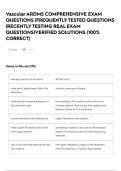
Vascular ARDMS COMPREHENSIVE EXAM
QUESTIONS |FREQUENTLY TESTED QUESTIONS
|RECENTLY TESTING REAL EXAM
QUESTIONS|VERIFIED SOLUTIONS (100%
CORRECT)
Save
Terms in this set (175)
average velocity of the aorta 60-100 cm/s
what aortic pathologies affect the stenosis, aneurysm, plaque
branches
what are the normal waveforms of low resistance flow pattern with continuous
the proximal aorta forward diastolic flow by the liver spleen, and
kidneys (similar to ICA waveform)
normal waveforms for distal aorta higher resistance flow pattern
what causes the distal aorta to be peripheral resistance and due to the triphasic
more high resistive nature of the aortic branches (reversal during
diastole)
why is the proximal aorta more high the highly metabolic organs of the abdomen
low resistive need forward flow in systole and diastole
, whats the most superior brach of celiac artery
the aorta arising from the anterior
surface
where to 95% of celiac arteries bif 1-3 cm from origin
what does the eliac artery bif into common hepatic, splenic, and left gastric
which pane is the celiac best seen transverse
in
what is the normal waveform for the low resistance flow due to the vascular beds of
celiac the liver and spleen with continuous forward flow
during diastole
what happens if the celiac occludes collateralization throught the
pancreaticoduodenal arterial arcade-network of
small vessels surrounding the pancreas and
duodenum (feed into duodenum then into the
common hepatic)
how does the splenic artery run it follows a tortuous course long the posterior,
superior pancreatic body and tail with several
pancreatic and gastric branches
where does the splenic artery it is a branch off of the celiac axis
originate
where does the splenic artery ends as branches in the splenic hilum
terminate
what is the normal splenic artery turbulent flow due to tortuosity (fig 26-3, 441)
waveform
QUESTIONS |FREQUENTLY TESTED QUESTIONS
|RECENTLY TESTING REAL EXAM
QUESTIONS|VERIFIED SOLUTIONS (100%
CORRECT)
Save
Terms in this set (175)
average velocity of the aorta 60-100 cm/s
what aortic pathologies affect the stenosis, aneurysm, plaque
branches
what are the normal waveforms of low resistance flow pattern with continuous
the proximal aorta forward diastolic flow by the liver spleen, and
kidneys (similar to ICA waveform)
normal waveforms for distal aorta higher resistance flow pattern
what causes the distal aorta to be peripheral resistance and due to the triphasic
more high resistive nature of the aortic branches (reversal during
diastole)
why is the proximal aorta more high the highly metabolic organs of the abdomen
low resistive need forward flow in systole and diastole
, whats the most superior brach of celiac artery
the aorta arising from the anterior
surface
where to 95% of celiac arteries bif 1-3 cm from origin
what does the eliac artery bif into common hepatic, splenic, and left gastric
which pane is the celiac best seen transverse
in
what is the normal waveform for the low resistance flow due to the vascular beds of
celiac the liver and spleen with continuous forward flow
during diastole
what happens if the celiac occludes collateralization throught the
pancreaticoduodenal arterial arcade-network of
small vessels surrounding the pancreas and
duodenum (feed into duodenum then into the
common hepatic)
how does the splenic artery run it follows a tortuous course long the posterior,
superior pancreatic body and tail with several
pancreatic and gastric branches
where does the splenic artery it is a branch off of the celiac axis
originate
where does the splenic artery ends as branches in the splenic hilum
terminate
what is the normal splenic artery turbulent flow due to tortuosity (fig 26-3, 441)
waveform


