

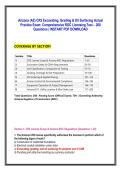
Arizona (AZ) CR2 Excavating, Grading & Oil Surfacing Actual
Practice Exam: Comprehensive ROC Licensing Test – 200
Questions | INSTANT PDF DOWNLOAD
COVERAGE BY SECTION
Section Title Questions
1 CR2 License Scope & Arizona ROC Regulations 1–25
2 Excavation Safety & OSHA Requirements 26–50
3 Soil Classification, Compaction & Testing 51–75
4 Grading, Drainage & Site Preparation 76–100
5 Oil Surfacing & Asphalt Paving 101–125
6 Erosion Control & Environmental Compliance 126–145
7 Equipment Operation & Project Management 146–170
8 Arizona 811, Utility Location & Blue Stake Law 171–200
Total Questions: 200 | Passing Score (Official Exam): 70% | Governing Authority:
Arizona Registrar of Contractors (ROC)
Section 1: CR2 License Scope & Arizona ROC Regulations (Questions 1–25)
1. The Arizona CR2 license specifically authorizes the licensee to perform which of
the following types of work?
a) Construction of residential foundations
b) Electrical conduit installation under slabs
c) Excavating, grading, and oil surfacing for projects over $1,000
d) Plumbing and utility line trenching as a primary contractor
,Explanation *The CR2 license is defined for contracting work in excavating, grading, and
oil surfacing where the total cost of one or more contracts is $1,000 or more, as established
by the Arizona Registrar of Contractors under A.R.S. § 32-1121. The CR2 is a dual
classification that includes both commercial (A-5) and residential (R-2) work scopes. *
2. Which of the following is NOT within the authorized scope of the CR2 license?
a) Digging and trenching
b) Grading and compacting
c) Horizontal boring and filling
d) Excavating for water, gas, or oil wells
Explanation *The CR2/A-5 license specifically excludes excavating for water, gas, or oil
wells. That work falls under the A-4 Drilling classification or A-16 Waterworks classification.
The CR2 allows digging, trenching, grading, horizontal boring, compacting, filling, and oil
surfacing.
3. According to Arizona law, when is a contractor license required for excavation
work?
a) Only for projects exceeding $5,000
b) Only when a building permit is required
c) Only for commercial projects
d) When labor and materials exceed $1,000 OR a permit is required (regardless of
price)
Explanation *Under A.R.S. § 32-1121(A)(14), anyone who performs work involving labor,
materials, or both valued at $1,000 or more, or work that requires a building permit, must be
licensed as a contractor in Arizona. This applies to all business structures including sole
proprietors, LLCs, corporations, and partnerships. *
4. What is the primary responsibility of a "qualifying party" for a CR2 license?
a) Operating all heavy equipment on site
b) Handling all payroll and accounting
c) Having the necessary experience, knowledge, and skills to supervise the
contracting work
d) Obtaining all material purchases
,Explanation The qualifying party is the regularly employed person with the required
experience who serves as the responsible managing employee for the license. All persons
listed on the license are responsible for the contracting activities of the business. The
qualifying party must have 4 years of verifiable experience and pass the trade exam.
5. Under A.R.S. § 32-1153, what is the consequence for an unlicensed contractor
performing work?
a) The contractor can still file a mechanics lien
b) The contractor can sue for payment after 30 days
c) The contract is void and unenforceable; the contractor cannot sue for payment
d) Only a warning is issued for first offense
Explanation *Under A.R.S. § 32-1153, an unlicensed contractor cannot sue for payment,
even if the work is completed or the owner benefited. This applies to written contracts, oral
agreements, and subcontractor relationships. Unlicensed contracting is also a misdemeanor
with penalties up to 6 months in jail and minimum $1,000 fine for first offense. *
6. Which agency administers contractor licensing in Arizona?
a) Arizona Department of Transportation (ADOT)
b) Arizona State Legislature
c) Arizona Registrar of Contractors (ROC)
d) Arizona Corporation Commission
Explanation The Arizona Registrar of Contractors (ROC) administers contractor licensing
under Title 32, Chapter 10 of the Arizona Revised Statutes. The ROC determines who must
be licensed, license classifications and scopes of work, bonding and exam requirements,
and enforces penalties for violations.
7. What is the minimum experience requirement to qualify for a CR2 license?
a) 2 years of verifiable experience
b) 3 years of verifiable experience
c) 4 years of verifiable experience
d) 5 years of verifiable experience
, Explanation The Arizona ROC requires applicants to have 4 years of verifiable experience
in the trade before applying for the CR2 license. Experience must be documented and
verified by previous employers or other qualified individuals.
8. A CR2 license is classified as which type of license in Arizona?
a) General Commercial Contractor only
b) General Residential Contractor only
c) Dual license covering both commercial (A-5) and residential (R-2) work
d) Specialty trade license only
Explanation *The CR2 is a dual license classification that includes both the commercial A-5
Excavating, Grading and Oil Surfacing scope and the residential R-2 Excavating, Grading
and Oil Surfacing scope. This allows the licensee to perform work on both commercial and
residential projects under a single license number. *
9. Which of the following must be subcontracted by a CR2 licensee?
a) Excavation and trenching
b) Grading and compacting
c) Oil surfacing application
d) Electrical, plumbing, or mechanical work
Explanation *Like other Arizona contractor classifications, the CR2 license does not
authorize electrical, plumbing, air conditioning, or mechanical work. Those trades must be
subcontracted to appropriately licensed contractors (e.g., CR-11 for electrical, CR-19 for
plumbing). *
10. What is the penalty for a first offense of unlicensed contracting in Arizona?
a) $500 fine only
b) 30 days in jail only
c) Up to 6 months in jail and minimum $1,000 fine
d) License suspension only
Explanation *Under A.R.S. § 32-1151, unlicensed contracting is a misdemeanor. First
offense penalties include up to 6 months in jail and a minimum fine of $1,000. Subsequent
offenses carry fines up to $2,500 and longer jail terms. Aggravated cases may include
additional charges for using fake license numbers or working while suspended. *
11. Under A.R.S. § 33-981, what lien rights does an unlicensed contractor have?
a) Full mechanics lien rights after 90 days
b) Limited lien rights for materials only
c) Lien rights if the owner benefited from the work
d) No mechanics lien rights; any lien recorded is void
Practice Exam: Comprehensive ROC Licensing Test – 200
Questions | INSTANT PDF DOWNLOAD
COVERAGE BY SECTION
Section Title Questions
1 CR2 License Scope & Arizona ROC Regulations 1–25
2 Excavation Safety & OSHA Requirements 26–50
3 Soil Classification, Compaction & Testing 51–75
4 Grading, Drainage & Site Preparation 76–100
5 Oil Surfacing & Asphalt Paving 101–125
6 Erosion Control & Environmental Compliance 126–145
7 Equipment Operation & Project Management 146–170
8 Arizona 811, Utility Location & Blue Stake Law 171–200
Total Questions: 200 | Passing Score (Official Exam): 70% | Governing Authority:
Arizona Registrar of Contractors (ROC)
Section 1: CR2 License Scope & Arizona ROC Regulations (Questions 1–25)
1. The Arizona CR2 license specifically authorizes the licensee to perform which of
the following types of work?
a) Construction of residential foundations
b) Electrical conduit installation under slabs
c) Excavating, grading, and oil surfacing for projects over $1,000
d) Plumbing and utility line trenching as a primary contractor
,Explanation *The CR2 license is defined for contracting work in excavating, grading, and
oil surfacing where the total cost of one or more contracts is $1,000 or more, as established
by the Arizona Registrar of Contractors under A.R.S. § 32-1121. The CR2 is a dual
classification that includes both commercial (A-5) and residential (R-2) work scopes. *
2. Which of the following is NOT within the authorized scope of the CR2 license?
a) Digging and trenching
b) Grading and compacting
c) Horizontal boring and filling
d) Excavating for water, gas, or oil wells
Explanation *The CR2/A-5 license specifically excludes excavating for water, gas, or oil
wells. That work falls under the A-4 Drilling classification or A-16 Waterworks classification.
The CR2 allows digging, trenching, grading, horizontal boring, compacting, filling, and oil
surfacing.
3. According to Arizona law, when is a contractor license required for excavation
work?
a) Only for projects exceeding $5,000
b) Only when a building permit is required
c) Only for commercial projects
d) When labor and materials exceed $1,000 OR a permit is required (regardless of
price)
Explanation *Under A.R.S. § 32-1121(A)(14), anyone who performs work involving labor,
materials, or both valued at $1,000 or more, or work that requires a building permit, must be
licensed as a contractor in Arizona. This applies to all business structures including sole
proprietors, LLCs, corporations, and partnerships. *
4. What is the primary responsibility of a "qualifying party" for a CR2 license?
a) Operating all heavy equipment on site
b) Handling all payroll and accounting
c) Having the necessary experience, knowledge, and skills to supervise the
contracting work
d) Obtaining all material purchases
,Explanation The qualifying party is the regularly employed person with the required
experience who serves as the responsible managing employee for the license. All persons
listed on the license are responsible for the contracting activities of the business. The
qualifying party must have 4 years of verifiable experience and pass the trade exam.
5. Under A.R.S. § 32-1153, what is the consequence for an unlicensed contractor
performing work?
a) The contractor can still file a mechanics lien
b) The contractor can sue for payment after 30 days
c) The contract is void and unenforceable; the contractor cannot sue for payment
d) Only a warning is issued for first offense
Explanation *Under A.R.S. § 32-1153, an unlicensed contractor cannot sue for payment,
even if the work is completed or the owner benefited. This applies to written contracts, oral
agreements, and subcontractor relationships. Unlicensed contracting is also a misdemeanor
with penalties up to 6 months in jail and minimum $1,000 fine for first offense. *
6. Which agency administers contractor licensing in Arizona?
a) Arizona Department of Transportation (ADOT)
b) Arizona State Legislature
c) Arizona Registrar of Contractors (ROC)
d) Arizona Corporation Commission
Explanation The Arizona Registrar of Contractors (ROC) administers contractor licensing
under Title 32, Chapter 10 of the Arizona Revised Statutes. The ROC determines who must
be licensed, license classifications and scopes of work, bonding and exam requirements,
and enforces penalties for violations.
7. What is the minimum experience requirement to qualify for a CR2 license?
a) 2 years of verifiable experience
b) 3 years of verifiable experience
c) 4 years of verifiable experience
d) 5 years of verifiable experience
, Explanation The Arizona ROC requires applicants to have 4 years of verifiable experience
in the trade before applying for the CR2 license. Experience must be documented and
verified by previous employers or other qualified individuals.
8. A CR2 license is classified as which type of license in Arizona?
a) General Commercial Contractor only
b) General Residential Contractor only
c) Dual license covering both commercial (A-5) and residential (R-2) work
d) Specialty trade license only
Explanation *The CR2 is a dual license classification that includes both the commercial A-5
Excavating, Grading and Oil Surfacing scope and the residential R-2 Excavating, Grading
and Oil Surfacing scope. This allows the licensee to perform work on both commercial and
residential projects under a single license number. *
9. Which of the following must be subcontracted by a CR2 licensee?
a) Excavation and trenching
b) Grading and compacting
c) Oil surfacing application
d) Electrical, plumbing, or mechanical work
Explanation *Like other Arizona contractor classifications, the CR2 license does not
authorize electrical, plumbing, air conditioning, or mechanical work. Those trades must be
subcontracted to appropriately licensed contractors (e.g., CR-11 for electrical, CR-19 for
plumbing). *
10. What is the penalty for a first offense of unlicensed contracting in Arizona?
a) $500 fine only
b) 30 days in jail only
c) Up to 6 months in jail and minimum $1,000 fine
d) License suspension only
Explanation *Under A.R.S. § 32-1151, unlicensed contracting is a misdemeanor. First
offense penalties include up to 6 months in jail and a minimum fine of $1,000. Subsequent
offenses carry fines up to $2,500 and longer jail terms. Aggravated cases may include
additional charges for using fake license numbers or working while suspended. *
11. Under A.R.S. § 33-981, what lien rights does an unlicensed contractor have?
a) Full mechanics lien rights after 90 days
b) Limited lien rights for materials only
c) Lien rights if the owner benefited from the work
d) No mechanics lien rights; any lien recorded is void


