

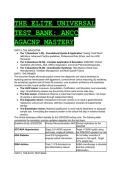
THE ELITE UNIVERSAL
TEST BANK: ANCC
AGACNP MASTERY
PART 0: THE NAVIGATOR
● Tier 1 (Questions 1–28) - Foundational Syntax & Application: Testing "Hard Deck"
definitions, Advanced Practice guidelines, Professional Role, Ethics, and the LACE
framework.
● Tier 2 (Questions 29–58) - Complex Application & Simulation: 2026/2027 Clinical
Guidelines (ACC/AHA, ADA, GINA), Diagnostics, and Acute Pharmacotherapeutics.
● Tier 3 (Questions 59–88) - Grandmaster Synthesis: High-Stakes Critical Care,
Hemodynamics, Ventilator Management, and Multi-System Failure.
PART I: THE PRIMER
This document forges advanced practice nurses into diagnostic and clinical tacticians by
replacing passive memorization with aggressive, context-driven clinical reasoning. By mastering
the escalating cognitive load of these 88 scenarios, your academic proficiency will seamlessly
translate into elite, board-certified clinical competence.
● The LACE Axiom: Licensure, Accreditation, Certification, and Education must universally
align; Grandfathering clauses are the primary friction point across state lines.
● The Role Axiom: Institutional influence is maximized via hospital committees ; full scope
of practice is demonstrated through independent billing.
● The Diagnostic Axiom: Unexplained microcytic anemia in an adult is gastrointestinal
malignancy until proven otherwise; definitive visualization precedes all supplemental
therapy.
● The Biostatistics Axiom: Statistical significance is most heavily dependent on adequate
sample size. Formulating the research problem is the critical first step in evidence-based
practice.
The clinical landscape shifted radically for the 2025/2026 testing cycle. The following table
summarizes the mandatory practice updates integrated into this test bank:
Guideline Entity (2025/2026) Primary Recommendation Shift Clinical Implication for the
AGACNP
ACC/AHA Hypertension Stage 2 (≥140/90) requires Target <130/80 rapidly using
dual-class, single-pill initiation. the PREVENT equation for risk.
ADA Diabetes Level 2/3 Hypoglycemia Do not delay correction if
requires instant intervention. glucose is <54 mg/dL. Target
5-7% weight loss.
GINA Asthma Track 1: ICS-formoterol as SABA monotherapy is obsolete;
anti-inflammatory reliever. treat the underlying
inflammation.
PART II: THE ELITE TEST BANK
,Q1: An Adult-Gerontology Primary Care Nurse Practitioner (AGPCNP) relocates to a state that
has fully adopted the APRN Consensus Model. The NP holds a generic "Adult NP" certification
from 2005. Based on the principles of the Consensus Model (LACE framework), which
regulatory factor presents the MOST ACCURATE barrier to practice? A) The state board's
failure to recognize the original university's accreditation. B) The strict application of licensure
requirements without flexible grandfathering clauses. C) The requirement to complete a
mandatory fellowship prior to state licensure. D) The inability to obtain an independent DEA
number for controlled substances.
● The Answer: B (The strict application of licensure requirements without flexible
grandfathering clauses.)
● Distractor Analysis:
○ A is incorrect: Accreditation applies to the educational institution at the time of
graduation, which is rarely revoked retroactively.
○ C is incorrect: Fellowships are institutional preferences, not legally mandated LACE
pillars.
○ D is incorrect: DEA registration is a federal process contingent upon state licensure,
not the primary LACE barrier.
The Mentor's Analysis: The Consensus Model separated "Adult" into "Acute" and "Primary"
tracks. When facing cross-state licensure, the immediate priority is verifying alignment of the
four pillars. By utilizing Grandfathering provisions, you bypass the common trap of forced
re-education. Professional Intuition: LACE requires exact alignment; older generic
degrees face licensure friction in fully adopted states.
Q2: An AGACNP wishes to implement a new evidence-based protocol for a Rapid Response
Team (RRT) but requires additional institutional funding. Based on the principles of Professional
Advocacy, which action is the FIRST and most effective strategy? A) Petition the local
government for state-level grant funding. B) Describe to the administration how the team will be
expanded geographically. C) Stress the importance of the team by presenting literature on how
the RRT affects patient outcomes. D) Organize a strike to highlight the dangers of inadequate
staffing.
● The Answer: C (Stress the importance of the team by presenting literature on how the
RRT affects patient outcomes.)
● Distractor Analysis:
○ A is incorrect: State funding is inefficient and inappropriate for an internal hospital
operational budget.
○ B is incorrect: Expansion mechanics mean nothing to administration without first
proving outcome-based return on investment.
○ D is incorrect: Striking is an extreme labor action, not a professional advocacy
strategy.
The Mentor's Analysis: Hospital administrators operate on metrics of safety, length of stay, and
mortality. When facing funding deficits, the immediate priority is proving value. By utilizing
Outcome-based evidence, you bypass the common trap of emotional pleading. Professional
Intuition: Always link clinical initiatives directly to measurable patient outcomes when
requesting institutional resources.
Q3: A pharmaceutical representative offers an AGACNP an honorarium to speak at a dinner,
requesting the NP explicitly state their medication is the "only effective treatment" for a specific
condition despite evidence to the contrary. Based on the principles of Healthcare Ethics, this
request violates which core concepts? A) Beneficence and Autonomy B) Veracity and Fidelity C)
Justice and Nonmaleficence D) Paternalism and Utility
, ● The Answer: B (Veracity and Fidelity)
● Distractor Analysis:
○ A is incorrect: Autonomy refers to patient self-determination, which is not the
primary issue in a corporate speaking engagement.
○ C is incorrect: Justice involves fair resource allocation, not truth-telling.
○ D is incorrect: Paternalism is making decisions for a patient, which does not apply
here.
The Mentor's Analysis: Ethics govern the NP's relationship with both patients and the public.
When facing corporate pressure, the immediate priority is maintaining truthfulness. By utilizing
Veracity (truth-telling) and Fidelity (loyalty), you bypass the common trap of commercial bias.
Professional Intuition: Truthfulness (Veracity) cannot be compromised for financial gain.
Q4: An AGACNP is transitioning out of a private cardiology practice. Based on the principles of
Legal Practice Management, which action is the provider legally required to execute to avoid
abandonment? A) Transfer all patient records to the local emergency department. B) Send a
certified letter with a return receipt requested to all active patients. C) Keep all patient records in
an unsecured personal file for five years. D) Provide patients with adequate time and resources
to find another provider.
● The Answer: D (Provide patients with adequate time and resources to find another
provider.)
● Distractor Analysis:
○ A is incorrect: Transferring records to an ED violates HIPAA and places undue
burden on acute care facilities.
○ B is incorrect: While good business practice, a certified letter is a method, not the
overarching legal requirement itself.
○ C is incorrect: Records must be secured (HIPAA), and retention laws vary by state.
The Mentor's Analysis: Closing a practice carries a high risk of patient abandonment claims.
When facing practice closure, the immediate priority is ensuring continuity of care. By utilizing
Adequate Notice, you bypass the common trap of negligence. Professional Intuition:
Avoiding abandonment requires giving the patient a reasonable timeframe to secure
alternative care.
---
Q5: An AGACNP is initiating a quality improvement project. Based on the components of the
Evidence-Based Research Process, which step must the NP complete FIRST and is the most
important to participate in? A) Formulating the hypothesis. B) Specifying methods of data
collection. C) Formulating the research problem. D) Conducting a randomized controlled trial.
● The Answer: C (Formulating the research problem.)
● Distractor Analysis:
○ A is incorrect: A hypothesis cannot be generated without first defining the clinical
problem.
○ B is incorrect: Data collection methods are designed only after the problem is
established.
○ D is incorrect: RCTs generate new knowledge; quality improvement utilizes existing
knowledge.
The Mentor's Analysis: Research must be anchored to a specific clinical deficit. When facing a
unit-based issue, the immediate priority is clearly defining the scope. By utilizing Problem
Formulation, you bypass the common trap of aimless data collection. Professional Intuition:
You cannot solve a problem or design a study until the clinical problem is explicitly
defined.
, Q6: A disgruntled former patient publishes false, written accusations on a public blog stating an
AGACNP operates an illegal prescription mill. Based on the principles of Medical Malpractice
and Law, this act is MOST accurately defined as: A) Slander B) Libel C) Assault D) Battery
● The Answer: B (Libel)
● Distractor Analysis:
○ A is incorrect: Slander is spoken defamation; the scenario specifies written
accusations.
○ C is incorrect: Assault is the threat of physical harm, not reputational damage.
○ D is incorrect: Battery is actual unconsented physical contact.
The Mentor's Analysis: Defamation damages professional reputation. When facing public
accusations, the immediate priority is identifying the medium. By utilizing the definition of Libel
(written/published), you bypass the common trap of confusing it with Slander (spoken).
Professional Intuition: "L" for Libel, "L" for Literature (Written). "S" for Slander, "S" for
Spoken.
Q7: An AGACNP is asked to provide the hospital credentialing committee with data proving that
central venous catheters placed by NPs have equivalent safety profiles to those placed by
physicians. Based on the Hierarchy of Evidence, which source provides the STRONGEST
data? A) An expert opinion from the Chief of Surgery. B) A single, well-designed Randomized
Controlled Trial (RCT). C) A Systematic Review and Meta-Analysis of multiple RCTs. D) A
retrospective cohort study from a single academic center.
● The Answer: C (A Systematic Review and Meta-Analysis of multiple RCTs.)
● Distractor Analysis:
○ A is incorrect: Expert opinion is the lowest tier of evidence.
○ B is incorrect: A single RCT is strong, but susceptible to single-center bias.
○ D is incorrect: Retrospective studies cannot control for confounding variables
effectively.
The Mentor's Analysis: Evidence strength dictates clinical policy. When facing institutional
scrutiny, the immediate priority is utilizing the apex of evidence. By utilizing Meta-Analyses, you
bypass the common trap of relying on isolated or biased studies. Professional Intuition: The
aggregation of multiple, rigorous RCTs (Meta-Analysis) is the absolute gold standard for
clinical decision-making.
Q8: An 82-year-old patient with end-stage dementia exhausts their private financial resources
while in a skilled nursing facility. Based on the principles of US Healthcare Economics, which
entity will become the primary payer for their long-term custodial care? A) Medicare Part A B)
Medicare Part B C) Medicaid D) Private Health Maintenance Organization (HMO)
● The Answer: C (Medicaid)
● Distractor Analysis:
○ A is incorrect: Medicare Part A covers acute inpatient hospitalizations, not long-term
custodial care.
○ B is incorrect: Medicare Part B covers outpatient services.
○ D is incorrect: Private HMOs rarely cover long-term custodial care indefinitely.
The Mentor's Analysis: Healthcare financing dictates access to long-term care. When facing
asset exhaustion ("spending down"), the immediate priority is transitioning to state-level safety
nets. By utilizing Medicaid, you bypass the common trap of assuming Medicare covers custodial
nursing homes. Professional Intuition: Medicaid pays after insurance and 3rd party payers
have paid; it is the ultimate safety net.
Q9: An AGACNP is reviewing literature to support a new sepsis protocol. The study reports a
reduction in mortality but has a small sample size. Based on the principles of Biostatistics, a
TEST BANK: ANCC
AGACNP MASTERY
PART 0: THE NAVIGATOR
● Tier 1 (Questions 1–28) - Foundational Syntax & Application: Testing "Hard Deck"
definitions, Advanced Practice guidelines, Professional Role, Ethics, and the LACE
framework.
● Tier 2 (Questions 29–58) - Complex Application & Simulation: 2026/2027 Clinical
Guidelines (ACC/AHA, ADA, GINA), Diagnostics, and Acute Pharmacotherapeutics.
● Tier 3 (Questions 59–88) - Grandmaster Synthesis: High-Stakes Critical Care,
Hemodynamics, Ventilator Management, and Multi-System Failure.
PART I: THE PRIMER
This document forges advanced practice nurses into diagnostic and clinical tacticians by
replacing passive memorization with aggressive, context-driven clinical reasoning. By mastering
the escalating cognitive load of these 88 scenarios, your academic proficiency will seamlessly
translate into elite, board-certified clinical competence.
● The LACE Axiom: Licensure, Accreditation, Certification, and Education must universally
align; Grandfathering clauses are the primary friction point across state lines.
● The Role Axiom: Institutional influence is maximized via hospital committees ; full scope
of practice is demonstrated through independent billing.
● The Diagnostic Axiom: Unexplained microcytic anemia in an adult is gastrointestinal
malignancy until proven otherwise; definitive visualization precedes all supplemental
therapy.
● The Biostatistics Axiom: Statistical significance is most heavily dependent on adequate
sample size. Formulating the research problem is the critical first step in evidence-based
practice.
The clinical landscape shifted radically for the 2025/2026 testing cycle. The following table
summarizes the mandatory practice updates integrated into this test bank:
Guideline Entity (2025/2026) Primary Recommendation Shift Clinical Implication for the
AGACNP
ACC/AHA Hypertension Stage 2 (≥140/90) requires Target <130/80 rapidly using
dual-class, single-pill initiation. the PREVENT equation for risk.
ADA Diabetes Level 2/3 Hypoglycemia Do not delay correction if
requires instant intervention. glucose is <54 mg/dL. Target
5-7% weight loss.
GINA Asthma Track 1: ICS-formoterol as SABA monotherapy is obsolete;
anti-inflammatory reliever. treat the underlying
inflammation.
PART II: THE ELITE TEST BANK
,Q1: An Adult-Gerontology Primary Care Nurse Practitioner (AGPCNP) relocates to a state that
has fully adopted the APRN Consensus Model. The NP holds a generic "Adult NP" certification
from 2005. Based on the principles of the Consensus Model (LACE framework), which
regulatory factor presents the MOST ACCURATE barrier to practice? A) The state board's
failure to recognize the original university's accreditation. B) The strict application of licensure
requirements without flexible grandfathering clauses. C) The requirement to complete a
mandatory fellowship prior to state licensure. D) The inability to obtain an independent DEA
number for controlled substances.
● The Answer: B (The strict application of licensure requirements without flexible
grandfathering clauses.)
● Distractor Analysis:
○ A is incorrect: Accreditation applies to the educational institution at the time of
graduation, which is rarely revoked retroactively.
○ C is incorrect: Fellowships are institutional preferences, not legally mandated LACE
pillars.
○ D is incorrect: DEA registration is a federal process contingent upon state licensure,
not the primary LACE barrier.
The Mentor's Analysis: The Consensus Model separated "Adult" into "Acute" and "Primary"
tracks. When facing cross-state licensure, the immediate priority is verifying alignment of the
four pillars. By utilizing Grandfathering provisions, you bypass the common trap of forced
re-education. Professional Intuition: LACE requires exact alignment; older generic
degrees face licensure friction in fully adopted states.
Q2: An AGACNP wishes to implement a new evidence-based protocol for a Rapid Response
Team (RRT) but requires additional institutional funding. Based on the principles of Professional
Advocacy, which action is the FIRST and most effective strategy? A) Petition the local
government for state-level grant funding. B) Describe to the administration how the team will be
expanded geographically. C) Stress the importance of the team by presenting literature on how
the RRT affects patient outcomes. D) Organize a strike to highlight the dangers of inadequate
staffing.
● The Answer: C (Stress the importance of the team by presenting literature on how the
RRT affects patient outcomes.)
● Distractor Analysis:
○ A is incorrect: State funding is inefficient and inappropriate for an internal hospital
operational budget.
○ B is incorrect: Expansion mechanics mean nothing to administration without first
proving outcome-based return on investment.
○ D is incorrect: Striking is an extreme labor action, not a professional advocacy
strategy.
The Mentor's Analysis: Hospital administrators operate on metrics of safety, length of stay, and
mortality. When facing funding deficits, the immediate priority is proving value. By utilizing
Outcome-based evidence, you bypass the common trap of emotional pleading. Professional
Intuition: Always link clinical initiatives directly to measurable patient outcomes when
requesting institutional resources.
Q3: A pharmaceutical representative offers an AGACNP an honorarium to speak at a dinner,
requesting the NP explicitly state their medication is the "only effective treatment" for a specific
condition despite evidence to the contrary. Based on the principles of Healthcare Ethics, this
request violates which core concepts? A) Beneficence and Autonomy B) Veracity and Fidelity C)
Justice and Nonmaleficence D) Paternalism and Utility
, ● The Answer: B (Veracity and Fidelity)
● Distractor Analysis:
○ A is incorrect: Autonomy refers to patient self-determination, which is not the
primary issue in a corporate speaking engagement.
○ C is incorrect: Justice involves fair resource allocation, not truth-telling.
○ D is incorrect: Paternalism is making decisions for a patient, which does not apply
here.
The Mentor's Analysis: Ethics govern the NP's relationship with both patients and the public.
When facing corporate pressure, the immediate priority is maintaining truthfulness. By utilizing
Veracity (truth-telling) and Fidelity (loyalty), you bypass the common trap of commercial bias.
Professional Intuition: Truthfulness (Veracity) cannot be compromised for financial gain.
Q4: An AGACNP is transitioning out of a private cardiology practice. Based on the principles of
Legal Practice Management, which action is the provider legally required to execute to avoid
abandonment? A) Transfer all patient records to the local emergency department. B) Send a
certified letter with a return receipt requested to all active patients. C) Keep all patient records in
an unsecured personal file for five years. D) Provide patients with adequate time and resources
to find another provider.
● The Answer: D (Provide patients with adequate time and resources to find another
provider.)
● Distractor Analysis:
○ A is incorrect: Transferring records to an ED violates HIPAA and places undue
burden on acute care facilities.
○ B is incorrect: While good business practice, a certified letter is a method, not the
overarching legal requirement itself.
○ C is incorrect: Records must be secured (HIPAA), and retention laws vary by state.
The Mentor's Analysis: Closing a practice carries a high risk of patient abandonment claims.
When facing practice closure, the immediate priority is ensuring continuity of care. By utilizing
Adequate Notice, you bypass the common trap of negligence. Professional Intuition:
Avoiding abandonment requires giving the patient a reasonable timeframe to secure
alternative care.
---
Q5: An AGACNP is initiating a quality improvement project. Based on the components of the
Evidence-Based Research Process, which step must the NP complete FIRST and is the most
important to participate in? A) Formulating the hypothesis. B) Specifying methods of data
collection. C) Formulating the research problem. D) Conducting a randomized controlled trial.
● The Answer: C (Formulating the research problem.)
● Distractor Analysis:
○ A is incorrect: A hypothesis cannot be generated without first defining the clinical
problem.
○ B is incorrect: Data collection methods are designed only after the problem is
established.
○ D is incorrect: RCTs generate new knowledge; quality improvement utilizes existing
knowledge.
The Mentor's Analysis: Research must be anchored to a specific clinical deficit. When facing a
unit-based issue, the immediate priority is clearly defining the scope. By utilizing Problem
Formulation, you bypass the common trap of aimless data collection. Professional Intuition:
You cannot solve a problem or design a study until the clinical problem is explicitly
defined.
, Q6: A disgruntled former patient publishes false, written accusations on a public blog stating an
AGACNP operates an illegal prescription mill. Based on the principles of Medical Malpractice
and Law, this act is MOST accurately defined as: A) Slander B) Libel C) Assault D) Battery
● The Answer: B (Libel)
● Distractor Analysis:
○ A is incorrect: Slander is spoken defamation; the scenario specifies written
accusations.
○ C is incorrect: Assault is the threat of physical harm, not reputational damage.
○ D is incorrect: Battery is actual unconsented physical contact.
The Mentor's Analysis: Defamation damages professional reputation. When facing public
accusations, the immediate priority is identifying the medium. By utilizing the definition of Libel
(written/published), you bypass the common trap of confusing it with Slander (spoken).
Professional Intuition: "L" for Libel, "L" for Literature (Written). "S" for Slander, "S" for
Spoken.
Q7: An AGACNP is asked to provide the hospital credentialing committee with data proving that
central venous catheters placed by NPs have equivalent safety profiles to those placed by
physicians. Based on the Hierarchy of Evidence, which source provides the STRONGEST
data? A) An expert opinion from the Chief of Surgery. B) A single, well-designed Randomized
Controlled Trial (RCT). C) A Systematic Review and Meta-Analysis of multiple RCTs. D) A
retrospective cohort study from a single academic center.
● The Answer: C (A Systematic Review and Meta-Analysis of multiple RCTs.)
● Distractor Analysis:
○ A is incorrect: Expert opinion is the lowest tier of evidence.
○ B is incorrect: A single RCT is strong, but susceptible to single-center bias.
○ D is incorrect: Retrospective studies cannot control for confounding variables
effectively.
The Mentor's Analysis: Evidence strength dictates clinical policy. When facing institutional
scrutiny, the immediate priority is utilizing the apex of evidence. By utilizing Meta-Analyses, you
bypass the common trap of relying on isolated or biased studies. Professional Intuition: The
aggregation of multiple, rigorous RCTs (Meta-Analysis) is the absolute gold standard for
clinical decision-making.
Q8: An 82-year-old patient with end-stage dementia exhausts their private financial resources
while in a skilled nursing facility. Based on the principles of US Healthcare Economics, which
entity will become the primary payer for their long-term custodial care? A) Medicare Part A B)
Medicare Part B C) Medicaid D) Private Health Maintenance Organization (HMO)
● The Answer: C (Medicaid)
● Distractor Analysis:
○ A is incorrect: Medicare Part A covers acute inpatient hospitalizations, not long-term
custodial care.
○ B is incorrect: Medicare Part B covers outpatient services.
○ D is incorrect: Private HMOs rarely cover long-term custodial care indefinitely.
The Mentor's Analysis: Healthcare financing dictates access to long-term care. When facing
asset exhaustion ("spending down"), the immediate priority is transitioning to state-level safety
nets. By utilizing Medicaid, you bypass the common trap of assuming Medicare covers custodial
nursing homes. Professional Intuition: Medicaid pays after insurance and 3rd party payers
have paid; it is the ultimate safety net.
Q9: An AGACNP is reviewing literature to support a new sepsis protocol. The study reports a
reduction in mortality but has a small sample size. Based on the principles of Biostatistics, a


