

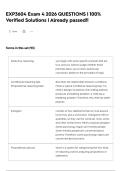
EXP3604 Exam 4 2026 QUESTIONS | 100%
Verified Solutions | Already passed!!
Save
Terms in this set (93)
Deductive reasoning you begin with some specific premises that are
true, and you need to judge whether those
premises allow you to draw a particular
conclusion, based on the principles of logic
Conditional reasoning task describes the relationship between conditions.
(Propositional reasoning task) Here's a typical conditional reasoning task: If a
child is allergic to peanuts, then eating peanuts
produces a breathing problem. A child has a
breathing problem. Therefore, this child has eaten
peanuts.
Syllogism consists of two statements that we must assume
to be true, plus a conclusion. Syllogisms refer to
quantities, so they use the words all, none, some,
and other similar terms. Here's a typical syllogism:
Some psychology majors are friendly people.
Some friendly people are concerned about
poverty. Therefore, some psychology majors are
concerned about poverty.
Propositional calculus which is a system for categorizing the four kinds
of reasoning used in analyzing propositions or
statements.
, Propositions statements
antecedent refers to the first proposition or statement; the
antecedent is contained in the "if..." part of the
sentence.
Consequent refers to the proposition that comes second; it is
the consequence. The consequent is contained in
the "then..." part of the sentence.
Affirming the antecedent it means that you say that the "if..." part of the
sentence is true. As shown in the upper-left
corner of Table 12.1, this kind of reasoning leads
to a valid, or correct, conclusion.
Affirming the consequent means that you say that the "then..." part of the
sentence is true. This kind of reasoning leads to
an invalid conclusion.
Denying the Antecedent means that you say that the"if..."part of the
sentence is false. Denying the antecedent also
leads to an invalid conclusion
Denying the consequent means that you say that the "then..." part of the
sentence is false.
Dual-process theory which distinguishes between two types of
cognitive processing
type 1 processing is fast and automatic; it requires little conscious
attention. For example, we use Type 1 processing
during depth perception, recognition of facial
expression, and automatic stereotyping
Verified Solutions | Already passed!!
Save
Terms in this set (93)
Deductive reasoning you begin with some specific premises that are
true, and you need to judge whether those
premises allow you to draw a particular
conclusion, based on the principles of logic
Conditional reasoning task describes the relationship between conditions.
(Propositional reasoning task) Here's a typical conditional reasoning task: If a
child is allergic to peanuts, then eating peanuts
produces a breathing problem. A child has a
breathing problem. Therefore, this child has eaten
peanuts.
Syllogism consists of two statements that we must assume
to be true, plus a conclusion. Syllogisms refer to
quantities, so they use the words all, none, some,
and other similar terms. Here's a typical syllogism:
Some psychology majors are friendly people.
Some friendly people are concerned about
poverty. Therefore, some psychology majors are
concerned about poverty.
Propositional calculus which is a system for categorizing the four kinds
of reasoning used in analyzing propositions or
statements.
, Propositions statements
antecedent refers to the first proposition or statement; the
antecedent is contained in the "if..." part of the
sentence.
Consequent refers to the proposition that comes second; it is
the consequence. The consequent is contained in
the "then..." part of the sentence.
Affirming the antecedent it means that you say that the "if..." part of the
sentence is true. As shown in the upper-left
corner of Table 12.1, this kind of reasoning leads
to a valid, or correct, conclusion.
Affirming the consequent means that you say that the "then..." part of the
sentence is true. This kind of reasoning leads to
an invalid conclusion.
Denying the Antecedent means that you say that the"if..."part of the
sentence is false. Denying the antecedent also
leads to an invalid conclusion
Denying the consequent means that you say that the "then..." part of the
sentence is false.
Dual-process theory which distinguishes between two types of
cognitive processing
type 1 processing is fast and automatic; it requires little conscious
attention. For example, we use Type 1 processing
during depth perception, recognition of facial
expression, and automatic stereotyping


