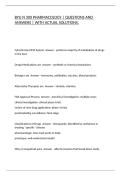
BYU N 300 PHARMACOLOGY | QUESTIONS AND
ANSWERS | WITH ACTUAL SOLUTIONS.
Cytochrome P450 System Answer - performs majority of metabolism of drugs
in the liver.
Drugs/Medications are Answer - synthetic or chemical extractions
Biologics are Answer - hormones, antibodies, vaccines, blood products
Alternative Therapies are Answer - Herbals, vitamins
FDA Approval Process Answer - preclinical investigation: multiple years
clinical investigation: clinical phase trials
review of new drug application: phase 3 trials
postmarketing surveillance: final stage
Classifications of Drugs Answer - therapuetic: identified by usefulness in
treating *specific* disease
pharmacologic: how med works in body
prototype: well-understood model
Why no Grapefruit juice Answer - affects enzymes that break down meds.
,Inactive Drug = Answer - bound to protein
Nursing Responsibilities of Drug Administration Answer - name/classification
of drug, intended use, effect on body, contraindications, special considerations,
side effects, patient specific, supply, route and dose, nursing considerations.
3 Checks Answer - check drug against medication information system, when
preparing it; removing it; or connecting to IV, before administration
Nursing Rights Answer - Right to complete and clear order, right drug route
and dose dispensed, access to info, policies on med administration, administer
meds safely and ID problems in system, stop;think; and be vigilant
Patient Rights Answer - Right to know med name, purpose, action, possible
adverse effects; refuse; qualified nurses/physicians; to be advised; receive, not
to receive
IV Administration Answer - can administer meds and fluids; direct
administration, immediate use, rapid onset, avoid GI tract/first-pass effect.
Calculation Rounding Answer - For an adult: .5 or > round up.
For a child round to lowest whole number (i.e. 8.7 gtts = 8 gtts)
4 Categories of ANS Drugs Answer - parasympathomimetics, anticholinergics,
sympathomimetics, adrenergic antagonists
Other Names for Parasympathomimetics Answer - Muscarinic agonist,
cholinergic agents
, Muscarinic Responses Answer - Miosis, decreased HR, bronchial constriction,
secretion promotion, voiding, generalized sweating, vasodilation (stimulates
parasympathetic system)
Muscarinic Agonist Prototype Answer - Bethanechol (Urecholine)
Action: bind to and activates muscarinic receptors.
Bethanechol Answer - Use: urinary retention
Adverse Effects: hypotension, bradycardia, exacerbation of asthma (bronchial
constriction)
Contraindications: urinary tract obstruction, bladder wall weakness, coronary
insufficiency, hyperthyroidism (causes rebound tachycardia)
Administration: 1 hr before or 2hrs after meals
Overdose: IV atropine, supportive measures
Acetylcholinesterase Inhibitor Uses Answer - Enhance effects of Ach, increase
muscle strength, Alzheimer's Disease
Neostigmine/physostigmine Answer - AchE inhibitor;
Adverse Effects: excessive muscarinic stimulation, neuromuscular block
Drug Interactions: anticholinergics, all neuromuscular blocks.
Anticholinergics Answer - Block parasympathetic system. Compete with Ach.
Anticholinergic Uses Answer - Preanesthesia (increase HR, dry secretions), eye
disorders, bradycardia, muscarinic agonist poisoning.
ANSWERS | WITH ACTUAL SOLUTIONS.
Cytochrome P450 System Answer - performs majority of metabolism of drugs
in the liver.
Drugs/Medications are Answer - synthetic or chemical extractions
Biologics are Answer - hormones, antibodies, vaccines, blood products
Alternative Therapies are Answer - Herbals, vitamins
FDA Approval Process Answer - preclinical investigation: multiple years
clinical investigation: clinical phase trials
review of new drug application: phase 3 trials
postmarketing surveillance: final stage
Classifications of Drugs Answer - therapuetic: identified by usefulness in
treating *specific* disease
pharmacologic: how med works in body
prototype: well-understood model
Why no Grapefruit juice Answer - affects enzymes that break down meds.
,Inactive Drug = Answer - bound to protein
Nursing Responsibilities of Drug Administration Answer - name/classification
of drug, intended use, effect on body, contraindications, special considerations,
side effects, patient specific, supply, route and dose, nursing considerations.
3 Checks Answer - check drug against medication information system, when
preparing it; removing it; or connecting to IV, before administration
Nursing Rights Answer - Right to complete and clear order, right drug route
and dose dispensed, access to info, policies on med administration, administer
meds safely and ID problems in system, stop;think; and be vigilant
Patient Rights Answer - Right to know med name, purpose, action, possible
adverse effects; refuse; qualified nurses/physicians; to be advised; receive, not
to receive
IV Administration Answer - can administer meds and fluids; direct
administration, immediate use, rapid onset, avoid GI tract/first-pass effect.
Calculation Rounding Answer - For an adult: .5 or > round up.
For a child round to lowest whole number (i.e. 8.7 gtts = 8 gtts)
4 Categories of ANS Drugs Answer - parasympathomimetics, anticholinergics,
sympathomimetics, adrenergic antagonists
Other Names for Parasympathomimetics Answer - Muscarinic agonist,
cholinergic agents
, Muscarinic Responses Answer - Miosis, decreased HR, bronchial constriction,
secretion promotion, voiding, generalized sweating, vasodilation (stimulates
parasympathetic system)
Muscarinic Agonist Prototype Answer - Bethanechol (Urecholine)
Action: bind to and activates muscarinic receptors.
Bethanechol Answer - Use: urinary retention
Adverse Effects: hypotension, bradycardia, exacerbation of asthma (bronchial
constriction)
Contraindications: urinary tract obstruction, bladder wall weakness, coronary
insufficiency, hyperthyroidism (causes rebound tachycardia)
Administration: 1 hr before or 2hrs after meals
Overdose: IV atropine, supportive measures
Acetylcholinesterase Inhibitor Uses Answer - Enhance effects of Ach, increase
muscle strength, Alzheimer's Disease
Neostigmine/physostigmine Answer - AchE inhibitor;
Adverse Effects: excessive muscarinic stimulation, neuromuscular block
Drug Interactions: anticholinergics, all neuromuscular blocks.
Anticholinergics Answer - Block parasympathetic system. Compete with Ach.
Anticholinergic Uses Answer - Preanesthesia (increase HR, dry secretions), eye
disorders, bradycardia, muscarinic agonist poisoning.