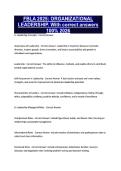
FBLA 2025: ORGANIZATIONAL LEADERSHIP. With correct answers 100% 2026
FBLA 2025: ORGANIZATIONAL LEADERSHIP. With correct answers 100% 2026 A. Leadership Concepts - Correct Answer Importance of Leadership - Correct Answer Leadership is important because it provides direction, inspires people, drives innovation, and fosters accountability and growth in individuals and organizations. Leadership - Correct Answer The ability to influence, motivate, and enable others to contribute toward organizational success. Self-Assessment in Leadership - Correct Answer A tool used to evaluate one's own values, strengths, and areas for improvement to determine leadership potential. Characteristics of Leaders - Correct Answer Include initiative, independence, follow-through, ethics, adaptability, resiliency, positive attitude, confidence, and a record of excellence. B. Leadership Managerial Roles - Correct Answer Interpersonal Roles - Correct Answer Include figurehead, leader, and liaison roles, focusing on relationships and people management. Informational Roles - Correct Answer Include monitor, disseminator, and spokesperson roles to collect and share information. Decisional Roles - Correct Answer Include entrepreneur, disturbance handler, resource allocator, and negotiator roles involving problem-solving and decision-making. Importance of Research - Correct Answer Effective research supports data-driven decisions and reduces uncertainty in leadership. Understanding Perspectives - Correct Answer Appreciating others' viewpoints builds collaboration, trust, and informed decisions. Reflection and Application - Correct Answer Successful leaders reflect on past experiences to prepare for future challenges. Situation Analysis - Correct Answer Leaders analyze situations for a deeper understanding to make better decisions. Systems Thinking - Correct Answer Connecting individual thinking with systems thinking allows for broader understanding and strategic alignment. Evaluating Alternatives - Correct Answer Leaders assess multiple options to choose the best course of action. Generating Ideas - Correct Answer Leaders think beyond convention to create innovative solutions. Problem Solving and Decision Making - Correct Answer Core duties of leaders that drive organizational effectiveness. Self-Understanding - Correct Answer Awareness of personal values, contributions, and competencies guides leadership growth. C. Leadership Behavior and Motivation - Correct Answer Leadership Styles - Correct Answer Include autocratic, democratic, laissez-faire, and transformational; vary in control and involvement. Job-Centered vs Employee-Centered Behavior - Correct Answer Job-centered focuses on task efficiency; employee-centered emphasizes well-being and development. Motivation Process - Correct Answer Involves identifying needs, setting goals, and providing support to meet those goals. Motivation Theories - Correct Answer Include Maslow's Hierarchy, Equity, Expectancy, Reinforcement, and Goal-Setting theories. Maslow's Hierarchy of Needs - Correct Answer Motivation is driven by satisfying needs: physiological, safety, love/belonging, esteem, and self-actualization. Balancing Needs - Correct Answer Leaders help individuals balance professional responsibilities and personal well-being. Equity Theory - Correct Answer Motivation is affected by perceived fairness of input-output ratios compared to others. Expectancy Theory - Correct Answer People are motivated when they believe effort leads to performance and desired outcomes. Reinforcement Theory - Correct Answer Behavior is shaped by rewards and punishments. Goal-Setting Theory - Correct Answer Specific, challenging goals enhance motivation and performance. D. Networking - Correct Answer Professional Networking - Correct Answer Building and maintaining relationships that benefit careers and leadership. Networking and Leadership - Correct Answer Networking supports collaboration, influence, and leadership growth. Advantages of Networks - Correct Answer Help leaders access resources, gain support, and enhance effectiveness. Power of Interpersonal Interaction - Correct Answer Productive interaction builds trust, motivation, and cooperation. Productive Leader Traits - Correct Answer Include empathy, mentoring, empowerment, motivation, collaboration, and effective communication. E. Communication Skills - Correct Answer Communication and Leadership - Correct Answer Effective leadership relies on clear, consistent communication. Communication Process - Correct Answer Includes sender, receiver, message, and feedback. Feedback Approaches - Correct Answer Include surveys, interviews, active listening, and informal check-ins. Nonverbal Communication - Cor
Written for
- Institution
- FBLA Organizational Leadership
- Course
- FBLA Organizational Leadership
Document information
- Uploaded on
- April 2, 2026
- Number of pages
- 12
- Written in
- 2025/2026
- Type
- Exam (elaborations)
- Contains
- Questions & answers
Subjects
-
a leadership concepts importance of leadership
-
situation analysis leaders analyze situations for
-
e communication skills communication and leade

Also available in package deal