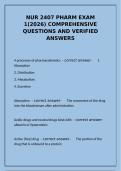
NUR 2407 PHARM EXAM
1(2026) COMPREHENSIVE
QUESTIONS AND VERIFIED
ANSWERS
4 processes of pharmacokinetics - correct answer- 1.
Absorption
2. Distribution
3. Metabolism
4. Excretion
Absorption - correct answer- The movement of the drug
into the bloodstream after administration
Acidic drugs and neutral drugs bind with - correct answer-
albumin or lipoproteins
Active (free) drug - correct answer- The portion of the
drug that is unbound to a protein
,Able to exit blood vessels and reach their site of action
Active transport - correct answer- Requires a carrier in
the form of an enzyme or protein to move the drug against the
concentration gradient
Energy is required
Additive drug effect - correct answer- When two drugs
are administered together and the response is increased beyond
what either could produce alone
Adrenergic Agonists - correct answer- Drugs that
stimulate the sympathetic nervous system
Adrenergic Antagonists - correct answer- Block effects of
adrenergic neurotransmitter
Adverse drug reaction - correct answer- Unintentional,
unexpected reactions to drug therapy that occur at normal drug
dosages
, Agonists - correct answer- Drugs that activate receptors
and produce a desired response
Alpha 1 receptors - correct answer- Increases force of
heart contraction; vasoconstriction increases blood pressure;
mydriasis (dilation of pupils) occurs; secretion in salivary glands
decreases; urinary bladder relaxation and urinary sphincter
contraction increases
Alpha 2 receptors - correct answer- Inhibits release of
norepinephrine; dilates blood vessels; produces hypotension;
decreases gastrointestinal motility and tone
Alzheimer's Drugs - correct answer-
Acetylcholinesterase/Cholinesterase Inhibitors
Antagonist - correct answer- Drugs that prevent receptor
activation and block response
Antagonistic drug effects - correct answer- One drug
reduces or blocks the effects of the other
1(2026) COMPREHENSIVE
QUESTIONS AND VERIFIED
ANSWERS
4 processes of pharmacokinetics - correct answer- 1.
Absorption
2. Distribution
3. Metabolism
4. Excretion
Absorption - correct answer- The movement of the drug
into the bloodstream after administration
Acidic drugs and neutral drugs bind with - correct answer-
albumin or lipoproteins
Active (free) drug - correct answer- The portion of the
drug that is unbound to a protein
,Able to exit blood vessels and reach their site of action
Active transport - correct answer- Requires a carrier in
the form of an enzyme or protein to move the drug against the
concentration gradient
Energy is required
Additive drug effect - correct answer- When two drugs
are administered together and the response is increased beyond
what either could produce alone
Adrenergic Agonists - correct answer- Drugs that
stimulate the sympathetic nervous system
Adrenergic Antagonists - correct answer- Block effects of
adrenergic neurotransmitter
Adverse drug reaction - correct answer- Unintentional,
unexpected reactions to drug therapy that occur at normal drug
dosages
, Agonists - correct answer- Drugs that activate receptors
and produce a desired response
Alpha 1 receptors - correct answer- Increases force of
heart contraction; vasoconstriction increases blood pressure;
mydriasis (dilation of pupils) occurs; secretion in salivary glands
decreases; urinary bladder relaxation and urinary sphincter
contraction increases
Alpha 2 receptors - correct answer- Inhibits release of
norepinephrine; dilates blood vessels; produces hypotension;
decreases gastrointestinal motility and tone
Alzheimer's Drugs - correct answer-
Acetylcholinesterase/Cholinesterase Inhibitors
Antagonist - correct answer- Drugs that prevent receptor
activation and block response
Antagonistic drug effects - correct answer- One drug
reduces or blocks the effects of the other