

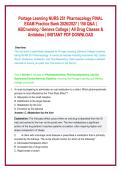
Portage Learning NURS 251 Pharmacology FINAL
EXAM Practice Bank 2026/2027 | 150 Q&A |
ABCnursing / Geneva College | All Drug Classes &
Antidotes | INSTANT PDF DOWNLOAD
Overview:
This test bank is specifically designed for Portage Learning (Geneva College) students
taking NURS 251 Pharmacology. It covers all modules including Autonomic NS, Cardio,
Renal, Endocrine, Antibiotics, and Pain/Respiratory. Each question includes a detailed
rationale to ensure you pass your final exam on the first try.
This is Section 1 focuses on Pharmacokinetics, Pharmacodynamics, and the
Autonomic/Central Nervous Systems, mirroring the Portage Learning and Geneva
College curriculum.
1. A nurse is preparing to administer an oral medication to a client. Which pharmacokinetic
process is most affected by the "First-Pass Effect"?
A. Absorption in the small intestine
B. Distribution to the target tissues
C. Metabolism by the liver
D. Excretion by the kidneys
Answer: C. Metabolism by the liver
Explanation: The first-pass effect occurs when an oral drug is absorbed from the GI
tract and carried to the liver via the portal vein. The liver metabolizes a significant
portion of the drug before it reaches systemic circulation, often requiring higher oral
doses compared to IV doses.
2. A client with end-stage renal disease is prescribed a medication that is primarily
excreted by the kidneys. The nurse should monitor for which of the following?
A. Decreased therapeutic effect
B. Increased risk of drug toxicity
C. Rapid onset of action
,D. Improved drug absorption
Answer: B. Increased risk of drug toxicity
Explanation: When renal function is impaired, the body cannot effectively filter and
excrete medications. This leads to drug accumulation in the bloodstream, significantly
increasing the risk of toxic effects.
3. A nurse is caring for a client with a suspected overdose of a Benzodiazepine
(e.g., Lorazepam). Which medication should the nurse anticipate administering?
A. Naloxone
B. Flumazenil
C. Acetylcysteine
D. Protamine Sulfate
Answer: B. Flumazenil
Explanation: Flumazenil is a specific competitive benzodiazepine receptor antagonist.
It reverses the sedative effects but must be used cautiously as it can precipitate
seizures in chronic users.
4. A client is prescribed Bethanechol for post-operative urinary retention. Which of
the following is a contraindication for this cholinergic medication?
A. Hypertension
B. Tachycardia
C. Asthma or COPD
D. Glaucoma
Answer: C. Asthma or COPD
Explanation: Bethanechol is a muscarinic agonist (cholinergic). It stimulates the
parasympathetic nervous system, which can cause bronchoconstriction. This makes it
dangerous for clients with underlying respiratory diseases like asthma.
5. A nurse is teaching a client about a new prescription for Phenytoin (Dilantin).
Which statement by the client indicates an understanding of the teaching?
A. "I will stop taking the medicine once my seizures stop for a month."
B. "I need to visit my dentist regularly for checkups."
C. "I should take this medication with a large glass of grapefruit juice."
D. "I will expect my heart rate to increase significantly."
Answer: B. "I need to visit my dentist regularly for checkups."
,Explanation: Phenytoin commonly causes gingival hyperplasia (gum overgrowth).
Strict oral hygiene and regular dental visits are necessary to manage this side effect.
6. A client is receiving Atropine to treat symptomatic bradycardia. The nurse should
monitor for which of the following anticholinergic side effects?
A. Diarrhea and urinary frequency
B. Excessive salivation and sweating
C. Dry mouth and urinary retention
D. Pupillary constriction (miosis)
Answer: C. Dry mouth and urinary retention
Explanation: Atropine blocks acetylcholine. This results in the "Can't see, can't spit,
can't pee, can't poop" side effects: blurred vision, dry mouth, urinary retention, and
constipation.
7. A nurse is providing teaching to a client starting Levodopa-Carbidopa for
Parkinson's disease. What is the primary purpose of the Carbidopa component?
A. It crosses the blood-brain barrier to increase dopamine levels.
B. It prevents the breakdown of Levodopa in the periphery.
C. It acts as a potent muscle relaxant.
D. It prevents the client from developing a dry cough.
Answer: B. It prevents the breakdown of Levodopa in the periphery.
Explanation: Carbidopa has no therapeutic effect on its own; it inhibits the enzyme
dopa-decarboxylase in the peripheral tissues, ensuring that more Levodopa reaches the
brain before being converted to dopamine.
8. A client is prescribed Lithium Carbonate for Bipolar Disorder. Which of the
following should the nurse instruct the client to maintain consistently in their diet?
A. Potassium
B. Calcium
C. Sodium
D. Vitamin K
Answer: C. Sodium
Explanation: Lithium is a salt. If a client's sodium intake drops or if they become
dehydrated (losing sodium), the kidneys will reabsorb Lithium in place of sodium,
leading to toxic Lithium levels.
, 9. A nurse is assessing a client taking an MAOI (Monoamine Oxidase Inhibitor) for
depression. The client reports a severe headache and nausea after eating a specialty
cheese platter. What is the nurse's priority concern?
A. Serotonin Syndrome
B. Hypertensive Crisis
C. Extrapyramidal Symptoms (EPS)
D. Neuroleptic Malignant Syndrome
Answer: B. Hypertensive Crisis
Explanation: MAOIs interact with tyramine-rich foods (aged cheeses, cured meats, red
wine). This interaction causes a massive release of norepinephrine, leading to
dangerous, acute hypertension.
10. A client is prescribed a medication with a "Low Therapeutic Index." How should
the nurse interpret this information?
A. The drug is very safe and rarely causes toxicity.
B. The difference between a therapeutic dose and a toxic dose is very small.
C. The drug has a very long half-life and stays in the body for weeks.
D. The drug must be taken on an empty stomach for maximum absorption.
Answer: B. The difference between a therapeutic dose and a toxic dose is very
small.
Explanation: Drugs with a narrow/low therapeutic index (like Digoxin, Lithium, or
Warfarin) require frequent blood level monitoring because even a small increase in dose
can lead to toxicity.
11. A nurse is preparing to administer Epinephrine to a client in anaphylactic shock.
What is the primary Alpha-1 stimulatory effect desired?
A. Bronchodilation
B. Increased heart rate
C. Vasoconstriction to increase blood pressure
D. Decreased gastrointestinal motility
Answer: C. Vasoconstriction to increase blood pressure
Explanation: Epinephrine is non-selective. While Beta-2 causes bronchodilation and
Beta-1 increases HR, the Alpha-1 effect causes vasoconstriction, which is critical for
reversing the severe hypotension seen in anaphylaxis.
EXAM Practice Bank 2026/2027 | 150 Q&A |
ABCnursing / Geneva College | All Drug Classes &
Antidotes | INSTANT PDF DOWNLOAD
Overview:
This test bank is specifically designed for Portage Learning (Geneva College) students
taking NURS 251 Pharmacology. It covers all modules including Autonomic NS, Cardio,
Renal, Endocrine, Antibiotics, and Pain/Respiratory. Each question includes a detailed
rationale to ensure you pass your final exam on the first try.
This is Section 1 focuses on Pharmacokinetics, Pharmacodynamics, and the
Autonomic/Central Nervous Systems, mirroring the Portage Learning and Geneva
College curriculum.
1. A nurse is preparing to administer an oral medication to a client. Which pharmacokinetic
process is most affected by the "First-Pass Effect"?
A. Absorption in the small intestine
B. Distribution to the target tissues
C. Metabolism by the liver
D. Excretion by the kidneys
Answer: C. Metabolism by the liver
Explanation: The first-pass effect occurs when an oral drug is absorbed from the GI
tract and carried to the liver via the portal vein. The liver metabolizes a significant
portion of the drug before it reaches systemic circulation, often requiring higher oral
doses compared to IV doses.
2. A client with end-stage renal disease is prescribed a medication that is primarily
excreted by the kidneys. The nurse should monitor for which of the following?
A. Decreased therapeutic effect
B. Increased risk of drug toxicity
C. Rapid onset of action
,D. Improved drug absorption
Answer: B. Increased risk of drug toxicity
Explanation: When renal function is impaired, the body cannot effectively filter and
excrete medications. This leads to drug accumulation in the bloodstream, significantly
increasing the risk of toxic effects.
3. A nurse is caring for a client with a suspected overdose of a Benzodiazepine
(e.g., Lorazepam). Which medication should the nurse anticipate administering?
A. Naloxone
B. Flumazenil
C. Acetylcysteine
D. Protamine Sulfate
Answer: B. Flumazenil
Explanation: Flumazenil is a specific competitive benzodiazepine receptor antagonist.
It reverses the sedative effects but must be used cautiously as it can precipitate
seizures in chronic users.
4. A client is prescribed Bethanechol for post-operative urinary retention. Which of
the following is a contraindication for this cholinergic medication?
A. Hypertension
B. Tachycardia
C. Asthma or COPD
D. Glaucoma
Answer: C. Asthma or COPD
Explanation: Bethanechol is a muscarinic agonist (cholinergic). It stimulates the
parasympathetic nervous system, which can cause bronchoconstriction. This makes it
dangerous for clients with underlying respiratory diseases like asthma.
5. A nurse is teaching a client about a new prescription for Phenytoin (Dilantin).
Which statement by the client indicates an understanding of the teaching?
A. "I will stop taking the medicine once my seizures stop for a month."
B. "I need to visit my dentist regularly for checkups."
C. "I should take this medication with a large glass of grapefruit juice."
D. "I will expect my heart rate to increase significantly."
Answer: B. "I need to visit my dentist regularly for checkups."
,Explanation: Phenytoin commonly causes gingival hyperplasia (gum overgrowth).
Strict oral hygiene and regular dental visits are necessary to manage this side effect.
6. A client is receiving Atropine to treat symptomatic bradycardia. The nurse should
monitor for which of the following anticholinergic side effects?
A. Diarrhea and urinary frequency
B. Excessive salivation and sweating
C. Dry mouth and urinary retention
D. Pupillary constriction (miosis)
Answer: C. Dry mouth and urinary retention
Explanation: Atropine blocks acetylcholine. This results in the "Can't see, can't spit,
can't pee, can't poop" side effects: blurred vision, dry mouth, urinary retention, and
constipation.
7. A nurse is providing teaching to a client starting Levodopa-Carbidopa for
Parkinson's disease. What is the primary purpose of the Carbidopa component?
A. It crosses the blood-brain barrier to increase dopamine levels.
B. It prevents the breakdown of Levodopa in the periphery.
C. It acts as a potent muscle relaxant.
D. It prevents the client from developing a dry cough.
Answer: B. It prevents the breakdown of Levodopa in the periphery.
Explanation: Carbidopa has no therapeutic effect on its own; it inhibits the enzyme
dopa-decarboxylase in the peripheral tissues, ensuring that more Levodopa reaches the
brain before being converted to dopamine.
8. A client is prescribed Lithium Carbonate for Bipolar Disorder. Which of the
following should the nurse instruct the client to maintain consistently in their diet?
A. Potassium
B. Calcium
C. Sodium
D. Vitamin K
Answer: C. Sodium
Explanation: Lithium is a salt. If a client's sodium intake drops or if they become
dehydrated (losing sodium), the kidneys will reabsorb Lithium in place of sodium,
leading to toxic Lithium levels.
, 9. A nurse is assessing a client taking an MAOI (Monoamine Oxidase Inhibitor) for
depression. The client reports a severe headache and nausea after eating a specialty
cheese platter. What is the nurse's priority concern?
A. Serotonin Syndrome
B. Hypertensive Crisis
C. Extrapyramidal Symptoms (EPS)
D. Neuroleptic Malignant Syndrome
Answer: B. Hypertensive Crisis
Explanation: MAOIs interact with tyramine-rich foods (aged cheeses, cured meats, red
wine). This interaction causes a massive release of norepinephrine, leading to
dangerous, acute hypertension.
10. A client is prescribed a medication with a "Low Therapeutic Index." How should
the nurse interpret this information?
A. The drug is very safe and rarely causes toxicity.
B. The difference between a therapeutic dose and a toxic dose is very small.
C. The drug has a very long half-life and stays in the body for weeks.
D. The drug must be taken on an empty stomach for maximum absorption.
Answer: B. The difference between a therapeutic dose and a toxic dose is very
small.
Explanation: Drugs with a narrow/low therapeutic index (like Digoxin, Lithium, or
Warfarin) require frequent blood level monitoring because even a small increase in dose
can lead to toxicity.
11. A nurse is preparing to administer Epinephrine to a client in anaphylactic shock.
What is the primary Alpha-1 stimulatory effect desired?
A. Bronchodilation
B. Increased heart rate
C. Vasoconstriction to increase blood pressure
D. Decreased gastrointestinal motility
Answer: C. Vasoconstriction to increase blood pressure
Explanation: Epinephrine is non-selective. While Beta-2 causes bronchodilation and
Beta-1 increases HR, the Alpha-1 effect causes vasoconstriction, which is critical for
reversing the severe hypotension seen in anaphylaxis.


