

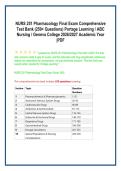
NURS 251 Pharmacology Final Exam Comprehensive
Test Bank (250+ Questions) Portage Learning / ABC
Nursing / Geneva College 2026/2027 Academic Year
|PDF
⭐⭐⭐⭐⭐ "I passed my NURS 251 Pharmacology Final with a 96%! The bold
italic answers made it easy to review, and the rationales with drug classification references
helped me understand the mechanisms, not just memorize answers. This test bank was
exactly what I needed for Portage Learning."
NURS 251 Pharmacology Final Exam Score: 96%
This comprehensive test bank includes 250 questions covering:
Section Topic Question
Numbers
1 Pharmacokinetics & Pharmacodynamics 1-25
2 Autonomic Nervous System Drugs 26-45
3 Cardiovascular Drugs 46-80
4 Antibiotics & Antimicrobials 81-115
5 Central Nervous System Drugs 116-145
6 Endocrine & Hormonal Drugs 146-170
7 Respiratory Drugs 171-185
8 Gastrointestinal Drugs 186-200
9 Dosage Calculations 201-225
10 Special Populations & Nursing 226-250
Considerations
, SECTION 1: Pharmacokinetics & Pharmacodynamics
1. A nurse is teaching a patient about how medications work in the body. Which
statement correctly defines pharmacokinetics?
A) The study of how drugs affect the body
B) The study of how the body processes drugs
C) The study of drug interactions with receptors
D) The study of drug toxicity and adverse effects
Answer: B) The study of how the body processes drugs
Rationale: Pharmacokinetics is the study of drug movement through the body, including
absorption, distribution, metabolism, and excretion (ADME). Pharmacodynamics is the
study of how drugs affect the body.
2. Which of the following processes describes the movement of a drug from the site
of administration into the bloodstream?
A) Distribution
B) Metabolism
C) Absorption
D) Excretion
Answer: C) Absorption
Rationale: Absorption is the process by which a drug enters the bloodstream from its
administration site. Distribution is transport to tissues, metabolism is biotransformation, and
excretion is elimination.
3. A patient asks why an intravenous (IV) medication works faster than an oral
medication. The nurse's best response is:
A) "IV medications do not require absorption and enter the bloodstream directly"
B) "Oral medications are always weaker than IV medications"
C) "IV medications are more potent than oral medications"
D) "Oral medications take longer to be prescribed"
, Answer: A) "IV medications do not require absorption and enter the bloodstream
directly"
Rationale: IV administration bypasses the absorption phase and delivers the drug directly
into systemic circulation, resulting in rapid onset of action.
4. A patient is prescribed a medication that undergoes extensive first-pass
metabolism. The nurse understands that this drug:
A) Should be administered intravenously to avoid first-pass effect
B) Will have increased bioavailability when taken orally
C) Is metabolized in the kidneys before reaching systemic circulation
D) Requires a lower oral dose compared to IV dose
Answer: A) Should be administered intravenously to avoid first-pass effect
Rationale: First-pass effect refers to metabolism of a drug in the liver before reaching
systemic circulation. IV administration bypasses this effect, increasing bioavailability. Oral
drugs with high first-pass metabolism require higher doses to achieve therapeutic effect.
5. The nurse understands that the half-life of a medication is 6 hours. After 12 hours,
what percentage of the drug remains in the body?
A) 50%
B) 25%
C) 12.5%
D) 75%
Answer: B) 25%
*Rationale: After 6 hours (one half-life), 50% remains; after 12 hours (two half-lives), 25%
remains; after 18 hours (three half-lives), 12.5% remains.*
6. A medication has a half-life of 24 hours. How many days will it take to reach steady
state?
, A) 1 day
B) 3 days
C) 5 days
D) 7 days
Answer: C) 5 days
*Rationale: Steady state is achieved after approximately 4-5 half-lives. For a 24-hour half-
life, steady state is reached in 4-5 days.*
7. Which of the following factors would decrease drug absorption? (Select all that
apply)
A) Administration with a high-fat meal
B) Reduced blood flow to the gastrointestinal tract
C) Increased gastric motility
D) Presence of food that binds to the drug
E) Administration on an empty stomach
Answers: B, C, D
Rationale: Reduced blood flow decreases absorption. Increased gastric motility reduces
contact time, decreasing absorption. Food binding reduces available drug. High-fat meals
can increase absorption of lipophilic drugs. Empty stomach typically increases absorption.
8. The nurse is administering a highly protein-bound drug. Which statement is
correct regarding protein binding?
A) The bound portion of the drug is pharmacologically active
B) The unbound (free) portion of the drug is pharmacologically active
C) Protein binding increases drug excretion
D) Protein binding decreases the duration of action
Answer: B) The unbound (free) portion of the drug is pharmacologically active
Rationale: Only unbound (free) drug is pharmacologically active and able to cross cell
membranes. Bound drug is inactive and acts as a reservoir.
Test Bank (250+ Questions) Portage Learning / ABC
Nursing / Geneva College 2026/2027 Academic Year
⭐⭐⭐⭐⭐ "I passed my NURS 251 Pharmacology Final with a 96%! The bold
italic answers made it easy to review, and the rationales with drug classification references
helped me understand the mechanisms, not just memorize answers. This test bank was
exactly what I needed for Portage Learning."
NURS 251 Pharmacology Final Exam Score: 96%
This comprehensive test bank includes 250 questions covering:
Section Topic Question
Numbers
1 Pharmacokinetics & Pharmacodynamics 1-25
2 Autonomic Nervous System Drugs 26-45
3 Cardiovascular Drugs 46-80
4 Antibiotics & Antimicrobials 81-115
5 Central Nervous System Drugs 116-145
6 Endocrine & Hormonal Drugs 146-170
7 Respiratory Drugs 171-185
8 Gastrointestinal Drugs 186-200
9 Dosage Calculations 201-225
10 Special Populations & Nursing 226-250
Considerations
, SECTION 1: Pharmacokinetics & Pharmacodynamics
1. A nurse is teaching a patient about how medications work in the body. Which
statement correctly defines pharmacokinetics?
A) The study of how drugs affect the body
B) The study of how the body processes drugs
C) The study of drug interactions with receptors
D) The study of drug toxicity and adverse effects
Answer: B) The study of how the body processes drugs
Rationale: Pharmacokinetics is the study of drug movement through the body, including
absorption, distribution, metabolism, and excretion (ADME). Pharmacodynamics is the
study of how drugs affect the body.
2. Which of the following processes describes the movement of a drug from the site
of administration into the bloodstream?
A) Distribution
B) Metabolism
C) Absorption
D) Excretion
Answer: C) Absorption
Rationale: Absorption is the process by which a drug enters the bloodstream from its
administration site. Distribution is transport to tissues, metabolism is biotransformation, and
excretion is elimination.
3. A patient asks why an intravenous (IV) medication works faster than an oral
medication. The nurse's best response is:
A) "IV medications do not require absorption and enter the bloodstream directly"
B) "Oral medications are always weaker than IV medications"
C) "IV medications are more potent than oral medications"
D) "Oral medications take longer to be prescribed"
, Answer: A) "IV medications do not require absorption and enter the bloodstream
directly"
Rationale: IV administration bypasses the absorption phase and delivers the drug directly
into systemic circulation, resulting in rapid onset of action.
4. A patient is prescribed a medication that undergoes extensive first-pass
metabolism. The nurse understands that this drug:
A) Should be administered intravenously to avoid first-pass effect
B) Will have increased bioavailability when taken orally
C) Is metabolized in the kidneys before reaching systemic circulation
D) Requires a lower oral dose compared to IV dose
Answer: A) Should be administered intravenously to avoid first-pass effect
Rationale: First-pass effect refers to metabolism of a drug in the liver before reaching
systemic circulation. IV administration bypasses this effect, increasing bioavailability. Oral
drugs with high first-pass metabolism require higher doses to achieve therapeutic effect.
5. The nurse understands that the half-life of a medication is 6 hours. After 12 hours,
what percentage of the drug remains in the body?
A) 50%
B) 25%
C) 12.5%
D) 75%
Answer: B) 25%
*Rationale: After 6 hours (one half-life), 50% remains; after 12 hours (two half-lives), 25%
remains; after 18 hours (three half-lives), 12.5% remains.*
6. A medication has a half-life of 24 hours. How many days will it take to reach steady
state?
, A) 1 day
B) 3 days
C) 5 days
D) 7 days
Answer: C) 5 days
*Rationale: Steady state is achieved after approximately 4-5 half-lives. For a 24-hour half-
life, steady state is reached in 4-5 days.*
7. Which of the following factors would decrease drug absorption? (Select all that
apply)
A) Administration with a high-fat meal
B) Reduced blood flow to the gastrointestinal tract
C) Increased gastric motility
D) Presence of food that binds to the drug
E) Administration on an empty stomach
Answers: B, C, D
Rationale: Reduced blood flow decreases absorption. Increased gastric motility reduces
contact time, decreasing absorption. Food binding reduces available drug. High-fat meals
can increase absorption of lipophilic drugs. Empty stomach typically increases absorption.
8. The nurse is administering a highly protein-bound drug. Which statement is
correct regarding protein binding?
A) The bound portion of the drug is pharmacologically active
B) The unbound (free) portion of the drug is pharmacologically active
C) Protein binding increases drug excretion
D) Protein binding decreases the duration of action
Answer: B) The unbound (free) portion of the drug is pharmacologically active
Rationale: Only unbound (free) drug is pharmacologically active and able to cross cell
membranes. Bound drug is inactive and acts as a reservoir.


