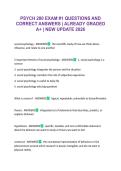
PSYCH 280 EXAM #1 QUESTIONS AND
CORRECT ANSWERS | ALREADY GRADED
A+ | NEW UPDATE 2026
social psychology - ANSWERS the scientific study of how we think about,
influence, and relate to one another
5 important themes of social psychology - ANSWERS 1. social psychology is a
science
2. social psychology integrates the person and the situation
3. social psychology considers the role of subjective experience
4. social psychology is useful to daily life
5. social psychology asks big questions
What is science? - ANSWERS logical, repeatable, vulnerable to disconfirmation
theory - ANSWERS integrated set of statements that describes, predicts, or
explains behavior
Hypothesis - ANSWERS specific, testable, and non-confirmable statement
about the behavior we want to study or theory we want to test
construct - ANSWERS the conceptual representation of behaviors or the
phenomenon around which research is based, intangible, and do not exist in
physical reality
,Operationalization - ANSWERS defines a construct in concrete terms
goals of science - ANSWERS describe, predict, and explain behavior
naturalistic observation/ethnography - ANSWERS observe behavior where it
typically happens
describe behavior - ANSWERS high external validity, low internal validity
predict behavior - ANSWERS cheap and lots of data, response bias, cannot
interpret causation
explain behavior - ANSWERS high internal validity, low external validity
internal validity - ANSWERS extent to which we can draw cause-and-effect
inferences from a study
external validity - ANSWERS extent to which we can generalize findings to real-
world settings
independent variable - ANSWERS variable that is manipulated
dependent variable - ANSWERS The measurable effect, outcome, or response
in which the research is interested.
, control variable - ANSWERS A variable that is kept constant during a controlled
experiment.
random assignment - ANSWERS assigning participants to experimental and
control conditions by chance, thus minimizing preexisting differences between
those assigned to the different groups
informed consent - ANSWERS An ethical principle requiring that research
participants be told enough to enable them to choose whether they wish to
participate.
Debriefing - ANSWERS the post-experimental explanation of a study, including
its purpose and any deceptions, to its participants
Institutional Review Board (IRB) - ANSWERS A committee at each institution
where research is conducted to review every experiment for ethics and
methodology.
fundamental attribution error - ANSWERS the tendency for observers, when
analyzing another's behavior, to underestimate the impact of the situation and to
overestimate the impact of personal disposition
interdependent view of the self - ANSWERS a way of defining oneself in terms
of one's relationships to other people, recognizing that one's behavior is often
determined by the thoughts, feelings, and actions of others
CORRECT ANSWERS | ALREADY GRADED
A+ | NEW UPDATE 2026
social psychology - ANSWERS the scientific study of how we think about,
influence, and relate to one another
5 important themes of social psychology - ANSWERS 1. social psychology is a
science
2. social psychology integrates the person and the situation
3. social psychology considers the role of subjective experience
4. social psychology is useful to daily life
5. social psychology asks big questions
What is science? - ANSWERS logical, repeatable, vulnerable to disconfirmation
theory - ANSWERS integrated set of statements that describes, predicts, or
explains behavior
Hypothesis - ANSWERS specific, testable, and non-confirmable statement
about the behavior we want to study or theory we want to test
construct - ANSWERS the conceptual representation of behaviors or the
phenomenon around which research is based, intangible, and do not exist in
physical reality
,Operationalization - ANSWERS defines a construct in concrete terms
goals of science - ANSWERS describe, predict, and explain behavior
naturalistic observation/ethnography - ANSWERS observe behavior where it
typically happens
describe behavior - ANSWERS high external validity, low internal validity
predict behavior - ANSWERS cheap and lots of data, response bias, cannot
interpret causation
explain behavior - ANSWERS high internal validity, low external validity
internal validity - ANSWERS extent to which we can draw cause-and-effect
inferences from a study
external validity - ANSWERS extent to which we can generalize findings to real-
world settings
independent variable - ANSWERS variable that is manipulated
dependent variable - ANSWERS The measurable effect, outcome, or response
in which the research is interested.
, control variable - ANSWERS A variable that is kept constant during a controlled
experiment.
random assignment - ANSWERS assigning participants to experimental and
control conditions by chance, thus minimizing preexisting differences between
those assigned to the different groups
informed consent - ANSWERS An ethical principle requiring that research
participants be told enough to enable them to choose whether they wish to
participate.
Debriefing - ANSWERS the post-experimental explanation of a study, including
its purpose and any deceptions, to its participants
Institutional Review Board (IRB) - ANSWERS A committee at each institution
where research is conducted to review every experiment for ethics and
methodology.
fundamental attribution error - ANSWERS the tendency for observers, when
analyzing another's behavior, to underestimate the impact of the situation and to
overestimate the impact of personal disposition
interdependent view of the self - ANSWERS a way of defining oneself in terms
of one's relationships to other people, recognizing that one's behavior is often
determined by the thoughts, feelings, and actions of others