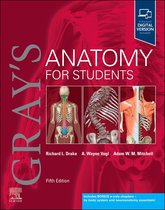
GRAY'S ANATOMY FOR
STUDENTS
5TH EDITION
• AUTHOR(S)RICHARD L. DRAKE
TEST BANK
1) Anatomical position and directional terms
Reference: Ch. 1 — The Body — Anatomical position and
directional terms
A patient is photographed for a clinical record while standing
with the palms facing backward and the feet crossed. The
clinician later describes the right forearm as “lateral” to the
trunk in this posture. Which statement is anatomically correct in
the standard reference position?
A. The palmar surface of the hand is posterior
B. The right forearm is lateral to the trunk
,C. The knees are superior to the hips
D. The thumb lies medial to the little finger
Correct Answer: B
Rationale — Correct Answer:
In anatomical position, the body stands erect with the palms
facing forward, so the forearm lies lateral to the trunk.
Directional terms are always interpreted from this standard
position, not from the patient’s accidental posture. This
prevents confusion in clinical description and imaging
interpretation.
Rationale — Incorrect Options:
A. The palmar surface faces anterior in anatomical position, not
posterior.
C. The knees are inferior to the hips, not superior.
D. The thumb is lateral to the little finger in anatomical position.
Teaching Point: Anatomical position is the fixed reference for all
directional terms.
Citation: Drake, R. L., Vogl, A. W., & Mitchell, A. W. M. (2023).
Gray’s Anatomy for Students (5th ed.). Ch. 1 — The Body.
2) Body planes in imaging
Reference: Ch. 1 — The Body — Body planes and imaging
orientation
,A CT scan of the abdomen is reconstructed so the viewer sees
the patient as if facing them. The radiologist refers to the image
as a frontal view. Which anatomical plane is this most
consistent with?
A. Sagittal plane
B. Coronal plane
C. Transverse plane
D. Oblique plane
Correct Answer: B
Rationale — Correct Answer:
A frontal view corresponds to the coronal plane, which divides
the body into anterior and posterior portions. This is a common
imaging orientation in CT and MRI. Recognizing plane
orientation helps correlate radiologic images with anatomy.
Rationale — Incorrect Options:
A. Sagittal planes divide the body into left and right parts.
C. Transverse planes divide the body into superior and inferior
parts.
D. Oblique planes are angled and not the standard frontal
orientation.
Teaching Point: Coronal = frontal; sagittal = left/right; transverse
= upper/lower.
Citation: Drake, R. L., Vogl, A. W., & Mitchell, A. W. M. (2023).
Gray’s Anatomy for Students (5th ed.). Ch. 1 — The Body.
, 3) Regional anatomy versus systemic anatomy
Reference: Ch. 1 — What is anatomy? — Regional and systemic
anatomy
A student studies the thorax by reviewing the heart, lungs,
great vessels, ribs, and intercostal muscles together. This
approach best reflects which type of anatomy?
A. Microscopic anatomy
B. Regional anatomy
C. Developmental anatomy
D. Surface anatomy only
Correct Answer: B
Rationale — Correct Answer:
Regional anatomy examines all structures within a specific body
region and emphasizes how they relate to one another. The
thorax is a classic example because multiple organ systems are
studied together in context. This approach is especially useful
clinically and surgically.
Rationale — Incorrect Options:
A. Microscopic anatomy focuses on tissues and cells, not gross
regional relationships.
C. Developmental anatomy concerns changes over time from
embryo to adult.
D. Surface anatomy focuses on external landmarks, not the full
regional contents.
STUDENTS
5TH EDITION
• AUTHOR(S)RICHARD L. DRAKE
TEST BANK
1) Anatomical position and directional terms
Reference: Ch. 1 — The Body — Anatomical position and
directional terms
A patient is photographed for a clinical record while standing
with the palms facing backward and the feet crossed. The
clinician later describes the right forearm as “lateral” to the
trunk in this posture. Which statement is anatomically correct in
the standard reference position?
A. The palmar surface of the hand is posterior
B. The right forearm is lateral to the trunk
,C. The knees are superior to the hips
D. The thumb lies medial to the little finger
Correct Answer: B
Rationale — Correct Answer:
In anatomical position, the body stands erect with the palms
facing forward, so the forearm lies lateral to the trunk.
Directional terms are always interpreted from this standard
position, not from the patient’s accidental posture. This
prevents confusion in clinical description and imaging
interpretation.
Rationale — Incorrect Options:
A. The palmar surface faces anterior in anatomical position, not
posterior.
C. The knees are inferior to the hips, not superior.
D. The thumb is lateral to the little finger in anatomical position.
Teaching Point: Anatomical position is the fixed reference for all
directional terms.
Citation: Drake, R. L., Vogl, A. W., & Mitchell, A. W. M. (2023).
Gray’s Anatomy for Students (5th ed.). Ch. 1 — The Body.
2) Body planes in imaging
Reference: Ch. 1 — The Body — Body planes and imaging
orientation
,A CT scan of the abdomen is reconstructed so the viewer sees
the patient as if facing them. The radiologist refers to the image
as a frontal view. Which anatomical plane is this most
consistent with?
A. Sagittal plane
B. Coronal plane
C. Transverse plane
D. Oblique plane
Correct Answer: B
Rationale — Correct Answer:
A frontal view corresponds to the coronal plane, which divides
the body into anterior and posterior portions. This is a common
imaging orientation in CT and MRI. Recognizing plane
orientation helps correlate radiologic images with anatomy.
Rationale — Incorrect Options:
A. Sagittal planes divide the body into left and right parts.
C. Transverse planes divide the body into superior and inferior
parts.
D. Oblique planes are angled and not the standard frontal
orientation.
Teaching Point: Coronal = frontal; sagittal = left/right; transverse
= upper/lower.
Citation: Drake, R. L., Vogl, A. W., & Mitchell, A. W. M. (2023).
Gray’s Anatomy for Students (5th ed.). Ch. 1 — The Body.
, 3) Regional anatomy versus systemic anatomy
Reference: Ch. 1 — What is anatomy? — Regional and systemic
anatomy
A student studies the thorax by reviewing the heart, lungs,
great vessels, ribs, and intercostal muscles together. This
approach best reflects which type of anatomy?
A. Microscopic anatomy
B. Regional anatomy
C. Developmental anatomy
D. Surface anatomy only
Correct Answer: B
Rationale — Correct Answer:
Regional anatomy examines all structures within a specific body
region and emphasizes how they relate to one another. The
thorax is a classic example because multiple organ systems are
studied together in context. This approach is especially useful
clinically and surgically.
Rationale — Incorrect Options:
A. Microscopic anatomy focuses on tissues and cells, not gross
regional relationships.
C. Developmental anatomy concerns changes over time from
embryo to adult.
D. Surface anatomy focuses on external landmarks, not the full
regional contents.