

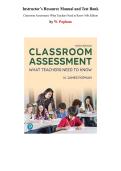
Instructor’s Resource Manual and Test Bank
Classroom Assessment: What Teachers Need to Know 10th Edition
by W. Popham
TE
ST
SO
LU
TI
O
N
, Table of Content
Why Do Teachers Need to Know About Assessment?
Deciding What to Assess
Reliability of Assessment
Validity
Fairness
TE
Selected-Response Tests
Constructed-Response Tests
Performance Assessment
ST
Portfolio Assessment
Affective Assessment
Improving Teacher-Developed Assessments
SO
Formative Assessment
Making Sense Out of Standardized Test Scores
Appropriate and Inappropriate Test-Preparation Practices
LU
The Evaluation of Instruction
Assessment-Based Grading
TI
O
N
, jhgfdsa
CHAPTER 1
WHY DO TEACHERS NEED TO KNOW ABOUT ASSESSMENT?
Instructor to Instructor
Firing Up the Troops
TE
If you’re teaching a classroom-assessment course, whether your students are prospective
teachers or experienced classroom teachers, you’ll almost certainly need to do at least some sort
of motivational job to get your students to approach the course with suitable zeal.
More often than not, at least in my experience, most students take courses because they
ST
are required to do so. Teacher education students typically enroll in a classroom-assessment
course either because it is a licensure requirement or because the student’s advisor urged the
course be taken. Experienced teachers might sign up for a classroom assessment course as part of
a degree program or, increasingly, because officials of a school district have decided the
district’s educators need a dose of classroom assessment. Teachers who are directed to take a
course, even though it might be billed as a professional development course, are rarely jubilant
SO
about that obligatory prospect. Having taught such indifferent, reluctant, or sometimes hostile
teachers, I know.
At any rate, I encourage you not to assume your students are breathlessly waiting to
gobble up all the assessment truths you toss their way. And, if you agree, this means you need to
try to bolster my efforts in Chapter 1 to get readers to recognize the importance of learning about
LU
classroom assessment. Part of the rationale for mastering the content you’ll be treating in
Chapter 1 sounds fairly lofty, for example, “A competent educational professional these days
must know something about assessment because students’ test scores are the chief indicators of
educational quality.” But I’ve found in my own courses that the most effective hook for students
is the recognition that this assessment content can make them more effective teachers.
TI
Indeed, in the ninth edition of Classroom Assessment, you’ll find that I often bang away
on this bongo, namely, the linkage between testing and teaching. Happily, not only is the
potential for the textbook’s instructional payoff a sound motivational ploy—it also happens to be
the truth. Thus, I hope you’ll spend at least some early-on time trying to get your students
O
energized so they’ll tackle the textbook’s content with enthusiasm. It really is important content.
Truly, teachers who are better classroom assessors will almost certainly be better teachers. Your
students need to realize it.
N
The chapter’s “Teste Self-Test About Teaching,” if you wish to use it for your entire
class, ought to be completed at the very outset of the course, for instance, during the first 5-10
minutes of your first class session. You can decide, of course, whether you’ll be asking students
to fill out the same self-test at the course’s conclusion. It’s more convenient for students, of
course, if you can print out the self-test, then pass it out so your students don’t need to mark up
their “precious” book.
kjhgfds
, jhgfdsa
Federal Law Fever
To many educators, the No Child Left Behind Act (NCLB) was a truly terrifying federal
law. That’s because, if students did not annually make substantial improvements in their test
scores, then a school (and, by implication, the school’s teachers) was regarded as failing. Few
teachers yearn to be working in such a school. Although a follow-up revision of that law, 2015’s
Every Student Succeeds Act (ESSA) appeared to relax federal demands to some extent, the
perception still exists that federal education-assessment demands can make classroom teachers
hop instructionally. Accordingly, try to assure your students that they’ll be learning about the
TE
likely impact of any significant federal education laws or initiatives on their personal day-in,
day-out activities. Only teachers these days who are completely catatonic will be unconcerned
about assessment-linked federal initiatives that can alter their own careers.
In 2009 (The Race to the Top Program) and 2011 (The ESEA Flexibility Program), two
ST
federal programs were accompanied by significant recommendations regarding states’ teacher-
evaluation systems. Both initiatives are laden with assessment-relevant implications.
What’s Coming
Many students, especially those inclined to engage in some level of advance awareness,
SO
like to know what’s coming in a course or in a textbook. Toward the end of Chapter 1, I spell out
three content foci for the whole book, namely, (1) constructing classroom assessments, (2) using
assessment devices constructed by others, and (3) planning instruction based on assessments that
can help guide a teacher’s instructional decision-making. Whenever I teach a full-length course
on classroom assessment (Sometimes, for shorter professional development programs, only parts
of the content in Classroom Assessment are treated.), I always try to keep these three emphases
LU
clearly in front of students. My students may still get lost along the way, of course, but I try hard
to let them know where they’re heading.
Number Fear
Based on my experience, somewhere around 42.74% of the students who take a
TI
classroom assessment course are afraid its numerical orientation will overwhelm them. I can’t be
too sure about the actual percent, however, because the sampling error on my survey is plus-or-
minus 99%. But, data notwithstanding, it’s pretty clear that a good many of your students may
be intimidated by what they believe will be a course that oozes quantitative complexity.
O
I’ve found it helpful to address these number-phobics early in the course. The truth,
clearly, is that a solid course in classroom assessment could probably be taught so it never asked
N
students to do much more than compute an arithmetic mean. I certainly believe the majority of
the key concepts associated with classroom assessment can be mastered without ever moving
beyond fifth-grade math. Usually, after I extol the virtues of a math-free approach to assessment
early in a course, I see a half-dozen or so of my students jubilantly pocket their tranquilizers.
kjhgfds
Classroom Assessment: What Teachers Need to Know 10th Edition
by W. Popham
TE
ST
SO
LU
TI
O
N
, Table of Content
Why Do Teachers Need to Know About Assessment?
Deciding What to Assess
Reliability of Assessment
Validity
Fairness
TE
Selected-Response Tests
Constructed-Response Tests
Performance Assessment
ST
Portfolio Assessment
Affective Assessment
Improving Teacher-Developed Assessments
SO
Formative Assessment
Making Sense Out of Standardized Test Scores
Appropriate and Inappropriate Test-Preparation Practices
LU
The Evaluation of Instruction
Assessment-Based Grading
TI
O
N
, jhgfdsa
CHAPTER 1
WHY DO TEACHERS NEED TO KNOW ABOUT ASSESSMENT?
Instructor to Instructor
Firing Up the Troops
TE
If you’re teaching a classroom-assessment course, whether your students are prospective
teachers or experienced classroom teachers, you’ll almost certainly need to do at least some sort
of motivational job to get your students to approach the course with suitable zeal.
More often than not, at least in my experience, most students take courses because they
ST
are required to do so. Teacher education students typically enroll in a classroom-assessment
course either because it is a licensure requirement or because the student’s advisor urged the
course be taken. Experienced teachers might sign up for a classroom assessment course as part of
a degree program or, increasingly, because officials of a school district have decided the
district’s educators need a dose of classroom assessment. Teachers who are directed to take a
course, even though it might be billed as a professional development course, are rarely jubilant
SO
about that obligatory prospect. Having taught such indifferent, reluctant, or sometimes hostile
teachers, I know.
At any rate, I encourage you not to assume your students are breathlessly waiting to
gobble up all the assessment truths you toss their way. And, if you agree, this means you need to
try to bolster my efforts in Chapter 1 to get readers to recognize the importance of learning about
LU
classroom assessment. Part of the rationale for mastering the content you’ll be treating in
Chapter 1 sounds fairly lofty, for example, “A competent educational professional these days
must know something about assessment because students’ test scores are the chief indicators of
educational quality.” But I’ve found in my own courses that the most effective hook for students
is the recognition that this assessment content can make them more effective teachers.
TI
Indeed, in the ninth edition of Classroom Assessment, you’ll find that I often bang away
on this bongo, namely, the linkage between testing and teaching. Happily, not only is the
potential for the textbook’s instructional payoff a sound motivational ploy—it also happens to be
the truth. Thus, I hope you’ll spend at least some early-on time trying to get your students
O
energized so they’ll tackle the textbook’s content with enthusiasm. It really is important content.
Truly, teachers who are better classroom assessors will almost certainly be better teachers. Your
students need to realize it.
N
The chapter’s “Teste Self-Test About Teaching,” if you wish to use it for your entire
class, ought to be completed at the very outset of the course, for instance, during the first 5-10
minutes of your first class session. You can decide, of course, whether you’ll be asking students
to fill out the same self-test at the course’s conclusion. It’s more convenient for students, of
course, if you can print out the self-test, then pass it out so your students don’t need to mark up
their “precious” book.
kjhgfds
, jhgfdsa
Federal Law Fever
To many educators, the No Child Left Behind Act (NCLB) was a truly terrifying federal
law. That’s because, if students did not annually make substantial improvements in their test
scores, then a school (and, by implication, the school’s teachers) was regarded as failing. Few
teachers yearn to be working in such a school. Although a follow-up revision of that law, 2015’s
Every Student Succeeds Act (ESSA) appeared to relax federal demands to some extent, the
perception still exists that federal education-assessment demands can make classroom teachers
hop instructionally. Accordingly, try to assure your students that they’ll be learning about the
TE
likely impact of any significant federal education laws or initiatives on their personal day-in,
day-out activities. Only teachers these days who are completely catatonic will be unconcerned
about assessment-linked federal initiatives that can alter their own careers.
In 2009 (The Race to the Top Program) and 2011 (The ESEA Flexibility Program), two
ST
federal programs were accompanied by significant recommendations regarding states’ teacher-
evaluation systems. Both initiatives are laden with assessment-relevant implications.
What’s Coming
Many students, especially those inclined to engage in some level of advance awareness,
SO
like to know what’s coming in a course or in a textbook. Toward the end of Chapter 1, I spell out
three content foci for the whole book, namely, (1) constructing classroom assessments, (2) using
assessment devices constructed by others, and (3) planning instruction based on assessments that
can help guide a teacher’s instructional decision-making. Whenever I teach a full-length course
on classroom assessment (Sometimes, for shorter professional development programs, only parts
of the content in Classroom Assessment are treated.), I always try to keep these three emphases
LU
clearly in front of students. My students may still get lost along the way, of course, but I try hard
to let them know where they’re heading.
Number Fear
Based on my experience, somewhere around 42.74% of the students who take a
TI
classroom assessment course are afraid its numerical orientation will overwhelm them. I can’t be
too sure about the actual percent, however, because the sampling error on my survey is plus-or-
minus 99%. But, data notwithstanding, it’s pretty clear that a good many of your students may
be intimidated by what they believe will be a course that oozes quantitative complexity.
O
I’ve found it helpful to address these number-phobics early in the course. The truth,
clearly, is that a solid course in classroom assessment could probably be taught so it never asked
N
students to do much more than compute an arithmetic mean. I certainly believe the majority of
the key concepts associated with classroom assessment can be mastered without ever moving
beyond fifth-grade math. Usually, after I extol the virtues of a math-free approach to assessment
early in a course, I see a half-dozen or so of my students jubilantly pocket their tranquilizers.
kjhgfds


