Written by students who passed Immediately available after payment Read online or as PDF Wrong document? Swap it for free 4.6 TrustPilot
logo-home
Exam (elaborations)

Walden NRNP 6635 Psychopathology FINAL Exam 2026/2027 | Complete Q&A | DSM-5-TR Criteria, Mood Disorders, Psychosis, Personality Disorders & Differential Diagnosis | Verified Answers with Rationales

Rating
-
Sold
-
Pages
22
Grade
A+
Uploaded on
26-03-2026
Written in
2025/2026

INSTANT PDF DOWNLOAD—This comprehensive study guide is specifically designed for Walden University PMHNP students preparing for the NRNP 6635 Psychopathology and Diagnostic Reasoning FINAL Exam for the 2026/2027 academic year. Based on verified exam materials from top-selling student resources, this resource contains expertly verified practice questions and 100% correct answers with detailed rationales to help you master core psychopathology concepts and achieve a top score (Grade A+). This comprehensive guide covers all major topics tested on the NRNP 6635 FINAL Exam : Mood Disorders : Major Depressive Disorder (MDD) requires at least 5 symptoms including depressed mood or anhedonia for ≥2 weeks ; Persistent Depressive Disorder (dysthymia) – chronic symptoms for ≥2 years . Bipolar I (at least one manic episode lasting ≥7 days or requiring hospitalization) ; Bipolar II (hypomanic episodes + major depressive episodes) . Manic episode symptoms: elevated/irritable mood, grandiosity, decreased need for sleep, pressured speech, flight of ideas, distractibility, increased goal-directed activity, excessive pleasure-seeking with high-risk potential . Hypomania (≥4 days, not severe enough to cause marked impairment) . Anxiety Disorders : Generalized Anxiety Disorder (GAD) – excessive anxiety/worry for ≥6 months with ≥3 symptoms (restlessness, fatigue, concentration problems, irritability, muscle tension, sleep disturbance) . Panic Disorder – recurrent unexpected panic attacks with ≥1 month of worry about future attacks or maladaptive behavior change . Social Anxiety Disorder – marked fear/anxiety about social situations where individual may be scrutinized . Agoraphobia – fear of situations where escape might be difficult . Separation Anxiety Disorder – developmentally inappropriate fear of separation from attachment figures . Selective Mutism – consistent failure to speak in social situations where speaking expected . Obsessive-Compulsive & Related Disorders : OCD requires presence of obsessions (recurrent intrusive thoughts, urges, images) and/or compulsions (repetitive behaviors or mental acts) ; time-consuming (1 hour/day) or cause significant distress/impairment . Body Dysmorphic Disorder – preoccupation with perceived defect in appearance ; Hoarding Disorder – persistent difficulty discarding possessions regardless of value ; Trichotillomania – recurrent pulling out of one's hair ; Excoriation – recurrent skin picking . Trauma & Stressor-Related Disorders : PTSD – exposure to actual or threatened death, serious injury, or sexual violence; intrusive symptoms, avoidance, negative alterations in cognition/mood, alterations in arousal/reactivity for 1 month . Acute Stress Disorder – similar symptoms lasting 3 days to 1 month . Adjustment Disorder – emotional/behavioral symptoms within 3 months of identifiable stressor . Psychotic Disorders : Schizophrenia requires ≥2 symptoms (delusions, hallucinations, disorganized speech, grossly disorganized/catatonic behavior, negative symptoms) for ≥1 month; continuous signs of disturbance for ≥6 months . Delusional Disorder – one or more delusions for ≥1 month without other psychotic symptoms . Schizoaffective Disorder – mood episode concurrent with schizophrenia symptoms; delusions/hallucinations for ≥2 weeks without major mood episode . Brief Psychotic Disorder – symptoms for 1 day to 1 month . Schizophreniform Disorder – 1-6 months . Personality Disorders (Clusters) : Cluster A (odd/eccentric) – paranoid, schizoid, schizotypal . Cluster B (dramatic/erratic) – antisocial, borderline, histrionic, narcissistic . Cluster C (anxious/fearful) – avoidant, dependent, obsessive-compulsive . Borderline PD – instability of interpersonal relationships, self-image, affect, impulsivity, fear of abandonment, splitting, self-harm/suicidal behavior . Antisocial PD – disregard for rights of others, lack of remorse, onset before age 15 (conduct disorder) . Narcissistic PD – grandiosity, need for admiration, lack of empathy . Neurocognitive Disorders : Delirium – acute disturbance in attention and awareness, develops over short period (hours to days), fluctuating course . Major Neurocognitive Disorder (dementia) – significant cognitive decline from previous level interfering with independence . Mild Neurocognitive Disorder – modest decline not interfering with independence . Alzheimer's Disease – most common type (60-80%), insidious onset, progressive impairment . Vascular Dementia – stepwise deterioration, focal neurological signs . Lewy Body Dementia – fluctuating cognition, visual hallucinations, REM sleep behavior disorder . Frontotemporal Dementia – behavioral/personality changes or language impairment . Substance-Related & Addictive Disorders : Alcohol Use Disorder – ≥2 symptoms within 12-month period (tolerance, withdrawal, larger amounts/longer than intended, persistent desire/unsuccessful attempts to cut down, time spent obtaining/using/recovering, craving, failure to fulfill major role obligations, continued use despite social/interpersonal problems, giving up activities, use in hazardous situations, continued use despite physical/psychological problems) . Opioid Use Disorder, Stimulant Use Disorder, Cannabis Use Disorder . Eating Disorders : Anorexia Nervosa – restriction of energy intake leading to significantly low body weight, intense fear of gaining weight, disturbance in self-perceived weight/shape . Bulimia Nervosa – recurrent episodes of binge eating followed by compensatory behaviors (purging, fasting, excessive exercise) at least once weekly for 3 months . Binge-Eating Disorder – recurrent binge eating without compensatory behaviors . Pediatric Mental Health : ADHD – persistent pattern of inattention and/or hyperactivity-impulsivity interfering with functioning/development; symptoms present before age 12; present in ≥2 settings . Autism Spectrum Disorder – persistent deficits in social communication/interaction across multiple contexts, restricted/repetitive patterns of behavior, interests, or activities . Oppositional Defiant Disorder (ODD) – pattern of angry/irritable mood, argumentative/defiant behavior, or vindictiveness for ≥6 months . Conduct Disorder – repetitive/persistent pattern of behavior violating basic rights of others or age-appropriate societal norms . Somatic Symptom & Related Disorders : Somatic Symptom Disorder – one or more somatic symptoms distressing/disrupting daily life, excessive thoughts/feelings/behaviors related to symptoms for ≥6 months . Illness Anxiety Disorder – preoccupation with having or acquiring serious illness, high health anxiety, minimal somatic symptoms . Conversion Disorder (Functional Neurological Symptom Disorder) – altered voluntary motor/sensory function, incompatible with known neurological/medical conditions . Factitious Disorder – falsification of physical/psychological signs/symptoms, deception, no external rewards . Dissociative Disorders : Dissociative Identity Disorder (DID) – disruption of identity characterized by ≥2 distinct personality states, gaps in recall of everyday events, not part of cultural/religious practice . Dissociative Amnesia – inability to recall important autobiographical information, usually traumatic/stressful . Depersonalization/Derealization Disorder – persistent/recurrent experiences of detachment from one's own mental processes/body (depersonalization) or from surroundings (derealization) . Sample Questions Include : "A 30-year-old patient presents with persistent sadness, anhedonia, and insomnia for 6 weeks. Which diagnosis is most likely?" → Major Depressive Disorder (persistent sadness, anhedonia, and insomnia for over 2 weeks meet DSM-5-TR criteria) "Which neurotransmitter is most implicated in the pathophysiology of schizophrenia?" → Dopamine (dopamine hypothesis suggests excessive dopamine activity in mesolimbic pathways) "Select the mental function that is most affected in mild cognitive impairment." → Recent memory (most significant early deficit) "Select the drug of choice to treat psychosis in delirious patients." → Haloperidol (first-line for psychosis in delirium) "Which personality disorder is characterized by a pervasive pattern of grandiosity and lack of empathy?" → Narcissistic Personality Disorder (Cluster B) "What is the minimum duration required for a diagnosis of generalized anxiety disorder?" → 6 months (excessive anxiety/worry for at least 6 months) "What is the key distinguishing feature between Bipolar I Disorder and Bipolar II Disorder?" → Presence of manic episodes (Bipolar I requires full manic episodes; Bipolar II involves hypomanic episodes only) "Which assessment tool is commonly used to screen for depression in primary care settings?" → PHQ-9 (Patient Health Questionnaire-9) "What is the therapeutic lithium level for acute mania?" → 0.8-1.2 mEq/L (maintenance: 0.6-0.8) "What are the 11 therapeutic factors in group therapy according to Yalom?" → Instillation of hope, universality, imparting information, altruism, corrective recapitulation, development of socializing techniques, imitative behavior, interpersonal learning, group cohesiveness, catharsis, existential factors All questions include complete rationales based on current DSM-5-TR criteria, evidence-based practice, and Walden University curriculum requirements. DOCUMENT ACCESS: This study guide is available as an instant digital download (PDF) immediately upon purchase. Fully text-searchable, printable, and accessible anytime through your user account. 100% satisfaction guarantee. Trusted by thousands of Walden PMHNP students for NRNP 6635 midterm exam preparation and mastering psychopathology competencies.

Show more Read less

Content preview

1|Page


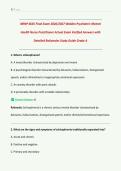
NRNP 6635 Final Exam 2026/2027 Walden Psychiatric Mental

Health Nurse Practitioner Actual Exam Verified Answers with

Detailed Rationales Study Guide Grade A


1. What is schizophrenia?

A. A mood disorder characterized by depression and mania

B. A psychological disorder characterized by delusions, hallucinations, disorganized

speech, and/or diminished or inappropriate emotional expression

C. An anxiety disorder with panic attacks

D. A personality disorder with unstable relationships

Correct Answer: B

Rationale: Schizophrenia is a chronic serious mental disorder characterized by

delusions, hallucinations, disorganized speech, and/or diminished emotional expression.


2. What are the signs and symptoms of schizophrenia traditionally separated into?

A. Acute and chronic

B. Positive and negative

C. Primary and secondary

,2|Page


D. Cognitive and affective

Correct Answer: B

Rationale: Schizophrenia symptoms are traditionally divided into positive symptoms

(delusions, hallucinations, disorganized speech/behavior) and negative symptoms (flat

affect, avolition, anhedonia, poor attention, alogia).


3. What is schizophrenia associated with?

A. A decline in cognitive and social functioning that often precedes the development of

florid psychosis

B. A sudden onset of symptoms without prior decline

C. Only positive symptoms without cognitive decline

D. Complete recovery without residual symptoms

Correct Answer: A

Rationale: Schizophrenia is associated with a decline in both cognitive and social

functioning that often precedes the development of florid psychosis.


4. What is the etiology of schizophrenia?

A. A single genetic factor

B. An increase in dopaminergic activity (thought to be linked, but no single etiological

, 3|Page


factor is responsible)

C. A viral infection

D. A traumatic brain injury

Correct Answer: B

Rationale: The exact etiology is unknown, but it is thought to be linked to an increase in

dopaminergic activity. No single etiological factor is responsible.


5. What is the treatment for schizophrenia?

A. Antidepressants alone

B. Antipsychotics in conjunction with behavioral therapy

C. Benzodiazepines alone

D. Electroconvulsive therapy only

Correct Answer: B

Rationale: Treatment includes antipsychotics in conjunction with behavioral therapy.


6. What is the average age of onset for schizophrenia in men and women?

A. Men: 20 years; Women: 22 years

B. Men: 23 years; Women: 26 years

C. Men: 25 years; Women: 28 years

Written for

Document information

Uploaded on
March 26, 2026
Number of pages
22
Written in
2025/2026
Type
Exam (elaborations)
Contains
Questions & answers

Subjects

$12.49
Get access to the full document:

Wrong document? Swap it for free Within 14 days of purchase and before downloading, you can choose a different document. You can simply spend the amount again.
Written by students who passed
Immediately available after payment
Read online or as PDF


Also available in package deal

Thumbnail
Package deal
Walden NRNP 6635 Psychopathology Midterm & Final Exam COMPILED BUNDLE
-
3 2026
$ 23.48 More info

Get to know the seller

Seller avatar
Reputation scores are based on the amount of documents a seller has sold for a fee and the reviews they have received for those documents. There are three levels: Bronze, Silver and Gold. The better the reputation, the more your can rely on the quality of the sellers work.
ExamitorMagnus Massachusetts Institute Of Technology
View profile
Follow You need to be logged in order to follow users or courses
Sold
117
Member since
2 year
Number of followers
7
Documents
1756
Last sold
1 week ago
Top Score

I am a professional writer with knowledge across diverse academic fields. I provide quality work and I guarantee superb, timely and original content. I know the pain of getting a shoddy work, and I would never wish this on any client! I guarantee a topnotch paper, with a fast High-score turnaround. I provide quality work guaranteed to give you an exemplary grade. Furthermore, I am a tutor of Research paper, Dissertation, proposal, management studies, economics, educational studies, sociology and psychology, marketing, Geography, History, Management, English, Literature, Education. Medical studies, Health Care studies and Nursing, Biology, Economics among other subjects.

Read more Read less
3.5

22 reviews

5
8
4
3
3
6
2
2
1
3

Why students choose Stuvia

Created by fellow students, verified by reviews

Quality you can trust: written by students who passed their tests and reviewed by others who've used these notes.

Didn't get what you expected? Choose another document

No worries! You can instantly pick a different document that better fits what you're looking for.

Pay as you like, start learning right away

No subscription, no commitments. Pay the way you're used to via credit card and download your PDF document instantly.

Student with book image

“Bought, downloaded, and aced it. It really can be that simple.”

Alisha Student

Working on your references?

Create accurate citations in APA, MLA and Harvard with our free citation generator.

Working on your references?

Frequently asked questions