

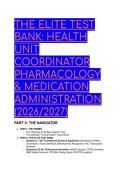
THE ELITE TEST
BANK: HEALTH
UNIT
COORDINATOR
PHARMACOLOGY
& MEDICATION
ADMINISTRATION
(2026/2027)
PART 0: THE NAVIGATOR
● PART I: THE PRIMER
○ The "Welcome to the Big Leagues" Hook
○ The 2026/2027 "Critical Action" Cheat Sheet
● PART II: THE ELITE TEST BANK
○ Questions 1–28: Foundational Syntax & Application (Apothecary & Metric
Conversions, Route Definitions, Brand/Generic Recognition, HUC Transcription
Symbols)
○ Questions 29–58: Professional Simulation (MAR Execution, CPOE Downtime,
ISMP Safety Protocols, PPD Skin Testing, Basic PCA/TPN Logistics)
, ○ Questions 59–88: Grandmaster Synthesis (Complex Interventions, Multi-System
Failures, ASPEN Guidelines, High-Stakes Prescriber Errors, 2026 Regulatory
Traps)
PART I: THE PRIMER
Students utilizing this test bank will directly intercept high-stakes errors and build top-tier
professional intuition. By mastering these 88 scenarios, the practitioner replaces academic rote
memorization with a surgical understanding of 2026/2027 pharmacological protocols, ensuring
flawless medication administration and order transcription under extreme clinical pressure.
The 2026/2027 "Critical Action" Cheat Sheet
Domain The Hard Deck Rule Clinical Mechanism /
Consequence
ISMP Safety Never transcribe "U", "Q.D.", These optical illusions cause
"Q.O.D.", or trailing zeros (e.g., lethal 10-fold dosing errors.
5.0 mg). Force the prescriber to write
"Units," "Daily," or "0.5 mg."
Apothecary to Metric 1 grain (gr) = 60 mg (or 65 mg Failure to convert apothecary
for aspirin); ss = one-half. 1 fractions accurately results in
fluid ounce = 30 mL. massive toxicological
emergencies.
TPN & Central Lines Total Parenteral Nutrition (TPN) Infusing hyperosmolar TPN into
> 900 mOsm/L MUST use a a peripheral vein causes
Central Venous Catheter. immediate chemical
thrombophlebitis and tissue
necrosis.
PCA Protocols Patient-Controlled Analgesia The lockout interval physically
orders MUST have a lockout prevents the pump from
interval. delivering fatal opiate
overdoses, regardless of
patient demand.
PPD Skin Testing Read strictly between 48 and T-cell delayed hypersensitivity
72 hours; measure induration, peaks in this window. Redness
not erythema. is irrelevant; the hard wheal
dictates exposure.
PART II: THE ELITE TEST BANK
Questions 1–28: Foundational Syntax & Application
Q1: A prescriber's handwritten order reads: "Aspirin gr xv PO STAT." To correctly process this
order into the 2026 Electronic Medical Record (EMR), the health unit coordinator (HUC) must
convert the apothecary dosage to the metric system. What is the ACCURATE metric dose? A)
15 mg B) 150 mg C) 500 mg D) 1000 mg
● The Answer: D (1000 mg)
, ● Distractor Analysis:
○ A is incorrect: This assumes "gr xv" means 15 milligrams, confusing grains with
milligrams.
○ B is incorrect: This is a random multiple of 15, showing a lack of conversion
knowledge.
○ C is incorrect: This represents an approximate standard dose of acetaminophen,
not the conversion of 15 grains.
The Mentor's Analysis: The apothecary system is archaic but still surfaces in legacy prescriber
habits. The foundational rule is 1 grain (gr) = 60 mg (or 65 mg for specific drugs like aspirin). 15
grains multiplied by roughly 60-65 mg yields approximately 900-1000 mg. For aspirin and
acetaminophen, gr xv is the standard equivalent to 1000 mg (1 gram). Professional Intuition:
Always map 'gr xv' directly to 1 gram to avoid lethal under- or over-dosing.
Q2: A physician writes an order for a preoperative patient: "Ativan 0.5 mg PO hs." What does
the abbreviation "hs" indicate for the timing of this administration? A) Immediately B)
Half-strength C) At bedtime D) Before meals
● The Answer: C (At bedtime)
● Distractor Analysis:
○ A is incorrect: Immediately is transcribed as "STAT".
○ B is incorrect: While "HS" can sometimes mean half-strength in compounding
contexts, in medication frequency, it strictly means hora somni (at bedtime).
○ D is incorrect: Before meals is abbreviated as "ac".
The Mentor's Analysis: Timing abbreviations dictate the rhythm of the nursing unit. "hs" (hora
somni) translates to the hour of sleep or bedtime. Transcribing this as "half-strength" for a
medication dose could lead to a severe sub-therapeutic failure. Professional Intuition: Context
dictates meaning; attached to a frequency, 'hs' is always bedtime.
Q3: The abbreviation "LOC" is noted on a patient's medication administration record (MAR) next
to a PRN order for Milk of Magnesia. In this specific pharmacological context, what does "LOC"
mean? A) Level of consciousness B) Laxative of choice C) Loss of control D) Liquid oral
concentrate
● The Answer: B (Laxative of choice)
● Distractor Analysis:
○ A is incorrect: While LOC means level of consciousness in a neurological
assessment, it does not apply to a bowel medication parameter.
○ C is incorrect: This is not a recognized medical abbreviation for medication
administration.
○ D is incorrect: This is a fabricated distractor that sounds plausible but does not exist
in standard HUC syntax.
The Mentor's Analysis: The HUC must navigate overlapping acronyms across disciplines.
While nurses assess "LOC" (Level of Consciousness) during a neurological exam, a prescriber
writing "LOC" next to a bowel regimen signifies "Laxative of Choice." Professional Intuition:
Always cross-reference the abbreviation with the therapeutic class of the prescribed drug.
Q4: A 2026 clinical protocol requires the administration of a medication via the "topical" route.
Which action reflects the CORRECT application of this route? A) Injecting the medication into
the subcutaneous adipose tissue. B) Instilling the medication deep into the rectal cavity. C)
Applying the medication directly to the epidermal surface or mucous membrane. D)
Administering the medication beneath the tongue for rapid absorption.
● The Answer: C (Applying the medication directly to the epidermal surface or mucous
membrane.)
BANK: HEALTH
UNIT
COORDINATOR
PHARMACOLOGY
& MEDICATION
ADMINISTRATION
(2026/2027)
PART 0: THE NAVIGATOR
● PART I: THE PRIMER
○ The "Welcome to the Big Leagues" Hook
○ The 2026/2027 "Critical Action" Cheat Sheet
● PART II: THE ELITE TEST BANK
○ Questions 1–28: Foundational Syntax & Application (Apothecary & Metric
Conversions, Route Definitions, Brand/Generic Recognition, HUC Transcription
Symbols)
○ Questions 29–58: Professional Simulation (MAR Execution, CPOE Downtime,
ISMP Safety Protocols, PPD Skin Testing, Basic PCA/TPN Logistics)
, ○ Questions 59–88: Grandmaster Synthesis (Complex Interventions, Multi-System
Failures, ASPEN Guidelines, High-Stakes Prescriber Errors, 2026 Regulatory
Traps)
PART I: THE PRIMER
Students utilizing this test bank will directly intercept high-stakes errors and build top-tier
professional intuition. By mastering these 88 scenarios, the practitioner replaces academic rote
memorization with a surgical understanding of 2026/2027 pharmacological protocols, ensuring
flawless medication administration and order transcription under extreme clinical pressure.
The 2026/2027 "Critical Action" Cheat Sheet
Domain The Hard Deck Rule Clinical Mechanism /
Consequence
ISMP Safety Never transcribe "U", "Q.D.", These optical illusions cause
"Q.O.D.", or trailing zeros (e.g., lethal 10-fold dosing errors.
5.0 mg). Force the prescriber to write
"Units," "Daily," or "0.5 mg."
Apothecary to Metric 1 grain (gr) = 60 mg (or 65 mg Failure to convert apothecary
for aspirin); ss = one-half. 1 fractions accurately results in
fluid ounce = 30 mL. massive toxicological
emergencies.
TPN & Central Lines Total Parenteral Nutrition (TPN) Infusing hyperosmolar TPN into
> 900 mOsm/L MUST use a a peripheral vein causes
Central Venous Catheter. immediate chemical
thrombophlebitis and tissue
necrosis.
PCA Protocols Patient-Controlled Analgesia The lockout interval physically
orders MUST have a lockout prevents the pump from
interval. delivering fatal opiate
overdoses, regardless of
patient demand.
PPD Skin Testing Read strictly between 48 and T-cell delayed hypersensitivity
72 hours; measure induration, peaks in this window. Redness
not erythema. is irrelevant; the hard wheal
dictates exposure.
PART II: THE ELITE TEST BANK
Questions 1–28: Foundational Syntax & Application
Q1: A prescriber's handwritten order reads: "Aspirin gr xv PO STAT." To correctly process this
order into the 2026 Electronic Medical Record (EMR), the health unit coordinator (HUC) must
convert the apothecary dosage to the metric system. What is the ACCURATE metric dose? A)
15 mg B) 150 mg C) 500 mg D) 1000 mg
● The Answer: D (1000 mg)
, ● Distractor Analysis:
○ A is incorrect: This assumes "gr xv" means 15 milligrams, confusing grains with
milligrams.
○ B is incorrect: This is a random multiple of 15, showing a lack of conversion
knowledge.
○ C is incorrect: This represents an approximate standard dose of acetaminophen,
not the conversion of 15 grains.
The Mentor's Analysis: The apothecary system is archaic but still surfaces in legacy prescriber
habits. The foundational rule is 1 grain (gr) = 60 mg (or 65 mg for specific drugs like aspirin). 15
grains multiplied by roughly 60-65 mg yields approximately 900-1000 mg. For aspirin and
acetaminophen, gr xv is the standard equivalent to 1000 mg (1 gram). Professional Intuition:
Always map 'gr xv' directly to 1 gram to avoid lethal under- or over-dosing.
Q2: A physician writes an order for a preoperative patient: "Ativan 0.5 mg PO hs." What does
the abbreviation "hs" indicate for the timing of this administration? A) Immediately B)
Half-strength C) At bedtime D) Before meals
● The Answer: C (At bedtime)
● Distractor Analysis:
○ A is incorrect: Immediately is transcribed as "STAT".
○ B is incorrect: While "HS" can sometimes mean half-strength in compounding
contexts, in medication frequency, it strictly means hora somni (at bedtime).
○ D is incorrect: Before meals is abbreviated as "ac".
The Mentor's Analysis: Timing abbreviations dictate the rhythm of the nursing unit. "hs" (hora
somni) translates to the hour of sleep or bedtime. Transcribing this as "half-strength" for a
medication dose could lead to a severe sub-therapeutic failure. Professional Intuition: Context
dictates meaning; attached to a frequency, 'hs' is always bedtime.
Q3: The abbreviation "LOC" is noted on a patient's medication administration record (MAR) next
to a PRN order for Milk of Magnesia. In this specific pharmacological context, what does "LOC"
mean? A) Level of consciousness B) Laxative of choice C) Loss of control D) Liquid oral
concentrate
● The Answer: B (Laxative of choice)
● Distractor Analysis:
○ A is incorrect: While LOC means level of consciousness in a neurological
assessment, it does not apply to a bowel medication parameter.
○ C is incorrect: This is not a recognized medical abbreviation for medication
administration.
○ D is incorrect: This is a fabricated distractor that sounds plausible but does not exist
in standard HUC syntax.
The Mentor's Analysis: The HUC must navigate overlapping acronyms across disciplines.
While nurses assess "LOC" (Level of Consciousness) during a neurological exam, a prescriber
writing "LOC" next to a bowel regimen signifies "Laxative of Choice." Professional Intuition:
Always cross-reference the abbreviation with the therapeutic class of the prescribed drug.
Q4: A 2026 clinical protocol requires the administration of a medication via the "topical" route.
Which action reflects the CORRECT application of this route? A) Injecting the medication into
the subcutaneous adipose tissue. B) Instilling the medication deep into the rectal cavity. C)
Applying the medication directly to the epidermal surface or mucous membrane. D)
Administering the medication beneath the tongue for rapid absorption.
● The Answer: C (Applying the medication directly to the epidermal surface or mucous
membrane.)


