

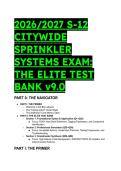
2026/2027 S-12
CITYWIDE
SPRINKLER
SYSTEMS EXAM:
THE ELITE TEST
BANK v9.0
PART 0: THE NAVIGATOR
● PART I: THE PRIMER
○ Welcome to the Big Leagues
○ The "Critical Action" Cheat Sheet
○ The 2026/2027 Core Metrics Table
● PART II: THE ELITE TEST BANK
○ Section 1: Foundational Syntax & Application (Q1–Q28)
■ Focus: FDNY Hard Deck Definitions, Tagging Parameters, and Component
Identification.
○ Section 2: Professional Simulation (Q29–Q58)
■ Focus: Immediate Actions, Impairment Protocols, Testing Frequencies, and
Troubleshooting.
○ Section 3: Grandmaster Synthesis (Q59–Q88)
■ Focus: High-Stakes Crisis Management, 2026/2027 NFPA 25 Updates, and
Interconnected Failures.
PART I: THE PRIMER
,Welcome to the Big Leagues This document is the crucible. By mastering this Elite Test Bank,
you will intercept high-stakes errors, transcend rote memorization, and forge the professional
intuition required of a top-tier FDNY S-12 Certificate of Fitness holder. You are here to learn how
to keep New York City from burning under strict 2026/2027 regulatory standards.
The "Critical Action" Cheat Sheet
● The Impairment Law: Any system out of service (OOS) requires a Fire Watch. If the
outage exceeds 4 hours or covers an area >50,000 sq ft, an F-01 Fire Guard is strictly
mandated.
● The Triad of Color Codes: Under NYC Building Code Chapter 9, dedicated Sprinkler
handles are Green. Dedicated Standpipe handles are Red. Combination handles are
Yellow. All exposed piping must be Red.
● The Tagging Doctrine: Green (Operational), Yellow (Non-critical Deficiency), Orange
(Critical Deficiency), Red (Impairment/OOS).
● The Golden Rule of Testing: Never initiate a test on a supervised system without FIRST
putting the central station on test mode.
The 2026/2027 Core Metrics Table
Component / Action Requirement / Frequency Code Reference / Update
Gravity Tank Water Temp Minimum 40°F (4°C) FDNY S-12 Hard Deck
Pressure Tank Air Minimum 75 psi (1/3 Air, 2/3 FDNY S-12 Hard Deck
Water)
Spare Heads (<300 total) 6 Spares + Wrenches
Standard Sprinkler Testing 50 Years (Mandatory 2026 NFPA 25 Update
replacement in dwellings)
Dry / ESFR Sprinkler Testing 20 Years 2026 NFPA 25 Update
Preaction Solenoid Quarterly Testing 2026 NFPA 25 Update
Monitoring
Dry/Preaction Valve Internal Annually
FDC Hydrostatic Test 150 psi for 2 hours (Every 5
years)
PART II: THE ELITE TEST BANK
Section 1: Foundational Syntax & Application (Q1–Q28)
Q1: Under New York City Local Law 58/09, a practitioner is inspecting a newly installed
dedicated sprinkler system. What color MUST the dedicated sprinkler valve handles be painted
to comply with the code? A) Red B) Yellow C) Green D) Orange
● The Answer: C (Green)
● Distractor Analysis:
○ A is incorrect: Red is strictly reserved for dedicated standpipe valves and exposed
piping.
○ B is incorrect: Yellow designates combination standpipe/sprinkler valves.
○ D is incorrect: Orange is not an authorized NYC valve handle color.
The Mentor's Analysis: Color coding prevents fatal hesitation. Green means water for
automatic sprinklers. Red means water for manual hoses. Professional Intuition: If a handle
, color does not match the riser placard, you have an immediate operational hazard.
Q2: You are auditing a pre-war high-rise with a combined sprinkler and standpipe system. The
main control valve handles MUST be painted which specific color? A) Red B) Yellow C) Green
D) Blue
● The Answer: B (Yellow)
● Distractor Analysis:
○ A is incorrect: Red applies only to dedicated standpipe systems.
○ C is incorrect: Green is strictly for dedicated sprinklers.
○ D is incorrect: Blue is not a recognized FDNY standard.
The Mentor's Analysis: Yellow warns the operator that closing this valve kills both offensive
and defensive water lines simultaneously. It is a high-stakes shutoff.
Q3: During a January inspection, you access the roof to verify gravity tank conditions. What is
the MINIMUM acceptable water temperature required to prevent system failure? A) 32°F (0°C)
B) 40°F (4°C) C) 50°F (10°C) D) 65°F (18°C)
● The Answer: B (40°F (4°C))
● Distractor Analysis:
○ A is incorrect: 32°F provides zero safety margin against solid ice formation.
○ C is incorrect: 50°F exceeds the mandated minimum and wastes heating energy.
○ D is incorrect: 65°F is ambient room temperature, not a tank minimum.
The Mentor's Analysis: Gravity tanks are massive steel heat-sinks. The 40°F floor provides the
exact thermal buffer needed before stagnation turns to solid ice, which expands and destroys
the tank.
Q4: A gravity tank must provide adequate pressure without a booster pump. What is the
MINIMUM required elevation of the gravity tank above the highest line of sprinkler heads? A) 10
feet B) 15 feet C) 25 feet D) 40 feet
● The Answer: C (25 feet)
● Distractor Analysis:
○ A is incorrect: Generates insufficient psi to push water through the deflector.
○ B is incorrect: Fails hydraulic minimums.
○ D is incorrect: 40 feet is excellent but 25 feet is the strict legal minimum.
The Mentor's Analysis: Every 2.31 feet of water elevation generates 1 psi. A 25-foot drop
ensures roughly 10.8 psi at the highest head, overcoming the 7 psi minimum needed to form a
proper spray pattern.
Q5: You are inspecting a pressure tank acting as the primary water supply. The tank has a
gross capacity of 6,000 gallons. What is the REQUIRED minimum air pressure inside this tank?
A) 50 psi B) 65 psi C) 75 psi D) 100 psi
● The Answer: C (75 psi)
● Distractor Analysis:
○ A is incorrect: Will fail to expel the final volume of water.
○ B is incorrect: Too low for standard FDNY codes.
○ D is incorrect: Unnecessary over-pressurization.
The Mentor's Analysis: Pressure tanks use compressed air as an artificial gravity. 75 psi is the
mathematical floor required to violently push water out of the tank and through the highest
remote sprinkler.
Q6: To maintain proper hydraulic dynamics, a standard pressure tank must be maintained at a
specific volume ratio. Which represents the CORRECT internal ratio? A) One-half water,
one-half pressurized air. B) One-third water, two-thirds pressurized air. C) Two-thirds water,
one-third pressurized air. D) Three-quarters water, one-quarter pressurized air.
CITYWIDE
SPRINKLER
SYSTEMS EXAM:
THE ELITE TEST
BANK v9.0
PART 0: THE NAVIGATOR
● PART I: THE PRIMER
○ Welcome to the Big Leagues
○ The "Critical Action" Cheat Sheet
○ The 2026/2027 Core Metrics Table
● PART II: THE ELITE TEST BANK
○ Section 1: Foundational Syntax & Application (Q1–Q28)
■ Focus: FDNY Hard Deck Definitions, Tagging Parameters, and Component
Identification.
○ Section 2: Professional Simulation (Q29–Q58)
■ Focus: Immediate Actions, Impairment Protocols, Testing Frequencies, and
Troubleshooting.
○ Section 3: Grandmaster Synthesis (Q59–Q88)
■ Focus: High-Stakes Crisis Management, 2026/2027 NFPA 25 Updates, and
Interconnected Failures.
PART I: THE PRIMER
,Welcome to the Big Leagues This document is the crucible. By mastering this Elite Test Bank,
you will intercept high-stakes errors, transcend rote memorization, and forge the professional
intuition required of a top-tier FDNY S-12 Certificate of Fitness holder. You are here to learn how
to keep New York City from burning under strict 2026/2027 regulatory standards.
The "Critical Action" Cheat Sheet
● The Impairment Law: Any system out of service (OOS) requires a Fire Watch. If the
outage exceeds 4 hours or covers an area >50,000 sq ft, an F-01 Fire Guard is strictly
mandated.
● The Triad of Color Codes: Under NYC Building Code Chapter 9, dedicated Sprinkler
handles are Green. Dedicated Standpipe handles are Red. Combination handles are
Yellow. All exposed piping must be Red.
● The Tagging Doctrine: Green (Operational), Yellow (Non-critical Deficiency), Orange
(Critical Deficiency), Red (Impairment/OOS).
● The Golden Rule of Testing: Never initiate a test on a supervised system without FIRST
putting the central station on test mode.
The 2026/2027 Core Metrics Table
Component / Action Requirement / Frequency Code Reference / Update
Gravity Tank Water Temp Minimum 40°F (4°C) FDNY S-12 Hard Deck
Pressure Tank Air Minimum 75 psi (1/3 Air, 2/3 FDNY S-12 Hard Deck
Water)
Spare Heads (<300 total) 6 Spares + Wrenches
Standard Sprinkler Testing 50 Years (Mandatory 2026 NFPA 25 Update
replacement in dwellings)
Dry / ESFR Sprinkler Testing 20 Years 2026 NFPA 25 Update
Preaction Solenoid Quarterly Testing 2026 NFPA 25 Update
Monitoring
Dry/Preaction Valve Internal Annually
FDC Hydrostatic Test 150 psi for 2 hours (Every 5
years)
PART II: THE ELITE TEST BANK
Section 1: Foundational Syntax & Application (Q1–Q28)
Q1: Under New York City Local Law 58/09, a practitioner is inspecting a newly installed
dedicated sprinkler system. What color MUST the dedicated sprinkler valve handles be painted
to comply with the code? A) Red B) Yellow C) Green D) Orange
● The Answer: C (Green)
● Distractor Analysis:
○ A is incorrect: Red is strictly reserved for dedicated standpipe valves and exposed
piping.
○ B is incorrect: Yellow designates combination standpipe/sprinkler valves.
○ D is incorrect: Orange is not an authorized NYC valve handle color.
The Mentor's Analysis: Color coding prevents fatal hesitation. Green means water for
automatic sprinklers. Red means water for manual hoses. Professional Intuition: If a handle
, color does not match the riser placard, you have an immediate operational hazard.
Q2: You are auditing a pre-war high-rise with a combined sprinkler and standpipe system. The
main control valve handles MUST be painted which specific color? A) Red B) Yellow C) Green
D) Blue
● The Answer: B (Yellow)
● Distractor Analysis:
○ A is incorrect: Red applies only to dedicated standpipe systems.
○ C is incorrect: Green is strictly for dedicated sprinklers.
○ D is incorrect: Blue is not a recognized FDNY standard.
The Mentor's Analysis: Yellow warns the operator that closing this valve kills both offensive
and defensive water lines simultaneously. It is a high-stakes shutoff.
Q3: During a January inspection, you access the roof to verify gravity tank conditions. What is
the MINIMUM acceptable water temperature required to prevent system failure? A) 32°F (0°C)
B) 40°F (4°C) C) 50°F (10°C) D) 65°F (18°C)
● The Answer: B (40°F (4°C))
● Distractor Analysis:
○ A is incorrect: 32°F provides zero safety margin against solid ice formation.
○ C is incorrect: 50°F exceeds the mandated minimum and wastes heating energy.
○ D is incorrect: 65°F is ambient room temperature, not a tank minimum.
The Mentor's Analysis: Gravity tanks are massive steel heat-sinks. The 40°F floor provides the
exact thermal buffer needed before stagnation turns to solid ice, which expands and destroys
the tank.
Q4: A gravity tank must provide adequate pressure without a booster pump. What is the
MINIMUM required elevation of the gravity tank above the highest line of sprinkler heads? A) 10
feet B) 15 feet C) 25 feet D) 40 feet
● The Answer: C (25 feet)
● Distractor Analysis:
○ A is incorrect: Generates insufficient psi to push water through the deflector.
○ B is incorrect: Fails hydraulic minimums.
○ D is incorrect: 40 feet is excellent but 25 feet is the strict legal minimum.
The Mentor's Analysis: Every 2.31 feet of water elevation generates 1 psi. A 25-foot drop
ensures roughly 10.8 psi at the highest head, overcoming the 7 psi minimum needed to form a
proper spray pattern.
Q5: You are inspecting a pressure tank acting as the primary water supply. The tank has a
gross capacity of 6,000 gallons. What is the REQUIRED minimum air pressure inside this tank?
A) 50 psi B) 65 psi C) 75 psi D) 100 psi
● The Answer: C (75 psi)
● Distractor Analysis:
○ A is incorrect: Will fail to expel the final volume of water.
○ B is incorrect: Too low for standard FDNY codes.
○ D is incorrect: Unnecessary over-pressurization.
The Mentor's Analysis: Pressure tanks use compressed air as an artificial gravity. 75 psi is the
mathematical floor required to violently push water out of the tank and through the highest
remote sprinkler.
Q6: To maintain proper hydraulic dynamics, a standard pressure tank must be maintained at a
specific volume ratio. Which represents the CORRECT internal ratio? A) One-half water,
one-half pressurized air. B) One-third water, two-thirds pressurized air. C) Two-thirds water,
one-third pressurized air. D) Three-quarters water, one-quarter pressurized air.


