

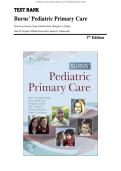
Test Bank - Burns' Pediatric Primary Care 7th Edition (Garzon, 2020)
TEST BANK
Burns' Pediatric Primary Care
Dawn Lee Garzon, Nancy Barber Starr, Margaret A. Brady,
Nan M. Gaylord, Martha Driessnack, Karen G. Duderstadt
7st Edition
, Test Bank - Burns' Pediatric Primary Care 7th Edition (Garzon, 2020)
Table of Contents
Unit I: Influences on Child Health and Child Health Assessment
1. Health Status of Children: Global and National Perspectives
2. Unique Issues in Pediatrics
3. Genetics and Child Health
4. Environmental Issues
5. Child and Family Health Assessment
6. Cultural Considerations for Pediatric Primary Care
7. Children with Special Health Care Needs
Unit II: Child Development
8. Developmental Management in Pediatric Primary Care
9. Developmental Management of Newborns
10. Developmental Management of Infants
11. Developmental Management of Early Childhood
12. Developmental Management of Middle Childhood
13. Developmental Management of Adolescents/Young Adults
Unit III: Child Health Supervision: Health Promotion and Health Protection
14. Introduction to Health Promotion and Health Protection for Children and Families
15. Behavioral and Mental Health Promotion Section
16. Breastfeeding
17. Nutrition
18. Elimination
19. Physical Activity and Sports
20. Sleep
21. Sexuality
22. Immunizations
23. Dental Health and Oral Disorders
24. Intentional and Unintentional Injuries: Injury Prevention and Child Maltreatment
Unit IV: Common Childhood Conditions and Disorders
25. Acute/Chronic Disease Management and Principles of Diagnostic Testing
26. Prescribing Medications in Pediatrics
27. Complementary and Integrative Health in Pediatrics
28. Pediatric Pain and Fever Management
29. Perinatal Disorders
30. Mental Health Disorders
31. Infectious Diseases
32. Common Genetic Disorders
33. Atopic, Rheumatic, and Immunodeficiency Disorders
34. Dermatologic Disorders
35. Eye and Vision Disorders
36. Ear and Hearing Disorders
37. Respiratory Disorders
38. Cardiovascular Disorders
39. Hematologic Disorders
40. Gastrointestinal Disorders
41. Genitourinary Disorders
42. Gynecologic Disorders
43. Musculoskeletal Disorders
44. Injuries and Toxic Exposures
45. Endocrine and Metabolic Disorders
46. Neurologic Disorders
, Test Bank - Burns' Pediatric Primary Care 7th Edition (Garzon, 2020)
Burns' Pediatric Primary Care 7th Edition Test
Bank
Chapter 1: Health Status of Children: Global and National Perspectives
1. Which region globally has the highest infant mortality rate?
A. Indonesia
B. Southern Asia
C. SubSaharan Africa Correct
D. Syria
2. The primary care pediatric nurse practitioner understands that, to achieve the
greatest worldwide
reduction in child mortality from pneumonia and diarrhea, which interventionis most
effective?
A. Antibiotics
B. Optimal nutrition
C. Vaccinations Correct
D. Water purification
3. Which is true about the health status of children in the United States?
.
13348413856
A. Globalism has relatively little impact on child health measures in the U.S.
B. Obesity rates among 2to5yearolds have shown a recent
significant
decrease. Correct
.
C. The rate of household poverty is lower than in other economically
developed nations.
D. Young children who attend preschool or day care have higher food
insecurity.
4. The primary care pediatric nurse practitioner understands that a majorchild
health outcome associated with worldwide climate change is
A. cost of living.
B. education.
C. nutrition. Correct
D. pollution.
5. When providing well child care for an infant in the first year of life, theprimary
care pediatric nurse practitioner is adhering to the most recent AmericanAcademy of
PediatricsRecommendations for Preventive Pediatric Health Care guidelinesby
A. focusing less on development and more on illness prevention and
nutrition.
B. following guidelines established by theBright Futures publication.
C. scheduling wellbaby visits to coincide with key developmental
milestones. Correct
D. seeing the infant at ages 2, 4, 6, and 12 months when immunizations aredue.
Chapter 2. Unique Issues in Pediatrics
1. A nurse is explaining the therapeutic milieu to a new nurse. The bestexplanation
of this term would be:
1. The place where the child is receiving care.
, Test Bank - Burns' Pediatric Primary Care 7th Edition (Garzon, 2020)
2. Group therapy.
3. Personal interactions between patients and staff.
4. All of the above are correct.
ANS: 4
2. A 16-year-old male has received a pink-slip from the police for inpatientpsychiatric
treatment. The teen
has been expressing thoughts of hanging himself because Life sucks. Thenursingstaff
should consider
placing the child:
1. With peers.
2. In an area where he can be watched one-on-one.
3. With aroommate thatisexpressing the sameconcerns.
4. In an area close to an external door.
ANS: 2
3. Learning disabilities in children have scientifically been linked to:
1. Poornutrition.
2. The environment in which the child lives.
3. Genetics.
4. Watching more than four hours of television a day.ANS:
3
4. A mental health nurse has assessed a child and determined that the childexhibits
behavioral challenges.
When the school nurse explains this to a teacher, the best description wouldbe:
.
1. The child may exhibit physical outbursts.
2. The child may exhibit violence toward others.
3. The child may be defiant or have tantrums.
4. The child will need special interventions for learning.ANS:
3
5. A child that has not exhibited enuresis in four years has exhibited thisbehavior
pattern for the last week.
The reason a child may revert back to this behavior pattern is because of:
1. Hallucinations.
2. Behavioral challenges.
3. Delusions.
4. Stress.
ANS: 4
6. An 18-year-old male has called the crisis line for help. The crisis nurserecognizes the
intervention needs
may consist of all of the following except:
1. Discussing the individuals everyday activities.
2. Recognizing that the patient may be in a catharsis state.
3. Expressing empathy toward the caller.
4. Avoiding entropy.
ANS: 1
7. An 8-year-old boy with a history of hallucinations and violent behavior hasbeen
place in a seclusion room
at the hospital because he has been hurting others. The nurse checks on thepatient and
realizes she must take
him out of the seclusion room when:
1. He is crying to be released.
, Test Bank - Burns' Pediatric Primary Care 7th Edition (Garzon, 2020)
2. He states, I will be a good boy now.
3. He starts headbutting the window.
4. He complains that his parents will file a lawsuit.ANS:
3
8. A child has been exhibiting the MacDonald Triad. These behaviors include:
1. Enuresis, pushing others, and pyromania.
2. Swinging a cat by the tail, bed-wetting, and lighting paper on fire in thetrash can.
3. Playing with other children, laughing, and conversing with adults.
4. Playing with a campfire, watching television, and seeking adult attention.ANS: 2
9. A teenager diagnosed with borderline personality disorder should havedischarge
planning instructions of:
1. A consistent caregiver.
2. Monitoring of media, such as the Internet, television, and video games.
3. Obtaining support from family and friends.
4. Seeking medical attention when the teenager feels good.ANS: 3
10. A mental health nurse is teaching the mother of a child with executivefunctioning issues
ways to help
her child. Interventions the mother should use include:
1. Placing visual aids on the bathroom mirror so that the child will follow themorning
routine.
2. Give the child a choice in foods to eat.
3. Allowing the child to ask for help when needed.
4. Reminding the child to be nice to others.ANS:
1
11. Ellie, a 9-year-old girl, was adopted by a family at the age of 4 after severalyears of
severe neglect by her birth family. The adoptive family hasbeen reporting that Ellie is angry a
lot, manipulative with her
teachers, and does not seek positive attention. The nurse working with EllieIwill need to:
1. Provide education on decreasing stimuli in the home environment thattriggers
the anger.
2. Realize Ellie may have attachment issues related to her previous historyand will
need to encourage the
family to be active in her care.
3. Support the family in the decision-making process of continuing to let Ellielive in
the home.
4. Discuss inpatient therapy to decrease Ellies manipulative behavior
patterns.
ANS: 2
12. An infant displays depression by:
1. Smiling at strangers.
2. Bonding to someone other than the immediate family.
3. Crying more than anaverage infant.
4. Looks away when an adult attempts to play with the infant.ANS: 4
TEST BANK
Burns' Pediatric Primary Care
Dawn Lee Garzon, Nancy Barber Starr, Margaret A. Brady,
Nan M. Gaylord, Martha Driessnack, Karen G. Duderstadt
7st Edition
, Test Bank - Burns' Pediatric Primary Care 7th Edition (Garzon, 2020)
Table of Contents
Unit I: Influences on Child Health and Child Health Assessment
1. Health Status of Children: Global and National Perspectives
2. Unique Issues in Pediatrics
3. Genetics and Child Health
4. Environmental Issues
5. Child and Family Health Assessment
6. Cultural Considerations for Pediatric Primary Care
7. Children with Special Health Care Needs
Unit II: Child Development
8. Developmental Management in Pediatric Primary Care
9. Developmental Management of Newborns
10. Developmental Management of Infants
11. Developmental Management of Early Childhood
12. Developmental Management of Middle Childhood
13. Developmental Management of Adolescents/Young Adults
Unit III: Child Health Supervision: Health Promotion and Health Protection
14. Introduction to Health Promotion and Health Protection for Children and Families
15. Behavioral and Mental Health Promotion Section
16. Breastfeeding
17. Nutrition
18. Elimination
19. Physical Activity and Sports
20. Sleep
21. Sexuality
22. Immunizations
23. Dental Health and Oral Disorders
24. Intentional and Unintentional Injuries: Injury Prevention and Child Maltreatment
Unit IV: Common Childhood Conditions and Disorders
25. Acute/Chronic Disease Management and Principles of Diagnostic Testing
26. Prescribing Medications in Pediatrics
27. Complementary and Integrative Health in Pediatrics
28. Pediatric Pain and Fever Management
29. Perinatal Disorders
30. Mental Health Disorders
31. Infectious Diseases
32. Common Genetic Disorders
33. Atopic, Rheumatic, and Immunodeficiency Disorders
34. Dermatologic Disorders
35. Eye and Vision Disorders
36. Ear and Hearing Disorders
37. Respiratory Disorders
38. Cardiovascular Disorders
39. Hematologic Disorders
40. Gastrointestinal Disorders
41. Genitourinary Disorders
42. Gynecologic Disorders
43. Musculoskeletal Disorders
44. Injuries and Toxic Exposures
45. Endocrine and Metabolic Disorders
46. Neurologic Disorders
, Test Bank - Burns' Pediatric Primary Care 7th Edition (Garzon, 2020)
Burns' Pediatric Primary Care 7th Edition Test
Bank
Chapter 1: Health Status of Children: Global and National Perspectives
1. Which region globally has the highest infant mortality rate?
A. Indonesia
B. Southern Asia
C. SubSaharan Africa Correct
D. Syria
2. The primary care pediatric nurse practitioner understands that, to achieve the
greatest worldwide
reduction in child mortality from pneumonia and diarrhea, which interventionis most
effective?
A. Antibiotics
B. Optimal nutrition
C. Vaccinations Correct
D. Water purification
3. Which is true about the health status of children in the United States?
.
13348413856
A. Globalism has relatively little impact on child health measures in the U.S.
B. Obesity rates among 2to5yearolds have shown a recent
significant
decrease. Correct
.
C. The rate of household poverty is lower than in other economically
developed nations.
D. Young children who attend preschool or day care have higher food
insecurity.
4. The primary care pediatric nurse practitioner understands that a majorchild
health outcome associated with worldwide climate change is
A. cost of living.
B. education.
C. nutrition. Correct
D. pollution.
5. When providing well child care for an infant in the first year of life, theprimary
care pediatric nurse practitioner is adhering to the most recent AmericanAcademy of
PediatricsRecommendations for Preventive Pediatric Health Care guidelinesby
A. focusing less on development and more on illness prevention and
nutrition.
B. following guidelines established by theBright Futures publication.
C. scheduling wellbaby visits to coincide with key developmental
milestones. Correct
D. seeing the infant at ages 2, 4, 6, and 12 months when immunizations aredue.
Chapter 2. Unique Issues in Pediatrics
1. A nurse is explaining the therapeutic milieu to a new nurse. The bestexplanation
of this term would be:
1. The place where the child is receiving care.
, Test Bank - Burns' Pediatric Primary Care 7th Edition (Garzon, 2020)
2. Group therapy.
3. Personal interactions between patients and staff.
4. All of the above are correct.
ANS: 4
2. A 16-year-old male has received a pink-slip from the police for inpatientpsychiatric
treatment. The teen
has been expressing thoughts of hanging himself because Life sucks. Thenursingstaff
should consider
placing the child:
1. With peers.
2. In an area where he can be watched one-on-one.
3. With aroommate thatisexpressing the sameconcerns.
4. In an area close to an external door.
ANS: 2
3. Learning disabilities in children have scientifically been linked to:
1. Poornutrition.
2. The environment in which the child lives.
3. Genetics.
4. Watching more than four hours of television a day.ANS:
3
4. A mental health nurse has assessed a child and determined that the childexhibits
behavioral challenges.
When the school nurse explains this to a teacher, the best description wouldbe:
.
1. The child may exhibit physical outbursts.
2. The child may exhibit violence toward others.
3. The child may be defiant or have tantrums.
4. The child will need special interventions for learning.ANS:
3
5. A child that has not exhibited enuresis in four years has exhibited thisbehavior
pattern for the last week.
The reason a child may revert back to this behavior pattern is because of:
1. Hallucinations.
2. Behavioral challenges.
3. Delusions.
4. Stress.
ANS: 4
6. An 18-year-old male has called the crisis line for help. The crisis nurserecognizes the
intervention needs
may consist of all of the following except:
1. Discussing the individuals everyday activities.
2. Recognizing that the patient may be in a catharsis state.
3. Expressing empathy toward the caller.
4. Avoiding entropy.
ANS: 1
7. An 8-year-old boy with a history of hallucinations and violent behavior hasbeen
place in a seclusion room
at the hospital because he has been hurting others. The nurse checks on thepatient and
realizes she must take
him out of the seclusion room when:
1. He is crying to be released.
, Test Bank - Burns' Pediatric Primary Care 7th Edition (Garzon, 2020)
2. He states, I will be a good boy now.
3. He starts headbutting the window.
4. He complains that his parents will file a lawsuit.ANS:
3
8. A child has been exhibiting the MacDonald Triad. These behaviors include:
1. Enuresis, pushing others, and pyromania.
2. Swinging a cat by the tail, bed-wetting, and lighting paper on fire in thetrash can.
3. Playing with other children, laughing, and conversing with adults.
4. Playing with a campfire, watching television, and seeking adult attention.ANS: 2
9. A teenager diagnosed with borderline personality disorder should havedischarge
planning instructions of:
1. A consistent caregiver.
2. Monitoring of media, such as the Internet, television, and video games.
3. Obtaining support from family and friends.
4. Seeking medical attention when the teenager feels good.ANS: 3
10. A mental health nurse is teaching the mother of a child with executivefunctioning issues
ways to help
her child. Interventions the mother should use include:
1. Placing visual aids on the bathroom mirror so that the child will follow themorning
routine.
2. Give the child a choice in foods to eat.
3. Allowing the child to ask for help when needed.
4. Reminding the child to be nice to others.ANS:
1
11. Ellie, a 9-year-old girl, was adopted by a family at the age of 4 after severalyears of
severe neglect by her birth family. The adoptive family hasbeen reporting that Ellie is angry a
lot, manipulative with her
teachers, and does not seek positive attention. The nurse working with EllieIwill need to:
1. Provide education on decreasing stimuli in the home environment thattriggers
the anger.
2. Realize Ellie may have attachment issues related to her previous historyand will
need to encourage the
family to be active in her care.
3. Support the family in the decision-making process of continuing to let Ellielive in
the home.
4. Discuss inpatient therapy to decrease Ellies manipulative behavior
patterns.
ANS: 2
12. An infant displays depression by:
1. Smiling at strangers.
2. Bonding to someone other than the immediate family.
3. Crying more than anaverage infant.
4. Looks away when an adult attempts to play with the infant.ANS: 4


