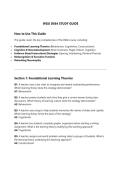
WGU D664 STUDY GUIDE
How to Use This Guide
This guide covers the key competencies of the D664 course, including:
Foundational Learning Theories (Behaviorism, Cognitivism, Constructivism)
Cognitive & Neurodevelopment (Brain structures, Piaget, Erikson, Vygotsky)
Evidence-Based Instructional Strategies (Spacing, Interleaving, Retrieval Practice)
Metacognition & Executive Function
Debunking Neuromyths
Section 1: Foundational Learning Theories
Q1: A teacher uses a star chart to recognize and reward outstanding performance.
Which learning theory does this strategy demonstrate?
A1: Behaviorism
Q2: A teacher praises students each time they give a correct answer during class
discussions. Which theory of learning science does this strategy demonstrate?
A2: Behaviorism
Q3: A teacher uses songs to help students memorize the names of states and capitals.
Which learning theory forms the basis of this strategy?
A3: Cognitivism
Q4: A teacher has students complete graphic organizers before starting a writing
assignment. What is the learning theory underlying this teaching approach?
A4: Cognitivism
Q5: A teacher assigns real-world problem-solving tasks to groups of students. What is
the learning theory underlying this teaching approach?
A5: Constructivism
, Q6: A teacher gives students the freedom to select a topic or real-world problem to
research for their final project. Which learning theory forms the basis of this strategy?
A6: Constructivism
Q7: A teacher values constructivism as a valuable approach to day-to-day learning.
Which strategy can the teacher use to incorporate this learning theory?
A7: Connecting each new concept to what students have already learned
Section 2: The Learning Process (Encoding, Storage, Retrieval)
Q8: Which component of the learning process involves transforming sensory input into
a usable form?
A8: Encoding
Q9: Which term refers to holding processed information for later use?
A9: Storage
Q10: Which component of the learning process involves accessing information that is
being held?
A10: Retrieval
Q11: Which part of learning involves receiving information about performance?
A11: Feedback
Q12: Which part of learning involves understanding one's own thought processes?
A12: Metacognition
Section 3: Evidence-Based Learning Strategies
Q13: Which strategy for learning refers to intentionally remembering stored
information?
A13: Retrieval Practice
Q14: Students quiz each other on important concepts to prepare for an upcoming
exam. Which strategy is being demonstrated?
A14: Retrieval Practice
How to Use This Guide
This guide covers the key competencies of the D664 course, including:
Foundational Learning Theories (Behaviorism, Cognitivism, Constructivism)
Cognitive & Neurodevelopment (Brain structures, Piaget, Erikson, Vygotsky)
Evidence-Based Instructional Strategies (Spacing, Interleaving, Retrieval Practice)
Metacognition & Executive Function
Debunking Neuromyths
Section 1: Foundational Learning Theories
Q1: A teacher uses a star chart to recognize and reward outstanding performance.
Which learning theory does this strategy demonstrate?
A1: Behaviorism
Q2: A teacher praises students each time they give a correct answer during class
discussions. Which theory of learning science does this strategy demonstrate?
A2: Behaviorism
Q3: A teacher uses songs to help students memorize the names of states and capitals.
Which learning theory forms the basis of this strategy?
A3: Cognitivism
Q4: A teacher has students complete graphic organizers before starting a writing
assignment. What is the learning theory underlying this teaching approach?
A4: Cognitivism
Q5: A teacher assigns real-world problem-solving tasks to groups of students. What is
the learning theory underlying this teaching approach?
A5: Constructivism
, Q6: A teacher gives students the freedom to select a topic or real-world problem to
research for their final project. Which learning theory forms the basis of this strategy?
A6: Constructivism
Q7: A teacher values constructivism as a valuable approach to day-to-day learning.
Which strategy can the teacher use to incorporate this learning theory?
A7: Connecting each new concept to what students have already learned
Section 2: The Learning Process (Encoding, Storage, Retrieval)
Q8: Which component of the learning process involves transforming sensory input into
a usable form?
A8: Encoding
Q9: Which term refers to holding processed information for later use?
A9: Storage
Q10: Which component of the learning process involves accessing information that is
being held?
A10: Retrieval
Q11: Which part of learning involves receiving information about performance?
A11: Feedback
Q12: Which part of learning involves understanding one's own thought processes?
A12: Metacognition
Section 3: Evidence-Based Learning Strategies
Q13: Which strategy for learning refers to intentionally remembering stored
information?
A13: Retrieval Practice
Q14: Students quiz each other on important concepts to prepare for an upcoming
exam. Which strategy is being demonstrated?
A14: Retrieval Practice