

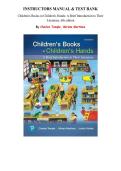
INSTRUCTORS MANUAL & TEST BANK
Children's Books in Children's Hands: A Brief Introduction to Their
Literature, 6th edition
By Charles Temple, Miriam Martinez
TE
ST
SO
LU
TI
O
N
, Table of Content
PART I: UNDERSTANDING LITERATURE AND THE CHILD READER
Children’s Books in Children’s Hands
Literary Elements in Works for Children
Picture books
Literature Representing Diverse Perspectives
International Literature
TE
PART II: EXPLORING THE GENRES OF CHILDREN’S LITERATURE
Poetry for Children
ST
Traditional Literature
Modern Fantasy and Science Fiction
Contemporary Realistic Fiction
SO
Historical Fiction
Nonfiction
LU
TI
O
N
, Dfghjkl;
CHAPTER ONE
Children’s Books in Children’s Hands
Overview
Simply put, Children’s Literature is the collection of books that are read to and by children.
TE
When teachers share good literature with children, the children reap the benefits. Identifying
“good books” for sharing is facilitated when we have knowledge of the history of children’s
literature along with an awareness of children’s development. The collection of literature
ST
published for children is both extensive and broad in range. The production of children’s books
has become increasingly important to publishers.
Although children’s books appear to be deceptively simple, creating quality literature
demands talent. Much of the literature for young people examines the same questions as those
SO
treated in adult literature. Good books for children contain child protagonists with issues
important to young people, presented with language and a story line that are accessible. Good
children’s literature expands awareness, is enjoyable without being didactic, and deals with
timeless human experiences. They have originality, aesthetic value and are characterized by
LU
internal structural consistency. Even comic books are part of this rich and varied literature.
Children’s literature has kept pace with the development of the idea of childhood. Literature
has been transformed from the presentation of grim instructional texts designed to inculcate
TI
morality to books where the pleasure derived from reading is as important as the virtue that may
be promoted in the content.
Children’s abilities to deal with books change as children mature. Jean Piaget offers an
O
explanation of how children operate in the world. He presents us with stages of development that
evolve from the sensory experience of early years to the ethical thought that appears later in life.
N
Others have related development to the way children respond to literature. Arthur Applebee
has identified a number of developmental differences in children’s responses to literature. Janet
Hickman traces maturing children’s “natural” responses to stories.
Books may also stimulate the process of moral reasoning in children. Young children are
more likely to defer to authority in order to differentiate right from wrong whereas more mature
sdfghjkl
, Dfghjkl;
youngsters exercise more principled autonomy. These characteristics are manifested as they
respond to moral dilemmas posed in the books they read.
Knowledge of the development of personality can be useful as we try to understand how
children respond to life’s problems as presented in literature. Erik Erikson provides us with
“Eight Ages of Man,” the first five of which refer to children and adolescents. The first of those
stages identifies the preoccupation associated with developing a trusting relationship during
infancy. They progress through the stress of early autonomy, increasing initiative, acquisition of
TE
skills valued by the society, and role identification.
As children are exposed to literature they are also learning to manipulate their language. The
importance of early experience with books cannot be overestimated. Word recognition is an
ST
essential step toward comprehension as children learn to read, and comprehension is fostered by
the habit of reading.
Maturity and life’s experiences will have an impact on children’s responses to books. Not
only do readers construct meaning from text, but they are also transformed by text. These
SO
characteristics of reading point to the significance of historical fiction and multicultural
literature.
Genre conveys meaning in literature. The expectations we entertain will be, in part, dependent
on the genre on which they are based.
LU
To be well informed in children’s literature, it is necessary to be aware of the quality literature
that has been published in the past (these are identified in Children’s Books in Children’s Hands)
and to read current journals that treat new children’s books.
TI
It is important to read aloud to children and to do it well. Using a variety of activities to get
youngsters to engage in good books will enhance their experience. We must learn to entice
O
children into reading with exciting texts presented to them in exciting ways.
N
All Chapters Included ⬛⬛⬛
All Answers Included ⬛⬛⬛
sdfghjkl
Children's Books in Children's Hands: A Brief Introduction to Their
Literature, 6th edition
By Charles Temple, Miriam Martinez
TE
ST
SO
LU
TI
O
N
, Table of Content
PART I: UNDERSTANDING LITERATURE AND THE CHILD READER
Children’s Books in Children’s Hands
Literary Elements in Works for Children
Picture books
Literature Representing Diverse Perspectives
International Literature
TE
PART II: EXPLORING THE GENRES OF CHILDREN’S LITERATURE
Poetry for Children
ST
Traditional Literature
Modern Fantasy and Science Fiction
Contemporary Realistic Fiction
SO
Historical Fiction
Nonfiction
LU
TI
O
N
, Dfghjkl;
CHAPTER ONE
Children’s Books in Children’s Hands
Overview
Simply put, Children’s Literature is the collection of books that are read to and by children.
TE
When teachers share good literature with children, the children reap the benefits. Identifying
“good books” for sharing is facilitated when we have knowledge of the history of children’s
literature along with an awareness of children’s development. The collection of literature
ST
published for children is both extensive and broad in range. The production of children’s books
has become increasingly important to publishers.
Although children’s books appear to be deceptively simple, creating quality literature
demands talent. Much of the literature for young people examines the same questions as those
SO
treated in adult literature. Good books for children contain child protagonists with issues
important to young people, presented with language and a story line that are accessible. Good
children’s literature expands awareness, is enjoyable without being didactic, and deals with
timeless human experiences. They have originality, aesthetic value and are characterized by
LU
internal structural consistency. Even comic books are part of this rich and varied literature.
Children’s literature has kept pace with the development of the idea of childhood. Literature
has been transformed from the presentation of grim instructional texts designed to inculcate
TI
morality to books where the pleasure derived from reading is as important as the virtue that may
be promoted in the content.
Children’s abilities to deal with books change as children mature. Jean Piaget offers an
O
explanation of how children operate in the world. He presents us with stages of development that
evolve from the sensory experience of early years to the ethical thought that appears later in life.
N
Others have related development to the way children respond to literature. Arthur Applebee
has identified a number of developmental differences in children’s responses to literature. Janet
Hickman traces maturing children’s “natural” responses to stories.
Books may also stimulate the process of moral reasoning in children. Young children are
more likely to defer to authority in order to differentiate right from wrong whereas more mature
sdfghjkl
, Dfghjkl;
youngsters exercise more principled autonomy. These characteristics are manifested as they
respond to moral dilemmas posed in the books they read.
Knowledge of the development of personality can be useful as we try to understand how
children respond to life’s problems as presented in literature. Erik Erikson provides us with
“Eight Ages of Man,” the first five of which refer to children and adolescents. The first of those
stages identifies the preoccupation associated with developing a trusting relationship during
infancy. They progress through the stress of early autonomy, increasing initiative, acquisition of
TE
skills valued by the society, and role identification.
As children are exposed to literature they are also learning to manipulate their language. The
importance of early experience with books cannot be overestimated. Word recognition is an
ST
essential step toward comprehension as children learn to read, and comprehension is fostered by
the habit of reading.
Maturity and life’s experiences will have an impact on children’s responses to books. Not
only do readers construct meaning from text, but they are also transformed by text. These
SO
characteristics of reading point to the significance of historical fiction and multicultural
literature.
Genre conveys meaning in literature. The expectations we entertain will be, in part, dependent
on the genre on which they are based.
LU
To be well informed in children’s literature, it is necessary to be aware of the quality literature
that has been published in the past (these are identified in Children’s Books in Children’s Hands)
and to read current journals that treat new children’s books.
TI
It is important to read aloud to children and to do it well. Using a variety of activities to get
youngsters to engage in good books will enhance their experience. We must learn to entice
O
children into reading with exciting texts presented to them in exciting ways.
N
All Chapters Included ⬛⬛⬛
All Answers Included ⬛⬛⬛
sdfghjkl


