Grade 11 Business Studies:
Comprehensive Study Guide
1. Module 1: Influences and Control Over Business
Environments
A business operates within three distinct but interrelated environments. To succeed,
entrepreneurs must understand these environments, the specific factors within them,
and the extent to which management can exercise control.
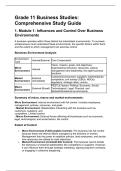
Business Environment Analysis
Environment
Internal/External Core Components
Type
Vision, mission, goals, and objectives;
Micro organisational structure; resources; culture;
Internal
Environment management and leadership; the eight business
functions.
Customers/consumers; suppliers; intermediaries;
Market External
competitors; civil society (CBOs, NGOs);
Environment (Immediate)
regulators; strategic allies; unions.
PESTLE factors: Political, Economic, Social,
Macro
External (Broad) Technological, Legal, Physical, and
Environment
Global/International environments.
Summary of micro, macro and market environments:
Micro Environment: Internal environment with full control. Includes employees,
management, policies, resources, and goals.
• Market Environment: Stakeholders interacting with the business such as
customers, suppliers, and
competitors. Limited control.
• Macro Environment: External forces affecting all businesses such as economic,
legal, technological, and social factors. No control.
Extent of Control
• Micro Environment (Full/Complete Control): The business has full control
because these are internal affairs managed by the directors or owners.
Management has the power to establish policies, lead employees, and decide
how resources are utilised to meet objectives.
• Market Environment (Limited/Little Control): The business cannot dictate
the behaviour of external stakeholders like competitors or suppliers. However,
it can influence them through strategic marketing, signing long-term contracts,
or engaging in collective bargaining.
, • Macro Environment (No Control): These are broad external factors—such
as global economic shifts, government policy, or climate change—that the
business cannot change. To survive, the business must monitor these factors
and adapt its strategies.
Core Components of the Micro Environment
The micro environment is the "internal operating system." It is defined by its
directional statements and the eight business functions:
Directional Elements:
• Vision and Mission: The vision defines the business's long-term dream,
while the mission explains why the business exists.
• Goals and Objectives: Specific targets and the steps taken to achieve them.
• Organisational Culture: The shared values, beliefs, and norms within the
workplace.
• Stakeholders: Any party with an interest in the company (employees,
owners, etc.) that can affect or be affected by the business.
The Eight Business Functions:
1. General Management: Oversees and coordinates the other seven functions
to ensure goals are met.
2. Purchasing: Acquires the raw materials and services needed for business
operations.
3. Production: Converts raw materials into finished or semi-finished goods.
4. Marketing: Handles market research, product development, pricing, and
promotion.
5. Finance: Manages the business’s capital, records transactions, and ensures
profitability.
6. Public Relations: Builds and maintains a positive image of the business
among the public.
7. Human Resources: Responsible for recruiting, training, and the welfare of
employees.
8. Administration: Manages the collection, storage, and processing of data and
information.
Influencing the Market Environment
Businesses can shape their immediate surroundings through these methods:
• Customers: Using market research to identify needs and applying marketing
strategies (discounts, advertisements) to influence purchasing decisions.
• Suppliers: Signing long-term contracts for fixed prices or forming strategic
alliances (mutually beneficial arrangements) to ensure a steady supply.
• Competitors: Joining community business forums or forming
a consortium (a group sharing resources) to undertake projects that benefit
all members.
Comprehensive Study Guide
1. Module 1: Influences and Control Over Business
Environments
A business operates within three distinct but interrelated environments. To succeed,
entrepreneurs must understand these environments, the specific factors within them,
and the extent to which management can exercise control.
Business Environment Analysis
Environment
Internal/External Core Components
Type
Vision, mission, goals, and objectives;
Micro organisational structure; resources; culture;
Internal
Environment management and leadership; the eight business
functions.
Customers/consumers; suppliers; intermediaries;
Market External
competitors; civil society (CBOs, NGOs);
Environment (Immediate)
regulators; strategic allies; unions.
PESTLE factors: Political, Economic, Social,
Macro
External (Broad) Technological, Legal, Physical, and
Environment
Global/International environments.
Summary of micro, macro and market environments:
Micro Environment: Internal environment with full control. Includes employees,
management, policies, resources, and goals.
• Market Environment: Stakeholders interacting with the business such as
customers, suppliers, and
competitors. Limited control.
• Macro Environment: External forces affecting all businesses such as economic,
legal, technological, and social factors. No control.
Extent of Control
• Micro Environment (Full/Complete Control): The business has full control
because these are internal affairs managed by the directors or owners.
Management has the power to establish policies, lead employees, and decide
how resources are utilised to meet objectives.
• Market Environment (Limited/Little Control): The business cannot dictate
the behaviour of external stakeholders like competitors or suppliers. However,
it can influence them through strategic marketing, signing long-term contracts,
or engaging in collective bargaining.
, • Macro Environment (No Control): These are broad external factors—such
as global economic shifts, government policy, or climate change—that the
business cannot change. To survive, the business must monitor these factors
and adapt its strategies.
Core Components of the Micro Environment
The micro environment is the "internal operating system." It is defined by its
directional statements and the eight business functions:
Directional Elements:
• Vision and Mission: The vision defines the business's long-term dream,
while the mission explains why the business exists.
• Goals and Objectives: Specific targets and the steps taken to achieve them.
• Organisational Culture: The shared values, beliefs, and norms within the
workplace.
• Stakeholders: Any party with an interest in the company (employees,
owners, etc.) that can affect or be affected by the business.
The Eight Business Functions:
1. General Management: Oversees and coordinates the other seven functions
to ensure goals are met.
2. Purchasing: Acquires the raw materials and services needed for business
operations.
3. Production: Converts raw materials into finished or semi-finished goods.
4. Marketing: Handles market research, product development, pricing, and
promotion.
5. Finance: Manages the business’s capital, records transactions, and ensures
profitability.
6. Public Relations: Builds and maintains a positive image of the business
among the public.
7. Human Resources: Responsible for recruiting, training, and the welfare of
employees.
8. Administration: Manages the collection, storage, and processing of data and
information.
Influencing the Market Environment
Businesses can shape their immediate surroundings through these methods:
• Customers: Using market research to identify needs and applying marketing
strategies (discounts, advertisements) to influence purchasing decisions.
• Suppliers: Signing long-term contracts for fixed prices or forming strategic
alliances (mutually beneficial arrangements) to ensure a steady supply.
• Competitors: Joining community business forums or forming
a consortium (a group sharing resources) to undertake projects that benefit
all members.