

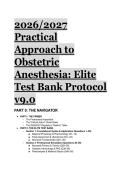
2026/2027
Practical
Approach to
Obstetric
Anesthesia: Elite
Test Bank Protocol
v9.0
PART 0: THE NAVIGATOR
● PART I: THE PRIMER
○ The Professional Imperative
○ The "Critical Action" Cheat Sheet
○ The 2026/2027 Regulatory "Redline" Table
● PART II: THE ELITE TEST BANK
○ Section 1: Foundational Syntax & Application (Questions 1–28)
■ Maternal Physiology & Pharmacology (Q1–10)
■ Fetal Assessment & Uterotonics (Q11–20)
■ Neuraxial Fundamentals (Q21–28)
○ Section 2: Professional Simulation (Questions 29–58)
■ Neuraxial Failures & Toxicity (Q29–38)
■ Obstetric Hemorrhage & PAS (Q39–48)
■ Preeclampsia & Maternal Sepsis (Q49–58)
, ○ Section 3: Grandmaster Synthesis (Questions 59–88)
■ Amniotic Fluid Embolism & Cardiac Arrest (Q59–68)
■ Obesity, Airway & Substance Use Disorders (Q69–78)
■ Multisystem Crisis Management (Q79–88)
PART I: THE PRIMER
The Professional Imperative
This document intercepts high-stakes clinical errors and forges raw academic knowledge into
elite professional intuition. By stripping away theoretical bloat, this test bank forces the
practitioner to confront the exact mechanical triggers of maternal-fetal crises. Candidates who
master these 88 highly calibrated scenarios will bridge the gap between textbook proficiency
and expert-level crisis management in the 2026/2027 obstetric suite.
The "Critical Action" Cheat Sheet
● Amniotic Fluid Embolism (AFE): AFE is an anaphylactoid immune storm, not a simple
clot. The "A-OK" protocol (Atropine 1mg, Ondansetron 8mg, Ketorolac 30mg) targets the
vagal, serotonin, and thromboxane pathways.
● Maternal Cardiac Arrest: Immediately initiate left lateral uterine displacement.
Discontinue magnesium, administer calcium, and execute a perimortem cesarean delivery
within 5 minutes if return of spontaneous circulation (ROSC) is not achieved.
● Local Anesthetic Systemic Toxicity (LAST): Administer 20% Lipid Emulsion early.
Bolus 1.5 mL/kg, followed by an infusion of 0.25 mL/kg/min. Strictly limit epinephrine to <1
mcg/kg.
● Failed Epidural Conversion: Young maternal age and prior fentanyl supplementation are
primary risk factors for failure. Do not hesitate to convert to spinal or general anesthesia.
The 2026/2027 Regulatory "Redline" Table
Gatekeeper Concept 2015 Legacy Standard 2026/2027 "Redline" Standard
PPH Threshold 500 mL 300 mL (Initiate Golden Hour
Protocol)
Sepsis Screen SIRS Criteria Modified SOFA (RR >25, SBP
<90)
Preeclampsia Proteinuria Required HTN + Severe Features
(Platelets <100k)
Opioid Use Disorder Detoxification / Tapering Maintain Baseline MAT
(Buprenorphine/Methadone)
PART II: THE ELITE TEST BANK
Section 1: Foundational Syntax & Application
Q1: A healthy parturient at 38 weeks gestation has an arterial blood gas drawn. The PaCO2 is
40 mmHg. Which interpretation is MOST ACCURATE? A) Normal compensated respiratory
, alkalosis of pregnancy. B) Impending respiratory failure requiring immediate intervention. C)
Normal metabolic acidosis secondary to fetal lactate production. D) Hyperventilation syndrome
induced by labor pain.
● The Answer: B (Impending respiratory failure requiring immediate intervention.)
● Distractor Analysis:
○ A is incorrect: Normal PaCO2 in pregnancy is 27-32 mmHg.
○ C is incorrect: Fetal lactate does not drive maternal PaCO2 to 40 mmHg.
○ D is incorrect: Hyperventilation would drive the PaCO2 lower, not up to 40 mmHg.
The Mentor's Analysis: In pregnancy, normal is abnormal. Progesterone drives resting PaCO2
down. A PaCO2 of 40 means the patient is losing her compensatory respiratory drive and is
crashing. Professional Intuition: Always recalibrate your baseline metrics for the gravid
patient.
Q2: During the induction of general anesthesia, a pregnant patient's minimum alveolar
concentration (MAC) requirements for volatile anesthetics are observed to be altered. Which
physiologic mechanism is PRIMARILY responsible? A) Increased maternal blood volume
diluting the anesthetic. B) Decreased functional residual capacity (FRC). C) Elevated central
nervous system progesterone levels. D) Increased hepatic metabolism of volatile agents.
● The Answer: C (Elevated central nervous system progesterone levels.)
● Distractor Analysis:
○ A is incorrect: Dilution does not alter the actual neural sensitivity (MAC).
○ B is incorrect: FRC affects wash-in speed, not the MAC value itself.
○ D is incorrect: Hepatic metabolism does not dictate alveolar concentration
thresholds.
The Mentor's Analysis: Mechanistic logic dictates that hormones alter receptor sensitivity.
Progesterone acts as a central nervous system depressant, reducing MAC by up to 30%.
Professional Intuition: Volatile anesthetics require profound downward titration in pregnancy to
avoid catastrophic overdose.
Q3: A patient in the second stage of labor exhibits early decelerations on the fetal monitor.
Which action is the MOST APPROPRIATE INITIAL response? A) Administer a fluid bolus and
reposition the mother. B) Continue routine monitoring and encourage pushing. C) Prepare for an
emergent cesarean delivery. D) Administer oxygen via non-rebreather mask.
● The Answer: B (Continue routine monitoring and encourage pushing.)
● Distractor Analysis:
○ A is incorrect: Fluid boluses treat hypotension or uteroplacental insufficiency, not
early decelerations.
○ C is incorrect: This is a benign finding; surgery is unjustified.
○ D is incorrect: Oxygen is reserved for true fetal hypoxia (late decelerations).
The Mentor's Analysis: Never treat a normal physiological reflex. Early decelerations are a
benign vagal response to fetal head compression, perfectly matching the contraction peak.
Professional Intuition: Differentiate head compression (early/benign) from chemoreceptor
hypoxia (late/pathologic).
Q4: A 28-year-old parturient receives a prophylactic vasopressor to prevent spinal-induced
hypotension. The provider chooses phenylephrine over ephedrine. Which fetal outcome is
MOST LIKELY improved by this choice? A) Increased fetal heart rate variability. B) Decreased
risk of neonatal acidosis. C) Increased umbilical cord blood volume. D) Decreased incidence of
meconium aspiration.
● The Answer: B (Decreased risk of neonatal acidosis.)
● Distractor Analysis:
Practical
Approach to
Obstetric
Anesthesia: Elite
Test Bank Protocol
v9.0
PART 0: THE NAVIGATOR
● PART I: THE PRIMER
○ The Professional Imperative
○ The "Critical Action" Cheat Sheet
○ The 2026/2027 Regulatory "Redline" Table
● PART II: THE ELITE TEST BANK
○ Section 1: Foundational Syntax & Application (Questions 1–28)
■ Maternal Physiology & Pharmacology (Q1–10)
■ Fetal Assessment & Uterotonics (Q11–20)
■ Neuraxial Fundamentals (Q21–28)
○ Section 2: Professional Simulation (Questions 29–58)
■ Neuraxial Failures & Toxicity (Q29–38)
■ Obstetric Hemorrhage & PAS (Q39–48)
■ Preeclampsia & Maternal Sepsis (Q49–58)
, ○ Section 3: Grandmaster Synthesis (Questions 59–88)
■ Amniotic Fluid Embolism & Cardiac Arrest (Q59–68)
■ Obesity, Airway & Substance Use Disorders (Q69–78)
■ Multisystem Crisis Management (Q79–88)
PART I: THE PRIMER
The Professional Imperative
This document intercepts high-stakes clinical errors and forges raw academic knowledge into
elite professional intuition. By stripping away theoretical bloat, this test bank forces the
practitioner to confront the exact mechanical triggers of maternal-fetal crises. Candidates who
master these 88 highly calibrated scenarios will bridge the gap between textbook proficiency
and expert-level crisis management in the 2026/2027 obstetric suite.
The "Critical Action" Cheat Sheet
● Amniotic Fluid Embolism (AFE): AFE is an anaphylactoid immune storm, not a simple
clot. The "A-OK" protocol (Atropine 1mg, Ondansetron 8mg, Ketorolac 30mg) targets the
vagal, serotonin, and thromboxane pathways.
● Maternal Cardiac Arrest: Immediately initiate left lateral uterine displacement.
Discontinue magnesium, administer calcium, and execute a perimortem cesarean delivery
within 5 minutes if return of spontaneous circulation (ROSC) is not achieved.
● Local Anesthetic Systemic Toxicity (LAST): Administer 20% Lipid Emulsion early.
Bolus 1.5 mL/kg, followed by an infusion of 0.25 mL/kg/min. Strictly limit epinephrine to <1
mcg/kg.
● Failed Epidural Conversion: Young maternal age and prior fentanyl supplementation are
primary risk factors for failure. Do not hesitate to convert to spinal or general anesthesia.
The 2026/2027 Regulatory "Redline" Table
Gatekeeper Concept 2015 Legacy Standard 2026/2027 "Redline" Standard
PPH Threshold 500 mL 300 mL (Initiate Golden Hour
Protocol)
Sepsis Screen SIRS Criteria Modified SOFA (RR >25, SBP
<90)
Preeclampsia Proteinuria Required HTN + Severe Features
(Platelets <100k)
Opioid Use Disorder Detoxification / Tapering Maintain Baseline MAT
(Buprenorphine/Methadone)
PART II: THE ELITE TEST BANK
Section 1: Foundational Syntax & Application
Q1: A healthy parturient at 38 weeks gestation has an arterial blood gas drawn. The PaCO2 is
40 mmHg. Which interpretation is MOST ACCURATE? A) Normal compensated respiratory
, alkalosis of pregnancy. B) Impending respiratory failure requiring immediate intervention. C)
Normal metabolic acidosis secondary to fetal lactate production. D) Hyperventilation syndrome
induced by labor pain.
● The Answer: B (Impending respiratory failure requiring immediate intervention.)
● Distractor Analysis:
○ A is incorrect: Normal PaCO2 in pregnancy is 27-32 mmHg.
○ C is incorrect: Fetal lactate does not drive maternal PaCO2 to 40 mmHg.
○ D is incorrect: Hyperventilation would drive the PaCO2 lower, not up to 40 mmHg.
The Mentor's Analysis: In pregnancy, normal is abnormal. Progesterone drives resting PaCO2
down. A PaCO2 of 40 means the patient is losing her compensatory respiratory drive and is
crashing. Professional Intuition: Always recalibrate your baseline metrics for the gravid
patient.
Q2: During the induction of general anesthesia, a pregnant patient's minimum alveolar
concentration (MAC) requirements for volatile anesthetics are observed to be altered. Which
physiologic mechanism is PRIMARILY responsible? A) Increased maternal blood volume
diluting the anesthetic. B) Decreased functional residual capacity (FRC). C) Elevated central
nervous system progesterone levels. D) Increased hepatic metabolism of volatile agents.
● The Answer: C (Elevated central nervous system progesterone levels.)
● Distractor Analysis:
○ A is incorrect: Dilution does not alter the actual neural sensitivity (MAC).
○ B is incorrect: FRC affects wash-in speed, not the MAC value itself.
○ D is incorrect: Hepatic metabolism does not dictate alveolar concentration
thresholds.
The Mentor's Analysis: Mechanistic logic dictates that hormones alter receptor sensitivity.
Progesterone acts as a central nervous system depressant, reducing MAC by up to 30%.
Professional Intuition: Volatile anesthetics require profound downward titration in pregnancy to
avoid catastrophic overdose.
Q3: A patient in the second stage of labor exhibits early decelerations on the fetal monitor.
Which action is the MOST APPROPRIATE INITIAL response? A) Administer a fluid bolus and
reposition the mother. B) Continue routine monitoring and encourage pushing. C) Prepare for an
emergent cesarean delivery. D) Administer oxygen via non-rebreather mask.
● The Answer: B (Continue routine monitoring and encourage pushing.)
● Distractor Analysis:
○ A is incorrect: Fluid boluses treat hypotension or uteroplacental insufficiency, not
early decelerations.
○ C is incorrect: This is a benign finding; surgery is unjustified.
○ D is incorrect: Oxygen is reserved for true fetal hypoxia (late decelerations).
The Mentor's Analysis: Never treat a normal physiological reflex. Early decelerations are a
benign vagal response to fetal head compression, perfectly matching the contraction peak.
Professional Intuition: Differentiate head compression (early/benign) from chemoreceptor
hypoxia (late/pathologic).
Q4: A 28-year-old parturient receives a prophylactic vasopressor to prevent spinal-induced
hypotension. The provider chooses phenylephrine over ephedrine. Which fetal outcome is
MOST LIKELY improved by this choice? A) Increased fetal heart rate variability. B) Decreased
risk of neonatal acidosis. C) Increased umbilical cord blood volume. D) Decreased incidence of
meconium aspiration.
● The Answer: B (Decreased risk of neonatal acidosis.)
● Distractor Analysis:


