lOMoAR cPSD| 61371432
WGU C955 Final Exam Study Guide: Key Concepts
in Statistics and Probability | Complete study
solutions | 2026 Updates | 100% correct
C955 Study Guide — Key Concepts and Formulas
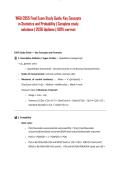
📘 1. Descriptive Statistics Types of data: o Qualitative (categorical)
– e.g., gender, color.
o Quantitative (numerical) – discrete (counts) or continuous (measurements).
• Scales of measurement: nominal, ordinal, interval, ratio.
• Measures of central tendency: o Mean = xˉ=∑xn\bar{x} =
\frac{\sum x}{n}xˉ=n∑x o Median = middle value o Mode = most
frequent value Measures of spread:
o Range = max – min
o Variance s2=∑(x−xˉ)2n−1s^2 = \frac{\sum (x - \bar{x})^2}{n - 1}s2=n−1∑(x−xˉ)2 o
Standard deviation s=s2s = \sqrt{s^2}s=s2
📊 2. Probability
• Basic rules:
o P(A)=favorable outcomestotal outcomesP(A) = \frac{\ text{favorable
outcomes}}{\text{total outcomes}}P(A)=total outcomesfavorable outcomes
o P(A′)=1−P(A)P(A') = 1 - P(A)P(A′)=1−P(A)
o P(A or B)=P(A)+P(B)−P(A and B)P(A \text{ or } B) = P(A) + P(B) P(A \text{ and }
B)P(A or B)=P(A)+P(B)−P(A and B) o P(A and B)=P(A)×P(B∣A)P(A \text{ and } B) =
WGU C955 Final Exam Study Guide: Key Concepts
in Statistics and Probability | Complete study
solutions | 2026 Updates | 100% correct
C955 Study Guide — Key Concepts and Formulas
📘 1. Descriptive Statistics Types of data: o Qualitative (categorical)
– e.g., gender, color.
o Quantitative (numerical) – discrete (counts) or continuous (measurements).
• Scales of measurement: nominal, ordinal, interval, ratio.
• Measures of central tendency: o Mean = xˉ=∑xn\bar{x} =
\frac{\sum x}{n}xˉ=n∑x o Median = middle value o Mode = most
frequent value Measures of spread:
o Range = max – min
o Variance s2=∑(x−xˉ)2n−1s^2 = \frac{\sum (x - \bar{x})^2}{n - 1}s2=n−1∑(x−xˉ)2 o
Standard deviation s=s2s = \sqrt{s^2}s=s2
📊 2. Probability
• Basic rules:
o P(A)=favorable outcomestotal outcomesP(A) = \frac{\ text{favorable
outcomes}}{\text{total outcomes}}P(A)=total outcomesfavorable outcomes
o P(A′)=1−P(A)P(A') = 1 - P(A)P(A′)=1−P(A)
o P(A or B)=P(A)+P(B)−P(A and B)P(A \text{ or } B) = P(A) + P(B) P(A \text{ and }
B)P(A or B)=P(A)+P(B)−P(A and B) o P(A and B)=P(A)×P(B∣A)P(A \text{ and } B) =