

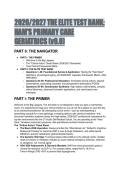
2026/2027 THE ELITE TEST BANK:
HAM'S PRIMARY CARE
GERIATRICS (v9.0)
PART 0: THE NAVIGATOR
● PART I: THE PRIMER
○ Welcome to the Big Leagues
○ The "Critical Action" Cheat Sheet (2026/2027 Standards)
○ Core Clinical Frameworks Matrix
● PART II: THE ELITE TEST BANK
○ Questions 1–28: Foundational Syntax & Application: Testing the "Hard Deck"
definitions, physiological aging, and 2026/2027 regulatory frameworks (Beers, ADA,
PREVENT).
○ Questions 29–58: Professional Simulation: Immediate clinical actions, atypical
presentations, prescribing cascades, and perioperative optimization (POSH).
○ Questions 59–88: Grandmaster Synthesis: High-stakes multimorbidity, complex
ethical dilemmas, advanced biomarker applications, and value-based care
intercepts.
PART I: THE PRIMER
Welcome to the Big Leagues. This test bank is not designed to help you pass a rudimentary
exam; it is engineered to forge your clinical intuition so you do not kill a patient on your first day
as an advanced practitioner. By intercepting novice errors—such as misinterpreting a
prescribing cascade for a new pathology or treating delirium with chemical restraints—this
document translates academic theory into high-stakes, 2026/2027 professional competence for
top-tier environments like the UT Austin Dell Medical School. You are operating at the "Hard
Deck." Amateurs memorize symptoms; elite practitioners architect clinical survival.
The "Critical Action" Cheat Sheet:
● The Beers 2026 Imperative: Always prioritize the "Alternatives List." Default to Cognitive
Behavioral Therapy for Insomnia (CBT-I) over Z-drugs (Zolpidem), and utilize topical
NSAIDs to prevent catastrophic gastrointestinal bleeds.
● The Geriatric Vital Sign: Functional status (ADLs/IADLs) is the ultimate metric. Sudden
drops in function or mentation indicate an acute medical emergency (infection, infarction,
or iatrogenic), not "normal aging".
● ADA 2026 Adipocentric & Glycemic Mandate: Shift from strict glucocentric goals to
visceral fat reduction via GLP-1s. For complex elders, target HbA1c <8.0% or
Time-In-Range (TIR) >50% to prevent fatal hypoglycemia.
, ● AHA/ACC PREVENT Equation: Replace the outdated Pooled Cohort Equations (PCE).
Integrate eGFR, UACR, and the Social Deprivation Index (SDI) for accurate 10- and
30-year cardiovascular risk assessments.
● Medicare G2211 & OBBBA 2025 Reality: Leverage the G2211 add-on code for
longitudinal, complex care in home/residence settings to sustain value-based models
against the severe Medicaid/Medicare cuts introduced by the One Big Beautiful Bill Act
(OBBBA).
Core Clinical Frameworks Matrix
Framework / Guideline Legacy Approach 2026/2027 Elite Clinical Implication
(Outdated) Standard
AHA PREVENT Risk Pooled Cohort eGFR, UACR, Social Removes structural
Equations (PCE), Deprivation Index (SDI) bias; accurately
race-based coefficients. integration. assesses 10- and
30-year ASCVD risk.
ADA Diabetes Care Strict A1c <7.0%, Adipocentric focus; TIR Prevents fatal
sliding scale insulin. >50% for complex hypoglycemia; targets
elders. visceral fat to protect
CKM system.
AGS Beers Criteria Focus solely on "Do "Alternatives List" focus Provides actionable,
Not Prescribe" lists. (e.g., CBT-I instead of non-pharmacological
zolpidem). scaffolding before
deprescribing.
Alzheimer's BBMs CSF lumbar puncture High-sensitivity/specifici Allows primary care
or PET scan for all. ty blood tests as triage; strictly for
triaging/confirmatory. patients with objective
impairment.
G2211 Billing Episodic care billing. Add-on for longitudinal, Compensates cognitive
continuous care in burden of complex
home/residence. geriatric management.
PART II: THE ELITE TEST BANK
Questions 1–28: Foundational Syntax & Application
Q1: According to the 2026 AGS Beers Criteria® Alternatives List, an 81-year-old patient
complaining of primary insomnia should be prescribed which of the following as the FIRST-LINE
intervention? A) Zolpidem 5mg PO at bedtime. B) Diphenhydramine 25mg PO at bedtime. C)
Cognitive Behavioral Therapy for Insomnia (CBT-I). D) Lorazepam 0.5mg PO at bedtime.
● The Answer: C (Cognitive Behavioral Therapy for Insomnia (CBT-I).)
● Distractor Analysis:
○ A is incorrect: Z-drugs significantly increase the risk of fractures and delirium in
older adults and are heavily restricted.
○ B is incorrect: Antihistamines cause severe anticholinergic effects.
○ D is incorrect: Benzodiazepines create severe fall risks and cognitive "brain fog."
The Mentor's Analysis: Sleep architecture degrades with age. Masking this physiological
change with chemical sedatives guarantees iatrogenic falls. Behavioral architecture must
,precede pharmacology.
Q2: Under the ADA 2026 Standards of Care, what is the MOST APPROPRIATE continuous
glucose monitoring (CGM) Time-in-Range (TIR) goal for an 84-year-old with multiple coexisting
chronic illnesses and two ADL impairments? A) TIR >70% B) TIR >50% C) TIR >85% D) Strict
HbA1c <6.5% regardless of TIR
● The Answer: B (TIR >50%)
● Distractor Analysis:
○ A is incorrect: A >70% TIR is the target for healthy older adults.
○ C is incorrect: This aggressively tight target guarantees fatal hypoglycemic events.
○ D is incorrect: The 2026 guidelines warn against reliance on A1C in complex
patients.
The Mentor's Analysis: In frail elders, the brain requires a steady glucose supply.
Hypoglycemia causes immediate falls, arrhythmias, and death. We accept mild hyperglycemia
to maintain life.
Q3: The 2026 Alzheimer's Association guidelines endorse Blood-Based Biomarkers (BBMs) as
a substitute for CSF analysis or PET imaging ONLY if the test meets which specific threshold?
A) ≥90% sensitivity and ≥75% specificity B) ≥80% sensitivity and ≥80% specificity C) ≥90%
sensitivity and ≥90% specificity D) ≥99% sensitivity and ≥50% specificity
● The Answer: C (≥90% sensitivity and ≥90% specificity)
● Distractor Analysis:
○ A is incorrect: This threshold qualifies a BBM as a triaging test, requiring
confirmation.
○ B is incorrect: This does not meet clinical practice minimums.
○ D is incorrect: High sensitivity with low specificity leads to massive overdiagnosis.
The Mentor's Analysis: Disease-Modifying Therapies (DMTs) carry significant risks like ARIA
(amyloid-related imaging abnormalities). You cannot initiate high-risk infusions without definitive,
highly specific pathology confirmation.
Q4: The LACE index is a critical tool utilized by elite practitioners during transitions of care.
Which variable is EXCLUDED from the LACE readmission risk calculation? A) Length of stay B)
Laboratory values (e.g., serum creatinine) C) Acuity of admission D) Comorbidities (Charlson
Comorbidity Index)
● The Answer: B (Laboratory values (e.g., serum creatinine))
● Distractor Analysis:
○ A is incorrect: Length of stay is the "L" in LACE.
○ C is incorrect: Acuity of admission is the "A" in LACE.
○ D is incorrect: Comorbidities form the "C" in LACE.
The Mentor's Analysis: LACE is an operational tool, not a purely physiological one. It predicts
healthcare utilization failure (30-day readmission) based on systemic stress, driving immediate
discharge planning.
Q5: The 2026 Medicare Physician Fee Schedule (MPFS) expanded the G2211 complexity
add-on code to include which clinical setting? A) Ambulatory surgical centers B) Home or
residence evaluation and management visits C) Emergency department consultations D)
Inpatient critical care units
● The Answer: B (Home or residence evaluation and management visits)
● Distractor Analysis:
○ A is incorrect: G2211 is not intended for procedural facility-based care.
○ C is incorrect: Emergency care is episodic, violating the continuous relationship
requirement.
, ○ D is incorrect: Critical care is billed under high-acuity DRGs.
The Mentor's Analysis: G2211 rewards the cognitive burden of managing the "5Ms" in the
community. It legally monetizes the time you spend intercepting cascades before they hit the ER
doors.
Q6: A core tenet of the 2026 ADA Adipocentric Paradigm for older adults with Type 2 Diabetes
prioritizes which physiological intervention? A) Maximizing pancreatic beta-cell output via
sulfonylureas. B) Strict glucocentric management targeting HbA1c <6.0%. C) Visceral fat
reduction using incretin therapies (GLP-1s) to protect the CKM system. D) Initiating sliding-scale
insulin for tight postprandial control.
● The Answer: C (Visceral fat reduction using incretin therapies (GLP-1s) to protect the
CKM system.)
● Distractor Analysis:
○ A is incorrect: Sulfonylureas cause severe hypoglycemia.
○ B is incorrect: Strict glucocentric targeting increases mortality in frail elders.
○ D is incorrect: Sliding-scale insulin is reactive and highly dangerous in the elderly.
The Mentor's Analysis: Adiposity drives systemic inflammation. By targeting visceral fat with
GLP-1s, you treat the root cardiovascular-kidney-metabolic (CKM) pathology, not just a number
on a glucometer.
Q7: Under the American Heart Association's PREVENT™ equations, which variables are newly
integrated to predict 10- and 30-year ASCVD risk more accurately than the legacy Pooled
Cohort Equations (PCE)? A) C-reactive protein and homocysteine B) Estimated glomerular
filtration rate (eGFR) and Social Deprivation Index (SDI) C) Race and ethnicity modifiers D)
Thyroid-stimulating hormone (TSH) and ferritin
● The Answer: B (Estimated glomerular filtration rate (eGFR) and Social Deprivation Index
(SDI))
● Distractor Analysis:
○ A is incorrect: These are non-specific inflammatory markers.
○ C is incorrect: The PREVENT equation explicitly removed race and ethnicity as
predictors.
○ D is incorrect: These are unrelated to the primary ASCVD calculation tool.
The Mentor's Analysis: Biology does not exist in a vacuum. Incorporating kidney function and
socioeconomic deprivation reflects the true multidimensional risk our patients face outside the
clinic walls.
Q8: Which geriatric assessment tool specifically ranks adequacy of performance in bathing,
dressing, toileting, transferring, continence, and feeding? A) The Lawton IADL Scale B) The
Katz Index of Independence C) The Mini-Cog D) The Hendrich II Model
● The Answer: B (The Katz Index of Independence)
● Distractor Analysis:
○ A is incorrect: The Lawton scale measures Instrumental ADLs (finances, medication
management).
○ C is incorrect: The Mini-Cog is a cognitive screening tool.
○ D is incorrect: The Hendrich II model assesses fall risk.
The Mentor's Analysis: The Katz ADL is the hard deck of human survival. Loss of these basic
functions signals a total loss of physiological reserve and demands immediate environmental
intervention.
Q9: When utilizing the SPICES overall assessment tool, the "P" stands for which geriatric
syndrome? A) Polypharmacy B) Pressure Ulcers C) Problems with eating or feeding D)
Persistent Pain
HAM'S PRIMARY CARE
GERIATRICS (v9.0)
PART 0: THE NAVIGATOR
● PART I: THE PRIMER
○ Welcome to the Big Leagues
○ The "Critical Action" Cheat Sheet (2026/2027 Standards)
○ Core Clinical Frameworks Matrix
● PART II: THE ELITE TEST BANK
○ Questions 1–28: Foundational Syntax & Application: Testing the "Hard Deck"
definitions, physiological aging, and 2026/2027 regulatory frameworks (Beers, ADA,
PREVENT).
○ Questions 29–58: Professional Simulation: Immediate clinical actions, atypical
presentations, prescribing cascades, and perioperative optimization (POSH).
○ Questions 59–88: Grandmaster Synthesis: High-stakes multimorbidity, complex
ethical dilemmas, advanced biomarker applications, and value-based care
intercepts.
PART I: THE PRIMER
Welcome to the Big Leagues. This test bank is not designed to help you pass a rudimentary
exam; it is engineered to forge your clinical intuition so you do not kill a patient on your first day
as an advanced practitioner. By intercepting novice errors—such as misinterpreting a
prescribing cascade for a new pathology or treating delirium with chemical restraints—this
document translates academic theory into high-stakes, 2026/2027 professional competence for
top-tier environments like the UT Austin Dell Medical School. You are operating at the "Hard
Deck." Amateurs memorize symptoms; elite practitioners architect clinical survival.
The "Critical Action" Cheat Sheet:
● The Beers 2026 Imperative: Always prioritize the "Alternatives List." Default to Cognitive
Behavioral Therapy for Insomnia (CBT-I) over Z-drugs (Zolpidem), and utilize topical
NSAIDs to prevent catastrophic gastrointestinal bleeds.
● The Geriatric Vital Sign: Functional status (ADLs/IADLs) is the ultimate metric. Sudden
drops in function or mentation indicate an acute medical emergency (infection, infarction,
or iatrogenic), not "normal aging".
● ADA 2026 Adipocentric & Glycemic Mandate: Shift from strict glucocentric goals to
visceral fat reduction via GLP-1s. For complex elders, target HbA1c <8.0% or
Time-In-Range (TIR) >50% to prevent fatal hypoglycemia.
, ● AHA/ACC PREVENT Equation: Replace the outdated Pooled Cohort Equations (PCE).
Integrate eGFR, UACR, and the Social Deprivation Index (SDI) for accurate 10- and
30-year cardiovascular risk assessments.
● Medicare G2211 & OBBBA 2025 Reality: Leverage the G2211 add-on code for
longitudinal, complex care in home/residence settings to sustain value-based models
against the severe Medicaid/Medicare cuts introduced by the One Big Beautiful Bill Act
(OBBBA).
Core Clinical Frameworks Matrix
Framework / Guideline Legacy Approach 2026/2027 Elite Clinical Implication
(Outdated) Standard
AHA PREVENT Risk Pooled Cohort eGFR, UACR, Social Removes structural
Equations (PCE), Deprivation Index (SDI) bias; accurately
race-based coefficients. integration. assesses 10- and
30-year ASCVD risk.
ADA Diabetes Care Strict A1c <7.0%, Adipocentric focus; TIR Prevents fatal
sliding scale insulin. >50% for complex hypoglycemia; targets
elders. visceral fat to protect
CKM system.
AGS Beers Criteria Focus solely on "Do "Alternatives List" focus Provides actionable,
Not Prescribe" lists. (e.g., CBT-I instead of non-pharmacological
zolpidem). scaffolding before
deprescribing.
Alzheimer's BBMs CSF lumbar puncture High-sensitivity/specifici Allows primary care
or PET scan for all. ty blood tests as triage; strictly for
triaging/confirmatory. patients with objective
impairment.
G2211 Billing Episodic care billing. Add-on for longitudinal, Compensates cognitive
continuous care in burden of complex
home/residence. geriatric management.
PART II: THE ELITE TEST BANK
Questions 1–28: Foundational Syntax & Application
Q1: According to the 2026 AGS Beers Criteria® Alternatives List, an 81-year-old patient
complaining of primary insomnia should be prescribed which of the following as the FIRST-LINE
intervention? A) Zolpidem 5mg PO at bedtime. B) Diphenhydramine 25mg PO at bedtime. C)
Cognitive Behavioral Therapy for Insomnia (CBT-I). D) Lorazepam 0.5mg PO at bedtime.
● The Answer: C (Cognitive Behavioral Therapy for Insomnia (CBT-I).)
● Distractor Analysis:
○ A is incorrect: Z-drugs significantly increase the risk of fractures and delirium in
older adults and are heavily restricted.
○ B is incorrect: Antihistamines cause severe anticholinergic effects.
○ D is incorrect: Benzodiazepines create severe fall risks and cognitive "brain fog."
The Mentor's Analysis: Sleep architecture degrades with age. Masking this physiological
change with chemical sedatives guarantees iatrogenic falls. Behavioral architecture must
,precede pharmacology.
Q2: Under the ADA 2026 Standards of Care, what is the MOST APPROPRIATE continuous
glucose monitoring (CGM) Time-in-Range (TIR) goal for an 84-year-old with multiple coexisting
chronic illnesses and two ADL impairments? A) TIR >70% B) TIR >50% C) TIR >85% D) Strict
HbA1c <6.5% regardless of TIR
● The Answer: B (TIR >50%)
● Distractor Analysis:
○ A is incorrect: A >70% TIR is the target for healthy older adults.
○ C is incorrect: This aggressively tight target guarantees fatal hypoglycemic events.
○ D is incorrect: The 2026 guidelines warn against reliance on A1C in complex
patients.
The Mentor's Analysis: In frail elders, the brain requires a steady glucose supply.
Hypoglycemia causes immediate falls, arrhythmias, and death. We accept mild hyperglycemia
to maintain life.
Q3: The 2026 Alzheimer's Association guidelines endorse Blood-Based Biomarkers (BBMs) as
a substitute for CSF analysis or PET imaging ONLY if the test meets which specific threshold?
A) ≥90% sensitivity and ≥75% specificity B) ≥80% sensitivity and ≥80% specificity C) ≥90%
sensitivity and ≥90% specificity D) ≥99% sensitivity and ≥50% specificity
● The Answer: C (≥90% sensitivity and ≥90% specificity)
● Distractor Analysis:
○ A is incorrect: This threshold qualifies a BBM as a triaging test, requiring
confirmation.
○ B is incorrect: This does not meet clinical practice minimums.
○ D is incorrect: High sensitivity with low specificity leads to massive overdiagnosis.
The Mentor's Analysis: Disease-Modifying Therapies (DMTs) carry significant risks like ARIA
(amyloid-related imaging abnormalities). You cannot initiate high-risk infusions without definitive,
highly specific pathology confirmation.
Q4: The LACE index is a critical tool utilized by elite practitioners during transitions of care.
Which variable is EXCLUDED from the LACE readmission risk calculation? A) Length of stay B)
Laboratory values (e.g., serum creatinine) C) Acuity of admission D) Comorbidities (Charlson
Comorbidity Index)
● The Answer: B (Laboratory values (e.g., serum creatinine))
● Distractor Analysis:
○ A is incorrect: Length of stay is the "L" in LACE.
○ C is incorrect: Acuity of admission is the "A" in LACE.
○ D is incorrect: Comorbidities form the "C" in LACE.
The Mentor's Analysis: LACE is an operational tool, not a purely physiological one. It predicts
healthcare utilization failure (30-day readmission) based on systemic stress, driving immediate
discharge planning.
Q5: The 2026 Medicare Physician Fee Schedule (MPFS) expanded the G2211 complexity
add-on code to include which clinical setting? A) Ambulatory surgical centers B) Home or
residence evaluation and management visits C) Emergency department consultations D)
Inpatient critical care units
● The Answer: B (Home or residence evaluation and management visits)
● Distractor Analysis:
○ A is incorrect: G2211 is not intended for procedural facility-based care.
○ C is incorrect: Emergency care is episodic, violating the continuous relationship
requirement.
, ○ D is incorrect: Critical care is billed under high-acuity DRGs.
The Mentor's Analysis: G2211 rewards the cognitive burden of managing the "5Ms" in the
community. It legally monetizes the time you spend intercepting cascades before they hit the ER
doors.
Q6: A core tenet of the 2026 ADA Adipocentric Paradigm for older adults with Type 2 Diabetes
prioritizes which physiological intervention? A) Maximizing pancreatic beta-cell output via
sulfonylureas. B) Strict glucocentric management targeting HbA1c <6.0%. C) Visceral fat
reduction using incretin therapies (GLP-1s) to protect the CKM system. D) Initiating sliding-scale
insulin for tight postprandial control.
● The Answer: C (Visceral fat reduction using incretin therapies (GLP-1s) to protect the
CKM system.)
● Distractor Analysis:
○ A is incorrect: Sulfonylureas cause severe hypoglycemia.
○ B is incorrect: Strict glucocentric targeting increases mortality in frail elders.
○ D is incorrect: Sliding-scale insulin is reactive and highly dangerous in the elderly.
The Mentor's Analysis: Adiposity drives systemic inflammation. By targeting visceral fat with
GLP-1s, you treat the root cardiovascular-kidney-metabolic (CKM) pathology, not just a number
on a glucometer.
Q7: Under the American Heart Association's PREVENT™ equations, which variables are newly
integrated to predict 10- and 30-year ASCVD risk more accurately than the legacy Pooled
Cohort Equations (PCE)? A) C-reactive protein and homocysteine B) Estimated glomerular
filtration rate (eGFR) and Social Deprivation Index (SDI) C) Race and ethnicity modifiers D)
Thyroid-stimulating hormone (TSH) and ferritin
● The Answer: B (Estimated glomerular filtration rate (eGFR) and Social Deprivation Index
(SDI))
● Distractor Analysis:
○ A is incorrect: These are non-specific inflammatory markers.
○ C is incorrect: The PREVENT equation explicitly removed race and ethnicity as
predictors.
○ D is incorrect: These are unrelated to the primary ASCVD calculation tool.
The Mentor's Analysis: Biology does not exist in a vacuum. Incorporating kidney function and
socioeconomic deprivation reflects the true multidimensional risk our patients face outside the
clinic walls.
Q8: Which geriatric assessment tool specifically ranks adequacy of performance in bathing,
dressing, toileting, transferring, continence, and feeding? A) The Lawton IADL Scale B) The
Katz Index of Independence C) The Mini-Cog D) The Hendrich II Model
● The Answer: B (The Katz Index of Independence)
● Distractor Analysis:
○ A is incorrect: The Lawton scale measures Instrumental ADLs (finances, medication
management).
○ C is incorrect: The Mini-Cog is a cognitive screening tool.
○ D is incorrect: The Hendrich II model assesses fall risk.
The Mentor's Analysis: The Katz ADL is the hard deck of human survival. Loss of these basic
functions signals a total loss of physiological reserve and demands immediate environmental
intervention.
Q9: When utilizing the SPICES overall assessment tool, the "P" stands for which geriatric
syndrome? A) Polypharmacy B) Pressure Ulcers C) Problems with eating or feeding D)
Persistent Pain


