

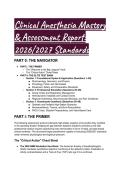
Clinical Anesthesia Mastery
& Assessment Report:
2026/2027 Standards
PART 0: THE NAVIGATOR
● PART I: THE PRIMER
○ The "Welcome to the Big Leagues" Hook
○ The "Critical Action" Cheat Sheet
● PART II: THE ELITE TEST BANK
○ Section 1: Foundational Syntax & Application (Questions 1–28)
■ Pharmacology, Genomics, and Physics
■ Physiology, Fluids, and Hemostasis
■ Equipment, Safety, and Preoperative Standards
○ Section 2: Professional Simulation (Questions 29–58)
■ Airway Crises and Respiratory Management
■ Hemodynamic Instability and Cardiac Events
■ Regional Anesthesia, Neuromuscular Blockade, and Pain Guidelines
○ Section 3: Grandmaster Synthesis (Questions 59–88)
■ Obstetric and Pediatric High-Stakes Scenarios
■ Neuroanesthesia, Trauma, and Burn Resuscitation
■ PACU Crises, Disaster Preparedness, and Value-Based Care
PART I: THE PRIMER
The following assessment protocol intercepts high-stakes cognitive errors before they manifest
in the operating theater. Bridging the gap between baseline academic proficiency and elite
professional intuition requires abandoning rote memorization in favor of rapid, principle-based
clinical synthesis. This document forges practitioners capable of executing 2026/2027 standards
under immense physiological and logistical pressure.
The "Critical Action" Cheat Sheet
● The 2026 NMB Extubation Hard-Deck: The American Society of Anesthesiologists
(ASA) mandates quantitative objective monitoring at the adductor pollicis. Extubation is
strictly contraindicated until a Train-of-Four (TOF) ratio \ge 0.9 is confirmed.
, ● Fascial Plane Superiority: The 2026 ASA Perioperative Pain Guidelines dictate the
integration of fascial plane blocks for open cardiothoracic and abdominal surgeries to
mitigate 24-hour postoperative opioid demand.
● Neuraxial Lethality Protocol: Inadvertent intrathecal administration of intravenous
agents (e.g., Tranexamic Acid, Digoxin) carries profound mortality; absolute visual and
secondary verification of preservative-free status is a non-negotiable mandate.
● The MAC Rule of Decay: Minimum Alveolar Concentration (MAC) decreases by
approximately 6% per decade of life after age 40; failure to titrate volatile agents
accordingly guarantees profound hemodynamic collapse in geriatric populations.
● Value-Based Optimization: Under the 2026 Perioperative Surgical Home (PSH) model,
preoperative optimization of frailty and comorbidities supersedes reactive intraoperative
salvage.
PART II: THE ELITE TEST BANK
Section 1: Foundational Syntax & Application
Q1: A 72-year-old patient requires maintenance of general anesthesia. According to
pharmacological principles, the Minimum Alveolar Concentration (MAC) of volatile anesthetics
for this patient is altered by which specific metric compared to a 40-year-old? A) It increases by
6% per decade. B) It decreases by 6% per decade. C) It remains static, but the blood:gas
partition coefficient alters. D) It decreases by 10% per decade.
● The Answer: B (It decreases by 6% per decade.)
● Distractor Analysis: * A is incorrect: MAC requirements drop, not rise, with age due to
decreased cerebral metabolic demand.
○ C is incorrect: MAC is highly dynamic regarding age; it is not static.
○ D is incorrect: The established physiological constant is approximately 6% per
decade.
The Mentor's Analysis: Geriatric neurophysiology demands less volatile agent to achieve
immobility. Overdosing based on young-adult MAC values is the primary driver of catastrophic
intraoperative hypotension in the elderly. Professional Intuition: Age lowers the anesthetic
ceiling; titrate down to protect the brain and the heart.
Q2: During the preoperative evaluation of a patient with a known CYP2D6 "Poor Metabolizer"
phenotype undergoing a mastectomy, which analgesic intervention will be LEAST effective for
postoperative pain? A) Intravenous Fentanyl B) Oral Codeine C) Intravenous Hydromorphone
D) Intravenous Ketorolac
● The Answer: B (Oral Codeine)
● Distractor Analysis: * A, C, and D are incorrect: These agents are direct-acting and do
not rely on CYP2D6 for activation. Codeine is a prodrug requiring CYP2D6 to convert into
active morphine.
The Mentor's Analysis: Genomic precision medicine is a 2026 standard. Administering a
prodrug to a poor metabolizer yields therapeutic failure. Professional Intuition: Never
prescribe a lock to a patient missing the metabolic key.
Q3: A patient in the operating room develops a rapidly expanding pneumothorax. Which inhaled
anesthetic must be IMMEDIATELY discontinued? A) Sevoflurane B) Desflurane C) Nitrous
Oxide (N_2O) D) Isoflurane
● The Answer: C (Nitrous Oxide (N_2O))
, ● Distractor Analysis: * A, B, and D are incorrect: Halogenated agents do not rapidly
expand closed air spaces. N_2O is 34 times more soluble in blood than nitrogen, causing
it to rapidly diffuse into air-filled cavities.
The Mentor's Analysis: Physics dictates the pharmacology. The high blood solubility of N_2O
turns minor trapped gas into lethal tension physiology. Professional Intuition: If it is filled with
air and shouldn't be, turn off the nitrous.
Q4: A patient undergoes rapid sequence induction. Succinylcholine is administered, but the
patient remains apneic for two hours. Which genomic anomaly is the MOST likely cause? A)
Malignant Hyperthermia Susceptibility (RYR1 mutation) B) Pseudocholinesterase deficiency C)
CYP3A4 hyper-metabolism D) Hoffman elimination failure
● The Answer: B (Pseudocholinesterase deficiency)
● Distractor Analysis: * A is incorrect: RYR1 mutations trigger MH, not isolated prolonged
apnea.
○ C is incorrect: CYP3A4 does not metabolize succinylcholine.
○ D is incorrect: Hoffman elimination applies to cisatracurium.
The Mentor's Analysis: Succinylcholine relies entirely on plasma pseudocholinesterase for
degradation. Professional Intuition: Prolonged paralysis from a depolarizer is a metabolic
deficiency; ventilate and wait.
Q5: According to the 2026 ASA standards for basic anesthetic monitoring, which parameter
must be CONTINUALLY evaluated via a quantitative method during general anesthesia? A)
Core body temperature B) End-tidal Nitrogen C) Blood oxygenation via pulse oximetry D)
Invasive arterial blood pressure
● The Answer: C (Blood oxygenation via pulse oximetry)
● Distractor Analysis: * A is incorrect: Temperature is monitored when changes are
intended or suspected, not continually mandated for every brief case.
○ B is incorrect: Nitrogen is not routinely monitored.
○ D is incorrect: Non-invasive blood pressure every 5 minutes is acceptable.
The Mentor's Analysis: Hypoxia kills in minutes. Quantitative oxygenation is the absolute
non-negotiable floor of monitoring. Professional Intuition: The pulse oximeter tone is the
heartbeat of your anesthetic; never silence it.
Q6: A patient with severe aortic stenosis presents for an open cholecystectomy. Which
hemodynamic goal is the MOST critical during induction? A) Maintaining a high heart rate to
increase cardiac output. B) Drastically reducing systemic vascular resistance (SVR) to promote
forward flow. C) Maintaining normal to high SVR and avoiding tachycardia. D) Decreasing
preload to prevent pulmonary edema.
● The Answer: C (Maintaining normal to high SVR and avoiding tachycardia.)
● Distractor Analysis: * A is incorrect: Tachycardia reduces diastolic filling time, fatally
compromising coronary perfusion to a hypertrophied left ventricle.
○ B is incorrect: Dropping SVR causes catastrophic hypotension because the fixed
stroke volume cannot compensate.
○ D is incorrect: These patients are highly preload-dependent.
The Mentor's Analysis: Aortic stenosis physiology is a fixed-obstruction system. The heart
requires a slow, full squeeze against a firm afterload to perfuse its coronaries. Professional
Intuition: Keep them slow, keep them full, and keep the pressure tight.
Q7: Which of the following volatile anesthetics is characterized by the lowest blood:gas partition
coefficient, resulting in the most rapid emergence? A) Isoflurane B) Sevoflurane C) Desflurane
D) Halothane
● The Answer: C (Desflurane)
& Assessment Report:
2026/2027 Standards
PART 0: THE NAVIGATOR
● PART I: THE PRIMER
○ The "Welcome to the Big Leagues" Hook
○ The "Critical Action" Cheat Sheet
● PART II: THE ELITE TEST BANK
○ Section 1: Foundational Syntax & Application (Questions 1–28)
■ Pharmacology, Genomics, and Physics
■ Physiology, Fluids, and Hemostasis
■ Equipment, Safety, and Preoperative Standards
○ Section 2: Professional Simulation (Questions 29–58)
■ Airway Crises and Respiratory Management
■ Hemodynamic Instability and Cardiac Events
■ Regional Anesthesia, Neuromuscular Blockade, and Pain Guidelines
○ Section 3: Grandmaster Synthesis (Questions 59–88)
■ Obstetric and Pediatric High-Stakes Scenarios
■ Neuroanesthesia, Trauma, and Burn Resuscitation
■ PACU Crises, Disaster Preparedness, and Value-Based Care
PART I: THE PRIMER
The following assessment protocol intercepts high-stakes cognitive errors before they manifest
in the operating theater. Bridging the gap between baseline academic proficiency and elite
professional intuition requires abandoning rote memorization in favor of rapid, principle-based
clinical synthesis. This document forges practitioners capable of executing 2026/2027 standards
under immense physiological and logistical pressure.
The "Critical Action" Cheat Sheet
● The 2026 NMB Extubation Hard-Deck: The American Society of Anesthesiologists
(ASA) mandates quantitative objective monitoring at the adductor pollicis. Extubation is
strictly contraindicated until a Train-of-Four (TOF) ratio \ge 0.9 is confirmed.
, ● Fascial Plane Superiority: The 2026 ASA Perioperative Pain Guidelines dictate the
integration of fascial plane blocks for open cardiothoracic and abdominal surgeries to
mitigate 24-hour postoperative opioid demand.
● Neuraxial Lethality Protocol: Inadvertent intrathecal administration of intravenous
agents (e.g., Tranexamic Acid, Digoxin) carries profound mortality; absolute visual and
secondary verification of preservative-free status is a non-negotiable mandate.
● The MAC Rule of Decay: Minimum Alveolar Concentration (MAC) decreases by
approximately 6% per decade of life after age 40; failure to titrate volatile agents
accordingly guarantees profound hemodynamic collapse in geriatric populations.
● Value-Based Optimization: Under the 2026 Perioperative Surgical Home (PSH) model,
preoperative optimization of frailty and comorbidities supersedes reactive intraoperative
salvage.
PART II: THE ELITE TEST BANK
Section 1: Foundational Syntax & Application
Q1: A 72-year-old patient requires maintenance of general anesthesia. According to
pharmacological principles, the Minimum Alveolar Concentration (MAC) of volatile anesthetics
for this patient is altered by which specific metric compared to a 40-year-old? A) It increases by
6% per decade. B) It decreases by 6% per decade. C) It remains static, but the blood:gas
partition coefficient alters. D) It decreases by 10% per decade.
● The Answer: B (It decreases by 6% per decade.)
● Distractor Analysis: * A is incorrect: MAC requirements drop, not rise, with age due to
decreased cerebral metabolic demand.
○ C is incorrect: MAC is highly dynamic regarding age; it is not static.
○ D is incorrect: The established physiological constant is approximately 6% per
decade.
The Mentor's Analysis: Geriatric neurophysiology demands less volatile agent to achieve
immobility. Overdosing based on young-adult MAC values is the primary driver of catastrophic
intraoperative hypotension in the elderly. Professional Intuition: Age lowers the anesthetic
ceiling; titrate down to protect the brain and the heart.
Q2: During the preoperative evaluation of a patient with a known CYP2D6 "Poor Metabolizer"
phenotype undergoing a mastectomy, which analgesic intervention will be LEAST effective for
postoperative pain? A) Intravenous Fentanyl B) Oral Codeine C) Intravenous Hydromorphone
D) Intravenous Ketorolac
● The Answer: B (Oral Codeine)
● Distractor Analysis: * A, C, and D are incorrect: These agents are direct-acting and do
not rely on CYP2D6 for activation. Codeine is a prodrug requiring CYP2D6 to convert into
active morphine.
The Mentor's Analysis: Genomic precision medicine is a 2026 standard. Administering a
prodrug to a poor metabolizer yields therapeutic failure. Professional Intuition: Never
prescribe a lock to a patient missing the metabolic key.
Q3: A patient in the operating room develops a rapidly expanding pneumothorax. Which inhaled
anesthetic must be IMMEDIATELY discontinued? A) Sevoflurane B) Desflurane C) Nitrous
Oxide (N_2O) D) Isoflurane
● The Answer: C (Nitrous Oxide (N_2O))
, ● Distractor Analysis: * A, B, and D are incorrect: Halogenated agents do not rapidly
expand closed air spaces. N_2O is 34 times more soluble in blood than nitrogen, causing
it to rapidly diffuse into air-filled cavities.
The Mentor's Analysis: Physics dictates the pharmacology. The high blood solubility of N_2O
turns minor trapped gas into lethal tension physiology. Professional Intuition: If it is filled with
air and shouldn't be, turn off the nitrous.
Q4: A patient undergoes rapid sequence induction. Succinylcholine is administered, but the
patient remains apneic for two hours. Which genomic anomaly is the MOST likely cause? A)
Malignant Hyperthermia Susceptibility (RYR1 mutation) B) Pseudocholinesterase deficiency C)
CYP3A4 hyper-metabolism D) Hoffman elimination failure
● The Answer: B (Pseudocholinesterase deficiency)
● Distractor Analysis: * A is incorrect: RYR1 mutations trigger MH, not isolated prolonged
apnea.
○ C is incorrect: CYP3A4 does not metabolize succinylcholine.
○ D is incorrect: Hoffman elimination applies to cisatracurium.
The Mentor's Analysis: Succinylcholine relies entirely on plasma pseudocholinesterase for
degradation. Professional Intuition: Prolonged paralysis from a depolarizer is a metabolic
deficiency; ventilate and wait.
Q5: According to the 2026 ASA standards for basic anesthetic monitoring, which parameter
must be CONTINUALLY evaluated via a quantitative method during general anesthesia? A)
Core body temperature B) End-tidal Nitrogen C) Blood oxygenation via pulse oximetry D)
Invasive arterial blood pressure
● The Answer: C (Blood oxygenation via pulse oximetry)
● Distractor Analysis: * A is incorrect: Temperature is monitored when changes are
intended or suspected, not continually mandated for every brief case.
○ B is incorrect: Nitrogen is not routinely monitored.
○ D is incorrect: Non-invasive blood pressure every 5 minutes is acceptable.
The Mentor's Analysis: Hypoxia kills in minutes. Quantitative oxygenation is the absolute
non-negotiable floor of monitoring. Professional Intuition: The pulse oximeter tone is the
heartbeat of your anesthetic; never silence it.
Q6: A patient with severe aortic stenosis presents for an open cholecystectomy. Which
hemodynamic goal is the MOST critical during induction? A) Maintaining a high heart rate to
increase cardiac output. B) Drastically reducing systemic vascular resistance (SVR) to promote
forward flow. C) Maintaining normal to high SVR and avoiding tachycardia. D) Decreasing
preload to prevent pulmonary edema.
● The Answer: C (Maintaining normal to high SVR and avoiding tachycardia.)
● Distractor Analysis: * A is incorrect: Tachycardia reduces diastolic filling time, fatally
compromising coronary perfusion to a hypertrophied left ventricle.
○ B is incorrect: Dropping SVR causes catastrophic hypotension because the fixed
stroke volume cannot compensate.
○ D is incorrect: These patients are highly preload-dependent.
The Mentor's Analysis: Aortic stenosis physiology is a fixed-obstruction system. The heart
requires a slow, full squeeze against a firm afterload to perfuse its coronaries. Professional
Intuition: Keep them slow, keep them full, and keep the pressure tight.
Q7: Which of the following volatile anesthetics is characterized by the lowest blood:gas partition
coefficient, resulting in the most rapid emergence? A) Isoflurane B) Sevoflurane C) Desflurane
D) Halothane
● The Answer: C (Desflurane)


