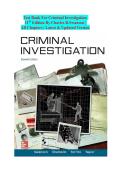
Test Bank For Criminal Investigation
11 th Edition By Charles R.Swanson |
All Chapters | Latest & Updated Version
,
,Chapter 01: The Evolution of Criminal Investigation and Forensic Science
Multiple Choice Questions
1. The first modern detective force was A)
the Bow Street Runners.
B) established by the Metropolitan Police Act of 1829.
C) created by Patrick Colquhoun.
D) headed by attorney Howard Vincent.
Ans: A
Page ref: 3
2. When the London Metropolitan Police force was established in 1829, the British public was
at first suspicious and at times even hostile towards it because A) King Edward II had supported
its creation.
B) Rowan and Mayne had intimate ties to the royal family.
C) social reformers such as Jeremy Bentham had long argued that it was a danger to personal
liberty.
D) French citizens had experienced oppression under centralized police.
Ans: D
Page ref: 3
3. In 1833, an ordinance creating America's first paid, daylight police force? A)
Philadelphia
B) Chicago
C) New York City
D) Baltimore
Ans: A
Page ref: 3-4
4. After the Civil War, Pinkerton’s National Detective Agency engaged in the two broad areas of
?
A) Locating war criminals and providing protection to the President of the United States.
B) Controlling a discontented working class and protection of the President of the United States.
C) Pursuing bank robbers and arresting train robbers.
D) Controlling a discontented working class and pursuing bank and railroad robbers. Ans: D
Page ref: 4
5. Which state and city was the first to create a unified police force in this country? A)
New Orleans, LA.
B) New York, NY.
C) Baltimore, MD.
D) Philadelphia, PA
Ans: B
, Page ref: 4
6. Which of the following is not one of the reasons cited in the textbook for having reliable
detectives in Americain the 1800’s?
A) Graft and corruption were common among America’s big city police officers.
B) Police jurisdictions were limited.
C) There was little information sharing among police departments.
D) All of the above are reasons cited in the textbook.
Ans: D
Page ref: 4
7. A rogues' gallery is
A) only practical in cities of 100,000 population or more.
B) photographs of known criminals arranged by criminal specialty and height.
C) a line-up of known offenders for viewing by detectives so they can recognize the criminals later
on the street.
D) only practical in cities of 100,000 population or more and are photographs of known criminals
arranged by criminal specialty and physical height.
Ans: B
Page ref: 6
8. What was the original mission of the Secret Service when created by Congress in 1865? A)
Combat counterfeiting.
B) Provide protection for Presidents.
C) Prevent drug importation into this country.
D) All of the preceding was addressed in the Secret Service’s original Charter.
Ans: A
Page ref: 6
9. What municipal agency was the first to establish a Criminal Identification Bureau? A)
Chicago, Ill.
B) Atlanta, GA.
C) Philadelphia, PA.
D) New Orleans, LA.
Ans: A
Page ref: 6
10. Which agency was the prototype for modern state police organizations? A)
New York State Police.
B) Georgia State Police.
C) Pennsylvania State Police.
D) Pinkerton International Detective Agency. Ans: C
Page ref: 611.
11. The Harrison Act of 1914 mad the distribution of nonmedical drugs a crime. The agency
currently charged with enforcing its provisions is .
11 th Edition By Charles R.Swanson |
All Chapters | Latest & Updated Version
,
,Chapter 01: The Evolution of Criminal Investigation and Forensic Science
Multiple Choice Questions
1. The first modern detective force was A)
the Bow Street Runners.
B) established by the Metropolitan Police Act of 1829.
C) created by Patrick Colquhoun.
D) headed by attorney Howard Vincent.
Ans: A
Page ref: 3
2. When the London Metropolitan Police force was established in 1829, the British public was
at first suspicious and at times even hostile towards it because A) King Edward II had supported
its creation.
B) Rowan and Mayne had intimate ties to the royal family.
C) social reformers such as Jeremy Bentham had long argued that it was a danger to personal
liberty.
D) French citizens had experienced oppression under centralized police.
Ans: D
Page ref: 3
3. In 1833, an ordinance creating America's first paid, daylight police force? A)
Philadelphia
B) Chicago
C) New York City
D) Baltimore
Ans: A
Page ref: 3-4
4. After the Civil War, Pinkerton’s National Detective Agency engaged in the two broad areas of
?
A) Locating war criminals and providing protection to the President of the United States.
B) Controlling a discontented working class and protection of the President of the United States.
C) Pursuing bank robbers and arresting train robbers.
D) Controlling a discontented working class and pursuing bank and railroad robbers. Ans: D
Page ref: 4
5. Which state and city was the first to create a unified police force in this country? A)
New Orleans, LA.
B) New York, NY.
C) Baltimore, MD.
D) Philadelphia, PA
Ans: B
, Page ref: 4
6. Which of the following is not one of the reasons cited in the textbook for having reliable
detectives in Americain the 1800’s?
A) Graft and corruption were common among America’s big city police officers.
B) Police jurisdictions were limited.
C) There was little information sharing among police departments.
D) All of the above are reasons cited in the textbook.
Ans: D
Page ref: 4
7. A rogues' gallery is
A) only practical in cities of 100,000 population or more.
B) photographs of known criminals arranged by criminal specialty and height.
C) a line-up of known offenders for viewing by detectives so they can recognize the criminals later
on the street.
D) only practical in cities of 100,000 population or more and are photographs of known criminals
arranged by criminal specialty and physical height.
Ans: B
Page ref: 6
8. What was the original mission of the Secret Service when created by Congress in 1865? A)
Combat counterfeiting.
B) Provide protection for Presidents.
C) Prevent drug importation into this country.
D) All of the preceding was addressed in the Secret Service’s original Charter.
Ans: A
Page ref: 6
9. What municipal agency was the first to establish a Criminal Identification Bureau? A)
Chicago, Ill.
B) Atlanta, GA.
C) Philadelphia, PA.
D) New Orleans, LA.
Ans: A
Page ref: 6
10. Which agency was the prototype for modern state police organizations? A)
New York State Police.
B) Georgia State Police.
C) Pennsylvania State Police.
D) Pinkerton International Detective Agency. Ans: C
Page ref: 611.
11. The Harrison Act of 1914 mad the distribution of nonmedical drugs a crime. The agency
currently charged with enforcing its provisions is .