

Biology Question 3
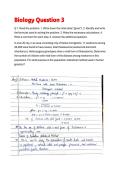
Q 1. Read the problem: 1. Write down the initial data (“given”). 2. Identify and write
the formulas used in solving the problem. 3. Make the necessary calculations. 4.
Write a comment for each step. 5. Answer the additional question.
In one US city, in an area consisting only of Italian immigrants, 11 newborns among
26,000 were found to have severe, fatal thalassemia (autosomal dominant
inheritance). Heterozygous genotypes show a mild form of thalassemia. Determine
the number of children with mild form of the disease among newborns in this
population. For what purpose is the population-statistical method used in human
genetics?
,2. Read the problem: 1. Write down the initial data (“given”). 2. Draw up a
crossbreeding scheme by recording the genotypes of all family members. 3. Specify
the phenotypes of all family members. 4. Calculate the probability. 5. Answer the
additional question.
There are two types of hereditary blindness, each of which is determined by
recessive gene alleles. The genes are not linked. What is the probability of having a
blind grandson in a family where maternal and paternal grandparents are
digomozygous and suffer from the same type of blindness, and both grandfathers
can see well (do not have recessive genes). What law of heredity is manifested in
this case?
,3. Read the problem: 1. Write down the initial data (“given”). 2. Draw up a
crossbreeding scheme by recording the genotypes of all family members. 3. Specify
the phenotypes of all family members. 4. Calculate the probability. 5. Answer the
additional question.
Hypoplasia of the tooth enamel is inherited as a dominant trait related to the X-
chromosome, six–fingeredness is an autosomal trait. In a family where the mother
is six-fingered and the father has enamel hypoplasia, a five-fingered healthy boy
was born? Is it possible for them to have a child with two anomalies at the same
time? Why didn’t the son show the traits of his parents?
,
Q 1. Read the problem: 1. Write down the initial data (“given”). 2. Identify and write
the formulas used in solving the problem. 3. Make the necessary calculations. 4.
Write a comment for each step. 5. Answer the additional question.
In one US city, in an area consisting only of Italian immigrants, 11 newborns among
26,000 were found to have severe, fatal thalassemia (autosomal dominant
inheritance). Heterozygous genotypes show a mild form of thalassemia. Determine
the number of children with mild form of the disease among newborns in this
population. For what purpose is the population-statistical method used in human
genetics?
,2. Read the problem: 1. Write down the initial data (“given”). 2. Draw up a
crossbreeding scheme by recording the genotypes of all family members. 3. Specify
the phenotypes of all family members. 4. Calculate the probability. 5. Answer the
additional question.
There are two types of hereditary blindness, each of which is determined by
recessive gene alleles. The genes are not linked. What is the probability of having a
blind grandson in a family where maternal and paternal grandparents are
digomozygous and suffer from the same type of blindness, and both grandfathers
can see well (do not have recessive genes). What law of heredity is manifested in
this case?
,3. Read the problem: 1. Write down the initial data (“given”). 2. Draw up a
crossbreeding scheme by recording the genotypes of all family members. 3. Specify
the phenotypes of all family members. 4. Calculate the probability. 5. Answer the
additional question.
Hypoplasia of the tooth enamel is inherited as a dominant trait related to the X-
chromosome, six–fingeredness is an autosomal trait. In a family where the mother
is six-fingered and the father has enamel hypoplasia, a five-fingered healthy boy
was born? Is it possible for them to have a child with two anomalies at the same
time? Why didn’t the son show the traits of his parents?
,


